What is it that lets a synth conjure the vastness of cinema—an expanse where emotion and atmosphere drift like fog through vacant streets? Devin Belanger, both architect and wanderer of these sonic realms, guides us through the five elemental ingredients that let synthesizers breathe in widescreen. In his signature Miles Away style, Devin reveals not just the tools, but the touch—where reverb becomes space, darkness becomes narrative, and a single note can spiral a story. Prepare to immerse yourself in the textures of cinematic synthesis.

31. July 2026
LUMINA
Devin Belanger and the Cinematic Synth: Sculpting Sound into Story
Maris Mercury X, Moog Sub 37, Novation Peak, Novation Summit, Strymon Cloud, Valhalla Supermassive
The Anatomy of Cinematic Sound
The word ‘cinematic’ lingers on the tongue like a distant echo, slippery in definition but unmistakable in sensation. Devin Belanger frames the term as both overused and magnetic—an aesthetic that draws us in, even as we question its meaning. He invites us to peel back the layers and discover what truly animates a cinematic synthesizer patch, promising five distinct elements that shape its character.
We are led not through a sterile checklist, but across a landscape textured by memory and resonance. Devin’s approach, shaped by both study and personal exploration, positions the cinematic synth not as a formula but as a living, breathing entity—one that is instantly recognizable, yet eternally open to interpretation. The journey begins with wonder, not with a manual.

"There's something about the cinematic synthesizer sound, even if it's done to death, that still captures my imagination and my heart."
© Screenshot/Quote: Devinbelangermusic (YouTube)
Reverb: The Breath of Space
"The type of reverb is what matters most in my opinion for something sounding cinematic versus muddy or murky or more pop focused."
© Screenshot/Quote: Devinbelangermusic (YouTube)
Reverb is the mist that dissolves a sound’s edges, stretching each note into a lingering afterimage. Devin lays bare the truth: cinematic atmosphere isn’t conjured by simply flooding a patch in endless decay. Instead, it is the careful sculpting of reverberant space—choosing the right type, balancing modulation and clarity, allowing echoes to bloom without smothering the sonic landscape.
Classic algorithms, like the Strymon Cloud or Valhalla Supermassive, become vessels for this spatial poetry. The magic lies not in excess, but in restraint—the right reverb wraps a synth line in fog and fractured light, letting it drift into the half-seen corners of our imagination. It is this sense of space, not mere size, that makes a sound cinematic.
Glide and Bend: Emotional Gravity
To make a synthesizer weep or soar, we must let the notes glide—slipping between pitches as if tracing the arc of a falling star. Devin champions the expressive power of glide and pitch bend, drawing parallels to the orchestral maneuvers that evoke drama and fluidity. These are not just effects, but gestures that give a patch its emotional gravity.
By weaving in these nuanced transitions, a synth patch transcends mechanical precision, hinting at the same aching humanity found in sweeping string sections. Whether through hardware, performance, or MPE controllers, these techniques invite us to abandon rigid steps and embrace the magnetic resonance of movement, letting each note bloom like a slow-motion underwater explosion.
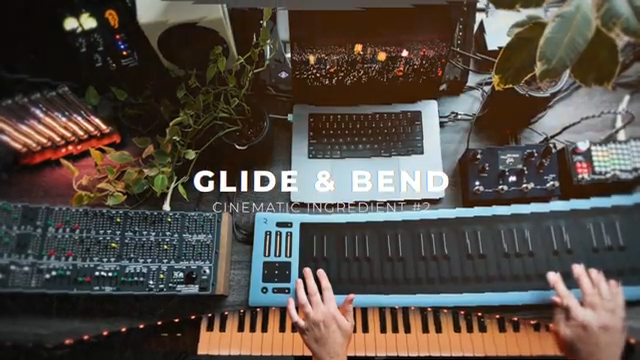
"One of my favorite ways to make a synth patch sound cinematic is by introducing some kind of glide or pitch bend either into the synth sound itself or at the performance level."
© Screenshot/Quote: Devinbelangermusic (YouTube)
Darkness and Depth: Filtering the Light
Darkness is not an absence but a deepening—a turning down of the sun so that other textures may shimmer in the twilight. Devin shifts the focus from aggressive timbres to the art of sculpting with filters, letting frequencies recede into shadow and subharmonic warmth. The result is a soundscape dense with mystery, where every note becomes a shadowy figure in a fog-laden alley.
Synths like the Novation Peak, Summit, and Moog Sub 37 are celebrated for their ability to summon these moody depths. By pulling back the brightness, we invite listeners to lean in, searching the gloom for hidden detail. This is the heart of cinematic mood: a tension between what is revealed and what is left to the imagination.
Modal Interchange: The Twist in the Tale

"The ability to change chords and change scales suddenly is the equivalent within music of a dramatic lighting change or a sudden twist in a story."
© Screenshot/Quote: Devinbelangermusic (YouTube)
The final element is not a sound, but a shift—a sleight of hand that changes the emotional weather in an instant. Devin introduces modal interchange: the technique of borrowing chords from parallel scales to create dramatic harmonic turns. This is the musical equivalent of a sudden cut to white or a thunderclap in a quiet scene, letting the mood pivot with cinematic flair.
By weaving between minor and major, between foreboding and release, a patch becomes more than texture; it becomes narrative. These harmonic detours are best experienced rather than explained—an invitation to let the synth become both storyteller and stage, where every chord change is a new direction in the unfolding film of sound.
This article is also available in German. Read it here: https://synthmagazin.at/devin-belanger-und-der-cineastische-synth-klang-als-erzaehlung-formen/
More articles about these products:
 Summit Stays Supreme: The Midlife Synthesist’s One-Year Verdict
 Starsky Carr’s £15,000 Synth Soup: Analog Royalty, Now in Your Serum
 A Studio of Sonic Memory: synth4ever Journeys through Devin Belanger’s Ambient Sanctuary
 OXI Instruments OXI One mkII: Mod Lanes Unleashed
 Novation Summit: David Hilowitz Music’s Subtractive Powerhouse – No Fluff, Just Fire
 OXI Instruments E16: Dual MIDI Destinations Demystified
 OXI Instruments: Architectural MIDI Connections with the OXI ONE MKII
 Sineway’s First Live Set: Gear Glory and Rookie Regrets
 OXI Instruments: Mod Lanes, Pattern Reset and the Hidden Rhythms Within
 Metamyther Throws Down: Mimeophon vs. Cosmic Debris vs. Supermassive – Hardware vs. Plugin Rumble
 Loop Liberation: The Unperson vs. The Eternal 8-Bar Trap
 The Midlife Synthesist Ditches Complexity: Summit & Push 3 Go Back to Basics
Watch on YouTube:
Latest articles
Watch on YouTube:
Visit the channel:
https://www.youtube.com/devinbelangermusic
https://www.youtube.com/devinbelangermusic
Links from devinbelangermusic:
Contact: https://links.devinbelangermusic.com
Miles Away: https://links.thisismilesaway.com
Instagram: https://instagram.com/devinbelangermusic
Sponsored links:
If you purchase via these links, we may earn a small commission – at no extra cost to you. The link opens an Amazon keyword search, and results may vary depending on availability.
Maris Mercury X
🔗 Check price on Amazon
🔗 Check price on Amazon
Moog Sub 37
🔗 Check price on Amazon
🔗 Check price on Amazon
Novation Peak
🔗 Check price on Amazon
🔗 Check price on Amazon
Novation Summit
🔗 Check price on Amazon
🔗 Check price on Amazon
Strymon Cloud
🔗 Check price on Amazon
🔗 Check price on Amazon
Valhalla Supermassive
🔗 Check price on Amazon
🔗 Check price on Amazon