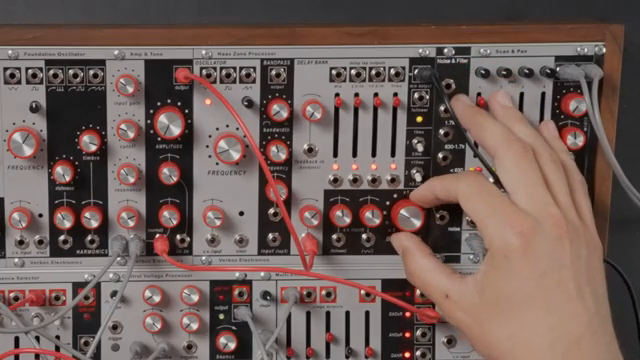
Verbos Electronics, ever the champions of West Coast modular quirks, unveil their Haas Zone Processor—a clocked multi-tap digital delay bank with a twist. In this first demo, the focus is on short delay times and the subtle (or not so subtle) ways these can warp, flange, and phase your signals. Expect comb filtering, feedback through a bandpass filter, and clever normalled routings that encourage experimental patching. It’s not just another delay; it’s a playground for time-domain mischief, as demonstrated with precision and a dry sense of humour.
24. September 2026
MILES
Verbos Electronics Haas Zone Processor: Short Delay, Deep Modulation
Short Delays, Big Ideas
The Haas Zone Processor enters the Verbos line-up aiming squarely at the world of ultra-short delay times. This isn’t about cavernous echoes or endless ambient tails—it’s about the psychoacoustic tricks that come from milliseconds of offset. The video introduces the module as a playground for exploring subtle sound manipulation using these short delays.
To kick things off, we’re treated to a straightforward run-through of the controls and signal flow. The presenter demonstrates how even minimal delays can create comb filtering and phase effects when mixed with the dry signal. It’s a distinctly modular approach—less about pristine repeats, more about sculpting the space around a sound. The emphasis is on experimentation, laying the groundwork for the more complex routing and feedback options that follow.
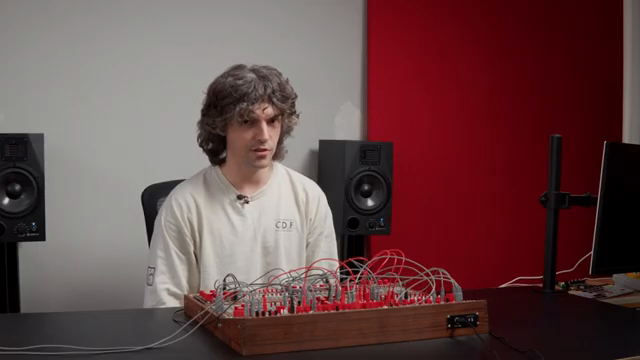
"It's all about really short delay times, and all the cool things that you can make happen with sounds, working with really short delays."
© Screenshot/Quote: Verboselectronicsgmbh (YouTube)
Four Taps, Filter, and Follower
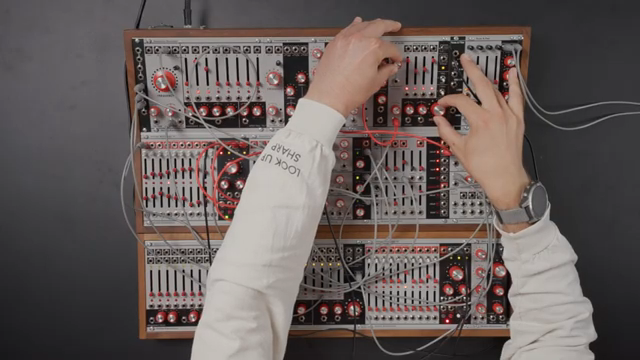
"By default, the third tap, the slowest one, goes through the bandpass filter."
© Screenshot/Quote: Verboselectronicsgmbh (YouTube)
A central feature is the four-tap delay structure: one dry channel plus three delay taps, each offset by a set time interval. Delay times for all taps are globally controlled, and the video makes it clear how this arrangement enables intricate phase cancellations and tonal shifts—especially as more taps are introduced into the mix.
In typical Verbos fashion, the module goes beyond simple delay. The third tap is normalled through a dedicated bandpass filter before returning to the feedback path, allowing filtered feedback tones. There’s also an envelope follower, which can be routed internally to modulate delay time based on input amplitude. These components combine to form a highly interactive set of modulation tools for those willing to get hands-on.
Phasing, Flanging, Feedback Fun
The heart of the demo is a hands-on exploration of delay time and feedback. By adjusting the main delay time control, the presenter demonstrates how the Haas Zone Processor can morph from subtle comb filtering to pronounced flanging—especially as more taps are layered and the timing switches are engaged to offset the first and second taps further.
Cranking up the feedback, especially through the bandpass filter, brings out metallic resonances and classic time-domain effects. This is where the module shows its teeth, letting users dial in everything from static phase shifts to self-oscillating feedback loops shaped by the filter’s bandwidth and frequency controls. The difference in feedback flavour, depending on which tap is routed, is highlighted as a source of patching variety.
"A lot of what we're going to be doing from now on is modulating the delay time to create different types of phasing, flanging, and short time domain based effects."
© Screenshot/Quote: Verboselectronicsgmbh (YouTube)
Oscillator and Normalled Modulation
No modern Verbos module is complete without at least one surprise in the modulation department. Here, it’s a built-in VCO—normalled to modulate the delay time, with a reversing attenuator for positive or negative sweep. The video walks through classic and audio-rate modulation, showing how slow sweeps yield gentle movement, while faster rates veer into outright FM territory.
Alongside the oscillator, the envelope follower’s output is also normalled to the delay time, creating dynamic, amplitude-driven modulation. CV inputs abound, and the VCO can be externally controlled, opening up unconventional patch possibilities. This flexibility encourages users to think beyond standard delay patching and consider the Haas Zone Processor as a source of audio-rate movement or even as a standalone voice in a pinch.
Individual Outs: Patchable Potential
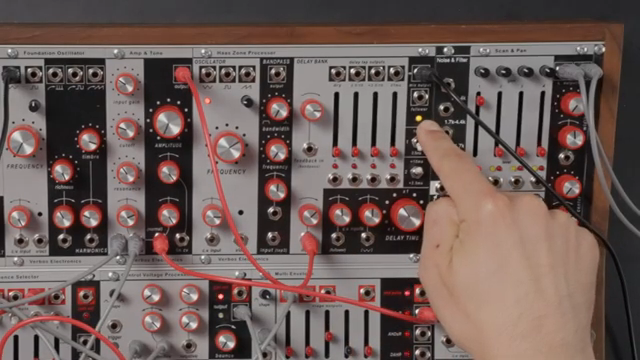
"We also have the individual outputs for the taps themselves, and these are actually quite useful because, as I mentioned before, by default the third tap goes to the feedback, but using either the first or the second taps provides a different flavor of feedback."
© Screenshot/Quote: Verboselectronicsgmbh (YouTube)
Rounding out the tour, the Haas Zone Processor offers individual outputs for each tap, a boon for creative patchers. The demo shows how rerouting feedback through different taps produces distinct tonalities—higher or lower resonant pitches depending on the tap’s inherent delay.
Each tap also features VCA inputs, allowing for dynamic level control and further modulation. While this video only scratches the surface, it’s clear the design invites experimentation with parallel processing, custom feedback paths, and advanced modulation schemes. For anyone chasing new shades of phase, flange, or rhythmic texture in their rack, these outputs are an open invitation to patch outside the box.
This article is also available in German. Read it here: https://synthmagazin.at/verbos-electronics-haas-zone-processor-kurze-delays-tiefe-modulation/
Watch on YouTube:
Latest articles
Watch on YouTube:
Visit the channel:
https://www.youtube.com/VerbosElectronicsGmbH
https://www.youtube.com/VerbosElectronicsGmbH
Links from VerbosElectronicsGmbH:
website: https://www.verboselectronics.com
tech_cards: https://www.verboselectronics.com/tech-cards
instagram: https://www.instagram.com/verboselectronics
Sponsored links:
If you purchase via these links, we may earn a small commission – at no extra cost to you. The link opens an Amazon keyword search, and results may vary depending on availability.
Verbos Electronics Haas Zone Processor
🔗 Check price on Amazon
🔗 Check price on Amazon