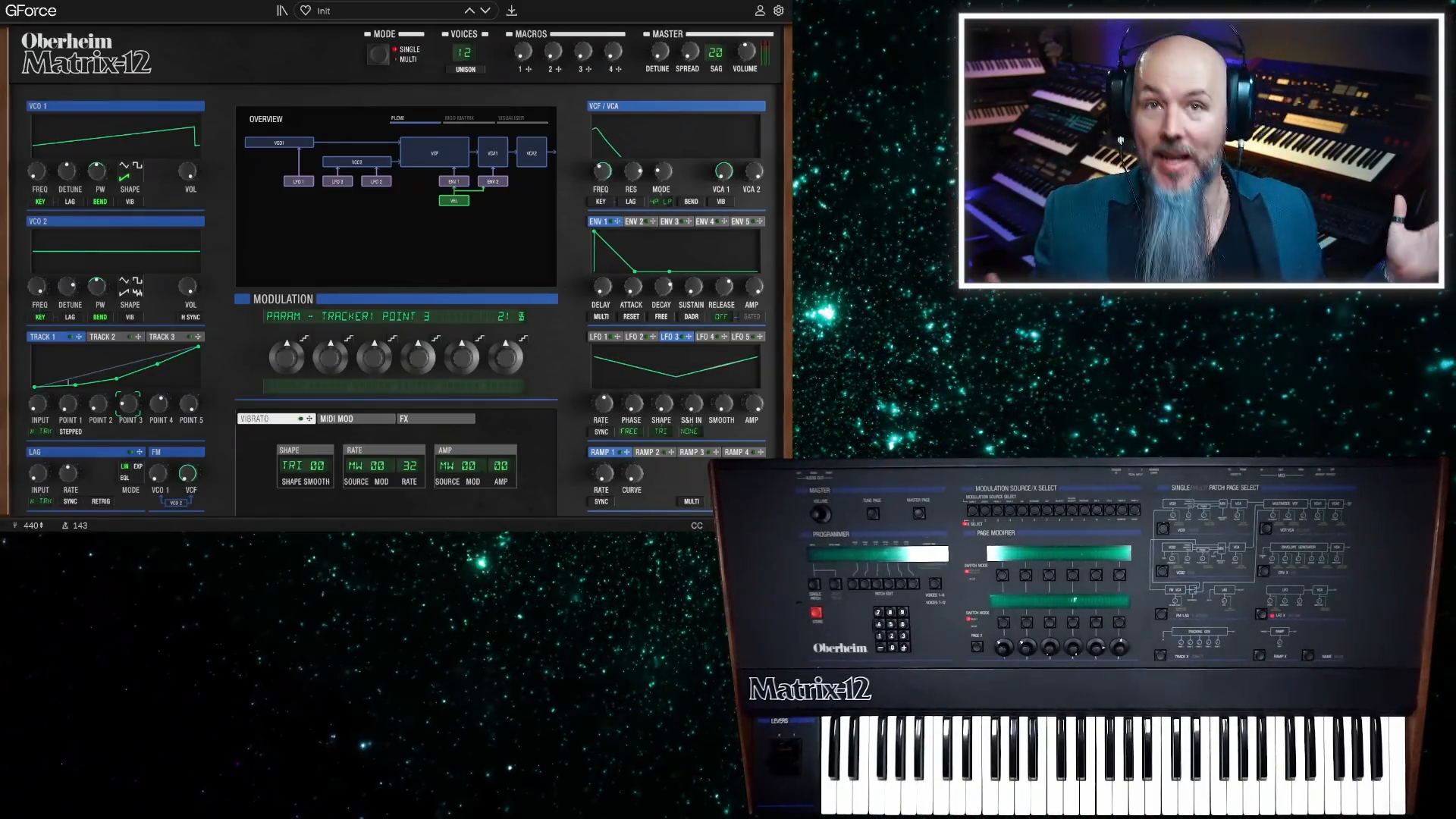
Two examples, a hidden assignment: Vulture Culture opens his video, published on November 5, 2026, with an A/B riddle. Example A turns out to be his vintage Matrix-12. Whether the difference matters musically is the more interesting question that follows. He explains that the hardware is calibrated, the signal chains are identical, and the levels are exactly matched. He also discloses his connection to the manufacturer: GForce paid him for factory presets. However, this video was neither commissioned nor paid for; GForce had no influence on the content.
A Bit Brighter Isn’t a Final Verdict
“It doesn't sound exactly like my hardware. Maybe it sounds exactly like the hardware they modeled it on. I don't know.”
© Screenshot/Quote: Vulture Culture (YouTube)
With the triangle, Vulture Culture hears a bit less top end in the plugin, but with the pulse, a bit more. With pulse width modulation, the difference becomes more pronounced for him; he brings the timbres closer by adjusting the filter modulation. He describes the noise as the first substantial difference: his hardware sounds more like pink noise, the software more like white. So, this round doesn’t deliver a blanket verdict of the plugin being fundamentally brighter or darker.
With the triangle raised by 36 semitones, he also identifies aliasing in the plugin using the spectral display. At the same time, he warns: YouTube’s compression can swallow such differences or even create artifacts itself. The video here provides his diagnosis, not an unadulterated listening test for every playback system.
Even the original isn’t an unchanging benchmark. In his hardware comparison with the Matrix-6 and Chroma Polaris from October 29, he regrets calibrating, because before that, there was more movement than with the Matrix-12. That’s why, for the plugin, there’s an important caveat to his enthusiastic conclusion:
The Torture Test Is Allowed to Bite
Vulture Culture doesn’t stop at the bare oscillator. He works through all 15 filter modes, adjusting envelopes and resonance values by ear. Identical numbers don’t always deliver the same behavior. He also notices deviations in LFO rates. For animated patches, this matters: not just the timbre, but also the tempo and contour of the movement count.
Filter FM is especially rewarding: he removes VCO 2 from the audible signal and changes its frequency to carve out a talking filter character. Here, the emulation convinces him. At extremely high cross modulation, he describes digital artifacts—but also doesn’t hide unwanted dirt from his analog hardware in these extreme ranges.
“I think GeForce nailed it where it counts, which is filter FM. That's the thing that plugins fail at all the time, but I did think sometimes the resonance was just a little bit sweeter on the vintage hardware.”
© Screenshot/Quote: Vulture Culture (YouTube)
Less Menu, More Movement
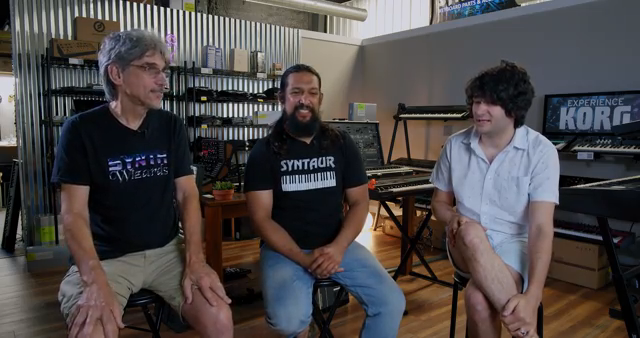
“That's another synth that we have not fully learned completely because the menu diving on it is infinite,”
© Screenshot/Quote: Syntaur (YouTube)
Programming reveals the clearest practical advantage. In the plugin, Vulture Culture drags LFO 1 onto pulse width; the matrix routing is created automatically. Out of habit, he prefers the classic parameter selection, but when setting up a second PWM connection, he admits: the software is faster.
How much access matters was already described by Jonray Higginbotham of Moonlab Studios in Syntaur’s 2021 conversation. He praises his Matrix-12 sonically but admits he hasn’t fully learned it yet. His reasoning is refreshingly unromantic:
Not Every Voice Has to Do the Same Thing
Higginbotham’s musical preference is very concrete. On the Oberheim Four Voice, he assigns different LFO speeds to the voices. That’s a different instrument, but a compelling musical decision: movement doesn’t just come from as much detuning as possible.
Vulture Culture’s final plugin patches also go beyond the uniform chord sound. For Arboretum of Galatea, he explains that each voice can play a different patch. In Voyager’s Last Light, he combines PWM with cross modulation and noise; voices eleven and twelve form wind-chime-like textures in unison. That’s where the comparison becomes music again.
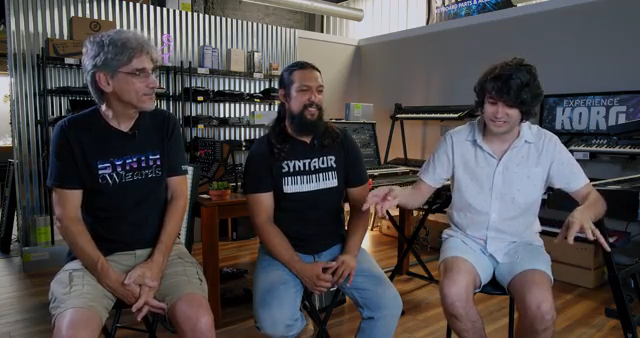
“Something I like to do on that one is like on the lower note, have that LFO going real slow, and then gradually each voice a little bit faster, and it just sounds so lush and beautiful.”
© Screenshot/Quote: Syntaur (YouTube)
The real gain isn’t that no one can tell a Matrix-12 apart anymore. It’s that its intricate possibilities become easier to play with. The blind test asks about the original; the patches at the end ask about the next track.
Videos for this article
All other articles featuring the Oberheim Matrix 12

All YouTube videos featuring the Oberheim Matrix 12
Primary – main topic (17)
 I Own a Matrix-12. GForce Got Closer Than I Wanted.
 Matrix-12 vs Matrix-6 vs Chroma Polaris: What the Money Buys You
 The Coolest Synth From Every Brand (Is Not What You Think)
 Synthfest UK 22: Sweet Discrete Can Pimp Your Vinyl Panels
 Oberheim Matrix-12 sample pack for TAL-sampler
 Oberheim Matrix-12 | Analog Superpowers
 Talking Synths, Episode 33: Jonray Higginbotham of Moonlab Studios
 Oberheim Matrix-12 -- first contact !
Show all (9 more)
 Vintage Oberheim Matrix 12 Analog Synthesizer Sounds
 Moods with JX-8P and Matrix-12
 Matrix-12 through Eventide H3000
 Oberheim Matrix-12 - beauty
 Test - Arturia Martix 12V - deutsch - Ist die Emulation des Oberheim gelungen?
 Arturia Matrix 12 V tutorial part 1
 Sonic TALK 361 - Axel Hartmann Synthesizer Designer
 Matrix-12 multi patches
 Oberheim Matrix-12
Substantial coverage (18)
 Expander: An Oberheim Retrospective
 Keyboard Mag Sept. '87 | What Was In It?
 Why We Bleep Podcast with Tom Oberheim
 Marcus Ryle & Daniel Fisher Talk Oberheim Legacy, Synthesis, Innovation & More
 The Oberheim Xpander from 1984
 An awesome chat with Under the Big Tree!
 Making an album in 2022, old school 80s style | Hardware MIDI sequencing and synthesizers
 Keyboard Mag. March '86 | What Was In It?
Show all (10 more)
 Studio Tour: Ham Plaza - synths a plenty
 FIVE G Legendary Synth Shop,Tokyo Visit
 Sonic TALK 585 - Willy Nilly 1, Willy Nilly 2, Willy Nilly 3
 Digging into the EPIC Arturia V Collection 7
 Tutorials | Pigments - Episode 3: Filters
 ARTURIA SEM & M-12 Filter Hands-On Demo - Oberheim Filters For Your DAW | SYNTH ANATOMY
 Music magazines
 Sonic TALK - Deep Forest Eric Mouquet
 Tom Oberheim Interviewed by Sweetwater Sound
 NAMM Preview & die Top-News der Woche
Mentioned (15)
 GForce Prophet-5, Cherry Audio ESQ-1, Behringer BMX, Neumann MT 48 & AI in the DAW
 the INDUSTRIAL METAL SYNTHESIZERS everyone should know
 The Great Synth Hunt: The Kurzweil K2000 Synthesizer
 Oberheim OB-X8 First Look & Demo | Superbooth | Thomann
 1€ für Plugins? Musiksoftware wird verramscht! Stammtisch
 SUPERBOOTH 2021 BJOOKS Synth Gems1 - Classy Synth Book
 A SWEET New LoFi Plugin 📻 | Unfiltered Audio Lo-Fi-AF
 Arturia's Pigments 2 complete guided tour
Show all (7 more)
 Arturia: NEW Pigments Soft Synth FIRST LOOK!
 Arturia V Collection 6 tour and review
 NAMM 2018 , Digitone, Zynapiq Orange Vocoder - Stammtisch Special
 Der Behringer Synth & weitere Synthi-News
 MP Interview #01 - Jason Amm 'Solvent'
 The Inventors of Synth (Roger Linn, Dave Smith & Tom Oberheim) - Sweetwater Gearfest 2015
 WNAMM13:Here Comes The Schmidt Polysynth - Video