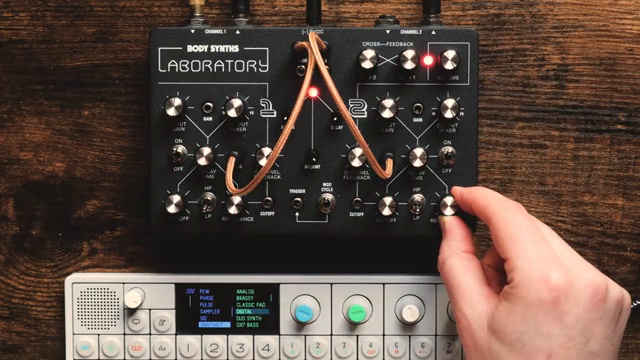
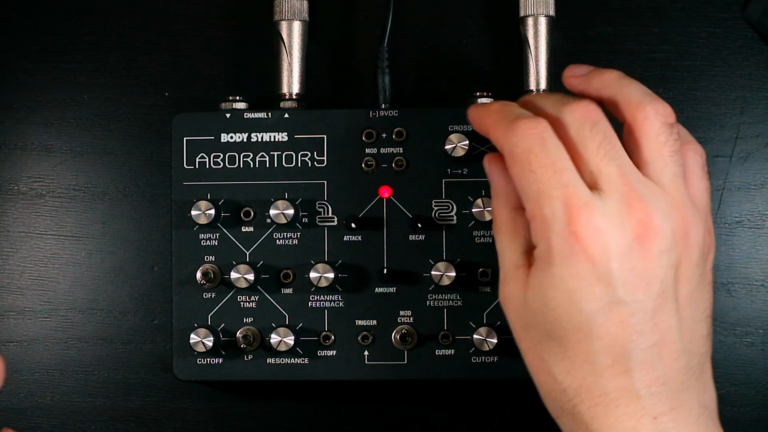
Ali, aka The Unperson, doesn’t start with a melody, but with a cranked feedback knob. He activates the delay on Laboratory’s first channel, generates noise, and sends the signal via cross-feedback to the second side. Instantly, a mono experiment becomes a stereo one. In his video “Body Synths Laboratory – My Gear of the Year?” published on November 15, 2026, he’s initially interested in exactly this role: the effects box as a sound source in its own right, not just as a finishing touch for other equipment.
Two Channels, One Circuit

© Screenshot: The Unperson (YouTube)
“Every time I sit down with this I create something.”
© Quote: The Unperson (YouTube)
Ali’s approach becomes especially vivid when he starts with a simple delay and then opens the connection in both directions: channel one feeds channel two, channel two in turn feeds channel one. He increases the feedback and lets the closed loop grow. Instead of calling up a finished drone, he creates the conditions for one to develop. It’s precisely this emergence that’s the interesting part of his experiment.
Ali describes this as an extremely rewarding activity. After his brief statement, he adds that something completely different comes out every time. That’s his experience with the device, not a promise of reproducible results—and for experimental music, perhaps that’s the more enticing prospect.
Body Synths Laboratory – Amazon keyword search
Search for this product on Amazon →
This link opens an Amazon keyword search. Depending on availability, other results may be shown.
Advertising – affiliate link. If you buy through this link, we may earn a commission – at no extra cost to you.
The Beautiful Detour: Turning Off the Delay
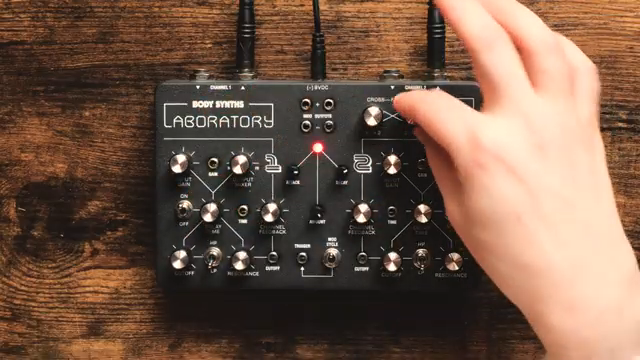
Ali demonstrates one of his favorite interventions right in the first experiment: resonance up, delay off. He describes the resulting tones as dirty sine waves; he tries this with both low-pass and high-pass. It’s a likeable tinkerer’s move: instead of adding another function, he takes one away and sees what remains. Later, he activates the delay on the second channel and brings the experiment back to a stereo drone.
© Screenshot: The Unperson (YouTube)
“One thing I really love to do is turn off the delay to get these beautiful sort of dirty sine wave tones coming through.”
© Quote: The Unperson (YouTube)
© Screenshot: DivKid (YouTube)
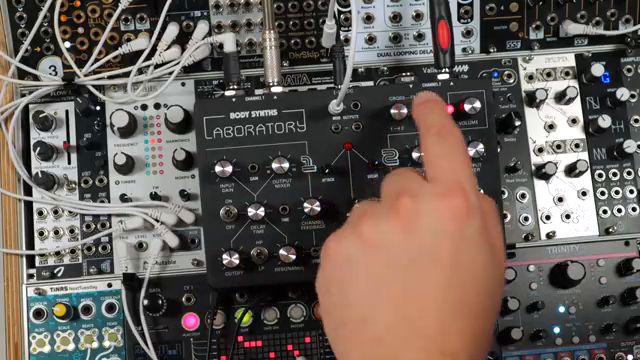
“If we start feeding this back, we'll be feeding sound back in to mix into the other oscillating filter.”
© Quote: DivKid (YouTube)
DivKid, in “FX Processor or Feedback Synthesizer? Both!!”, takes it even further by using the filters as sound sources. His Body Synths-sponsored video includes an experiment with no input signal: he increases the resonance and plays the two self-oscillating filters like a pair of oscillators. Through feedback, sound then enters the other oscillating filter. This means cross-feedback doesn’t just affect spatial distribution; the two sound sources become coupled.
DivKid also brings in the delays. In another step, he switches to high-pass and dials back the resonance so the filters no longer self-oscillate. These changes make his exploration insightful: he doesn’t just show the wild end state, but different paths by which Laboratory becomes an independent noise instrument.
Autonomy Is Not the Same as Randomness
For the impression of organic change, these experiments don’t need a random generator. The mere growth of the feedback already provides a progression. Targeted movement is added via the internal modulation section: an envelope that can also run cyclically. Ali uses it to modulate the delay time for a vibrato effect and changes its speed. So there is indeed guidance here, not just applause for chaos.
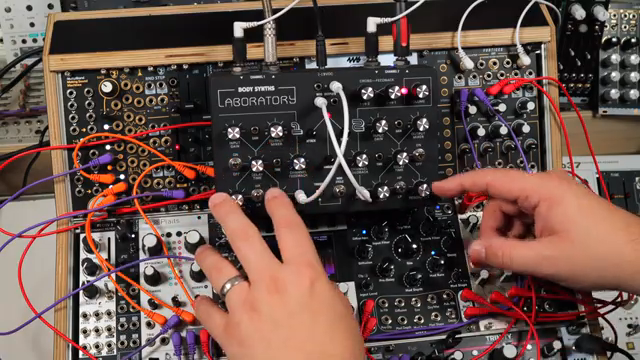
DivKid makes the positive and negative modulation outputs musically tangible: in his stereo delay experiments, he moves one high-pass up and the other down. A single modulator can thus give the two channels opposing behavior. It’s a straightforward connection with far-reaching consequences for movement in the stereo field—and a practical starting point if you want to turn exploration into a consciously shaped passage.
© Screenshot: DivKid (YouTube)
“So you could patch the same positive or negative signal to each channel without needing splitters, or you could give each channel an opposing behaviour from the modulation.”
© Quote: DivKid (YouTube)
Ali calls Laboratory a possible personal favorite of the year at the end. After his experiments, the appeal certainly isn’t in finally taming feedback completely. It’s more interesting to listen to it and intervene at the right moment: open a path, turn off a delay, change the resonance. The next sound doesn’t have to be predetermined for the next decision to be musical.
Body Synths Laboratory – Amazon keyword search
Search for this product on Amazon →
This link opens an Amazon keyword search. Depending on availability, other results may be shown.
Advertising – affiliate link. If you buy through this link, we may earn a commission – at no extra cost to you.
Videos for this article
All other articles featuring the Body Synths Laboratory
All YouTube videos featuring the Body Synths Laboratory
Primary – main topic (5)
 Body Synths Laboratory - My Gear of the Year?
 FX Processor or Feedback Synthesizer? Both!! // LABORATORY by Body Synths
 Cooking up some beautiful filth in the Body Synths Laboratory
 I went to Superbooth and THIS happened (I saw synths that were good, here are some of them)
 Body Synths: Laboratory Module - Superbooth 2026

