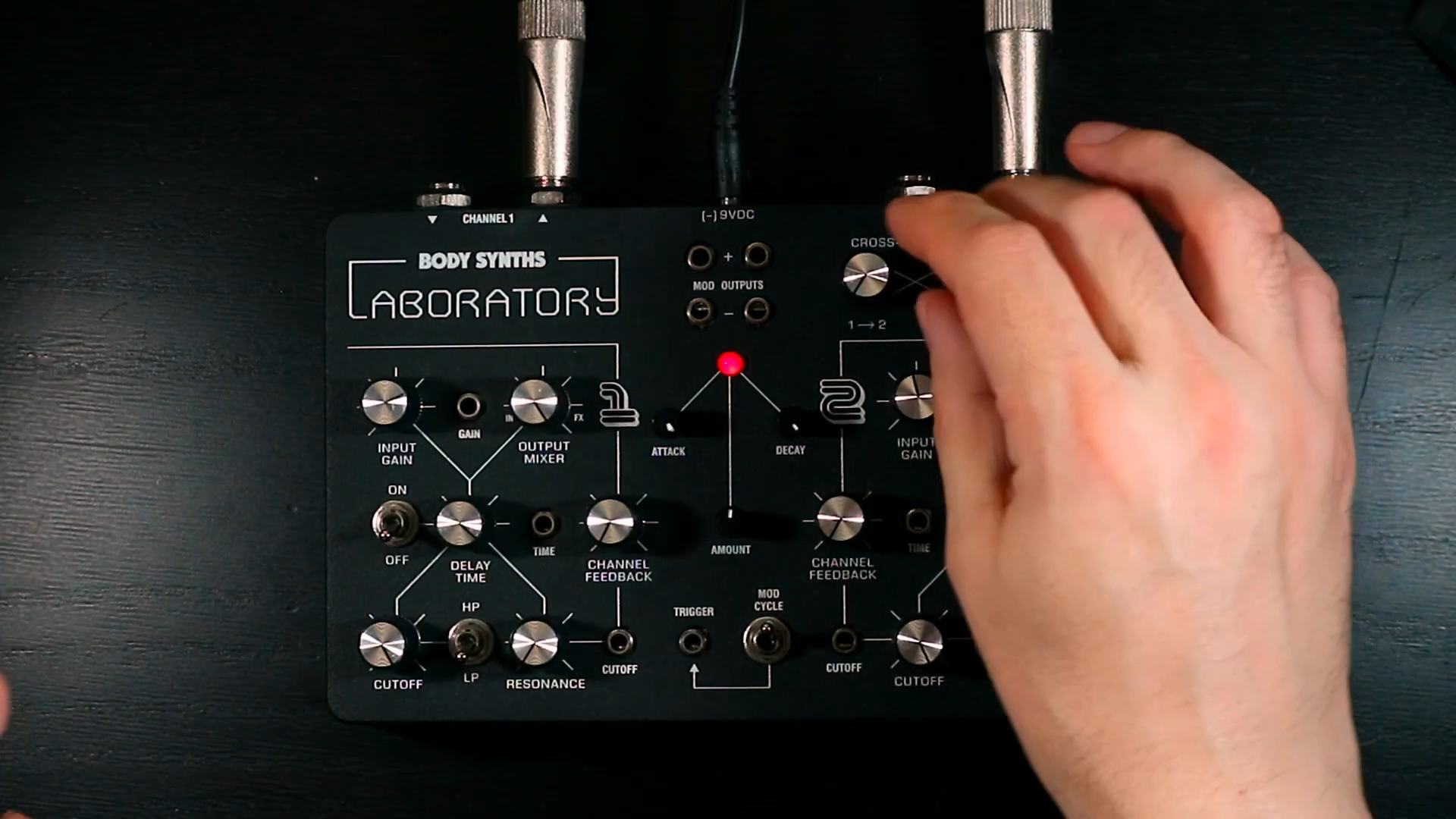
No playback device, delays switched off, feedback cautiously increased: Oscillator Sink makes the Laboratory from Body Synths sound without giving it an audio signal. In his video published on November 10, 2026, this experiment does not begin with maximum racket. He describes the resulting tones as gentle, almost sine-like, and barely distorted. For a box he extensively uses for sonic pollution, this is a remarkably restrained performance.
The Feedback Loop Is Already Built In
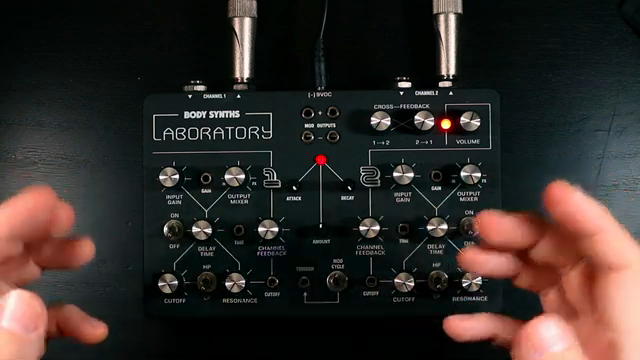
“let's just explore what can happen when we start making it feedback on its own without any input”
© Screenshot/Quote: Oscillator Sink (YouTube)
Oscillator Sink is reminded of no-input mixer synthesis: a mixing desk generates its own tones through feedback, with EQ and inserted effects shaping them. Laboratory already provides the necessary paths. Each of its two channels has its own feedback; additionally, the channels can be fed into each other in both directions. In his video, also published on the same day, DivKid traces the signal path: saturating input stage with VCA, switchable delay, then a resonant high- or low-pass filter. The filter supplies the signal for the channel feedback back to the delay.
In the experiment, Oscillator Sink lets the sides work independently at first and changes their pitches via the filter frequencies. With cross-feedback, further interactions are added; he is surprised himself by an emerging rhythm. Only then does he switch on a delay. With longer delay times, he describes how its crackling gets into the other channel and stimulates what happens there. Side noises here are not a residue to be eliminated, but musical material.
Two Filters Take Over the Voices
DivKid, while preparing his solo noise demonstration, finds a different approach: he drives the filters into self-oscillation via their resonance and treats them as a pair of oscillators. Again, the audio input remains unconnected. This makes an important difference tangible: a filter can oscillate on its own; the additional feedback paths can then bring these oscillations into interaction with each other.
However, he does not stop at two whistling filters. After switching on the delays, he changes to high-pass and reduces the resonance so far that the filters no longer self-oscillate. Later, longer delay times, cross-feedback, and modulation are added. This change of working method is particularly interesting: Laboratory does not always need the same source of oscillation to continue living as an instrument.
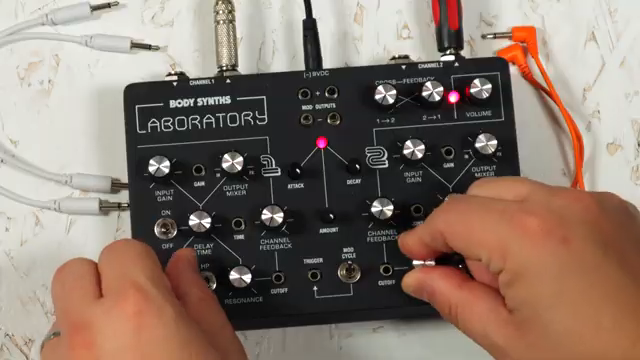
“And playing with those oscillating filters as a pair of oscillators.”
© Screenshot/Quote: DivKid (YouTube)
What Goes In Can Be Dosed
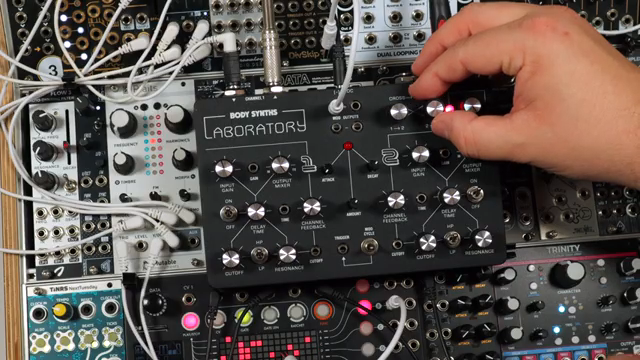
“Now turning this down, channel one's input gain is like our effects send level.”
© Screenshot/Quote: DivKid (YouTube)
DivKid demonstrates how precisely the network can be operated with a ping-pong delay for an external sequence. The channel feedback controls remain closed. Instead, cross-feedback sends the delayed signal from channel one to channel two and back again. He turns down the input of channel two so that the normalized input signal does not land there as well. He mixes the dry signal outside of the Laboratory.
The input gain of the first channel thus becomes the send control. DivKid controls it via the internal envelope, triggered by the sequencer, and thus lets selected notes into the delay. A nice piece of instrument design: not every note has to immediately land in the entire feedback network. However, this patch controls the injection—not the strength of the already running feedback.
One Jack Is Missing in the Feedback Loop
This is exactly where Oscillator Sink's most significant criticism comes in. Gain can be controlled via CV, but channel feedback cannot. He wishes for pulsating and swelling delays as well as additional interventions in the pitches of the no-input sounds. This is not a call for more features for their own sake: as soon as feedback becomes the instrument's voice, its level becomes a musical means of expression.
This limitation does not fundamentally diminish his enthusiasm; he explicitly states that his criticisms are not dealbreakers. For context: both creators disclose support from Body Synths. Oscillator Sink is allowed to keep the provided device and states that he was not otherwise paid. DivKid labels his contribution as sponsored.
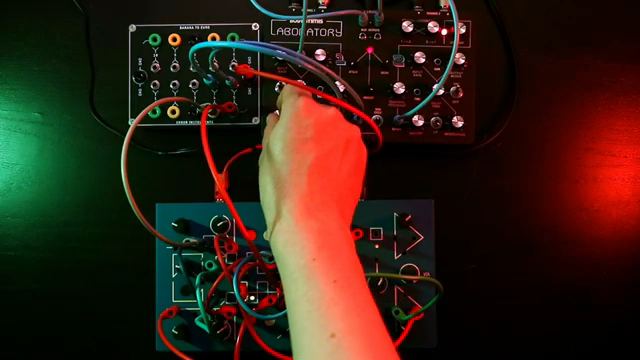
“i think the biggest one for me is the lack of cv control over the channel feedback although you've got cv control over the gain”
© Screenshot/Quote: Oscillator Sink (YouTube)
In these experiments, Laboratory acts less like an effect with a handy self-oscillation trick and more like an instrument that also masters effects. Its interesting range begins where small knob movements set the two channels in a new relationship to each other. The missing feedback CV remains a real boundary. For this part of musical movement, the hand is still in charge.


