
Faders, buttons, jacks: Andrew Huang doesn't need a long explanation for his first impression of Faderpunk. In his video "The most innovative music tools of the year," published on November 13, 2026, he presents ATOV's device as the winner of the Commercial Hardware category at the MIDI Innovation Awards. The overview is sponsored by the MIDI Association. Huang's enthusiasm gets interesting where a seemingly simple fader bank becomes a toolbox for very different setups.
The task comes before the fader

© Screenshot: Andrew Huang (YouTube)
“You've got 16 of each of these. And this is easily configurable to do almost anything you want.”
© Quote: Andrew Huang (YouTube)
Huang describes 16 faders, 16 buttons, and a jack per channel. A configurator lets you define which tasks the surface takes on. A channel can simply act as a controller; combinations of several channels enable other functions. Huang mentions LFOs, envelopes, clock dividers, various sequencers, MIDI-to-CV conversion, and scale quantizers. The appealing principle: it's not the next device that determines the setup, but the question of which control function your instrument is currently missing. Huang's enthusiasm is correspondingly clear:
ATOV Faderpunk – Amazon keyword search
Search for this product on Amazon →
No verified direct product link was available. This link opens an Amazon keyword search; results may vary.
Advertising – affiliate link. If you buy through this link, we may earn a commission – at no extra cost to you.
Bitwig drums, the modular system runs
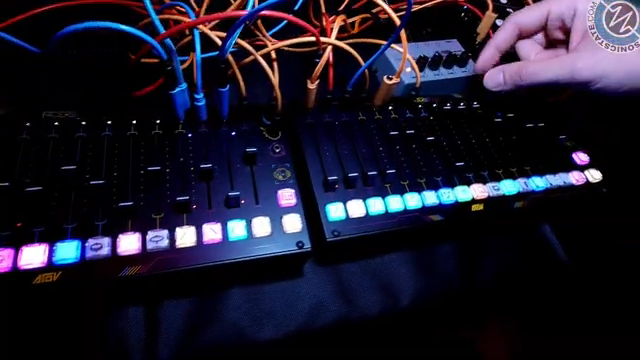
Arthur from ATOV demonstrates what this can look like in practice in sonicstate's Bristronica feature from 2025. One sequencer controls the modular system, another the C-Shell. There's also MIDI control for Bitwig and envelopes from Faderpunk itself. Later, Arthur explains that two-channel Euclidean sequencers send MIDI to the drums in Bitwig. This isn't just a list of functions: multiple tasks in a hybrid setup are handled on the same control surface.
The reverse direction is also interesting: Arthur mentions CV-to-MIDI as a way to supply a polyphonic MIDI synthesizer with external CV modulation. So the modular system doesn't have to remain isolated.
The early demonstration also shows the space calculation: the smallest app unit includes jack, fader, and button; larger apps take up multiple channels. The sequencer shown there, with four 16-step sequences, uses eight of them. Versatile doesn't mean unlimited. The sonicstate interviewer sums up the overarching benefit as a question:
© Screenshot: sonicstate (YouTube)
“So it's a control hub, but it also sits in between your MIDI and your software as well?”
© Quote: sonicstate (YouTube)
Set up, unplug, keep playing
© Screenshot: Andrew Huang (YouTube)
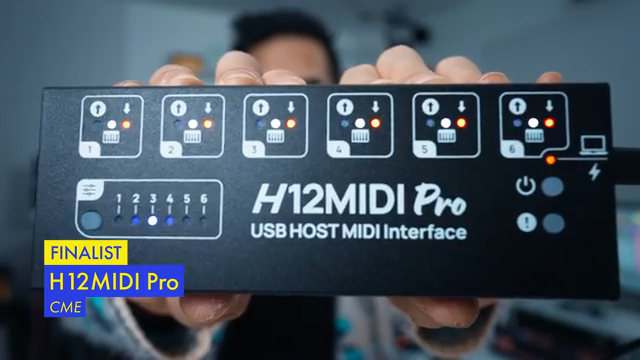
“It comes in this metal enclosure and it's USB-C powered, but it's also Euro rack format. So if you want, you can just put it in your case and power it from there.”
© Quote: Andrew Huang (YouTube)
For everyday use, an unspectacular detail is crucial: according to Arthur, the apps run on the device. The configurator is for setup; after that, you can disconnect and run Faderpunk standalone. In the same demo, he changes an app color to green and explains color coding for live use. There are also stickers for the buttons. Free assignment is only convenient if you still know what's happening where later on.
Huang also points out that you don't have to decide between desktop and rack module once and for all at purchase:
Not every good idea needs its own module
The open firmware opens up another kind of customization. Huang points to the ability to program your own functions if the existing apps don't fit. In the sonicstate interview from Superbooth 2026, Arthur already reports a concrete community contribution: with version 1.9, a port of Mutable Instruments Grids was added as a four-channel app. That's a more tangible argument for open source than the usual promise of limitless possibilities.
But Arthur isn't just interested in the next big feature. He also describes the platform as an opportunity to try out small ideas and see with the community whether they're actually used. In the sonicstate interview, he says:
© Screenshot: sonicstate (YouTube)
“And the nice thing with this is that you can really experiment and we can make apps and like little functions that would never really be viable as a product.”
© Quote: sonicstate (YouTube)
That's exactly where the charm lies for experimental studios: an idiosyncratic musical idea doesn't have to justify buying another device. Sometimes it just needs a few free channels—and a surface where it can be tried out.
ATOV Faderpunk – View product
Search for this product on Amazon →
No verified direct product link was available. This link opens an Amazon keyword search; results may vary.
Advertising – affiliate link. If you buy through this link, we may earn a commission – at no extra cost to you.


