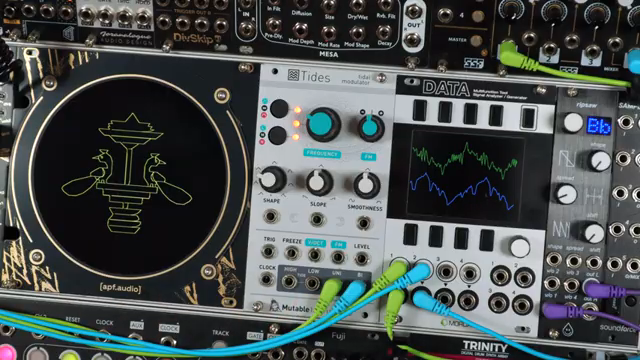
Two peacocks at a rather ornate fountain: modulation rarely looks like this. In his video published on November 17, 2026, DivKid brings this drawing out of Mutable Instruments Tides Mk1. He sends its unipolar and bipolar outputs to an XY display. But the decorative aha moment is not the end: DivKid listens to both signals individually and finally builds a techno patch from them.
Two Cables to Nowhere
© Screenshot: DivKid (YouTube)
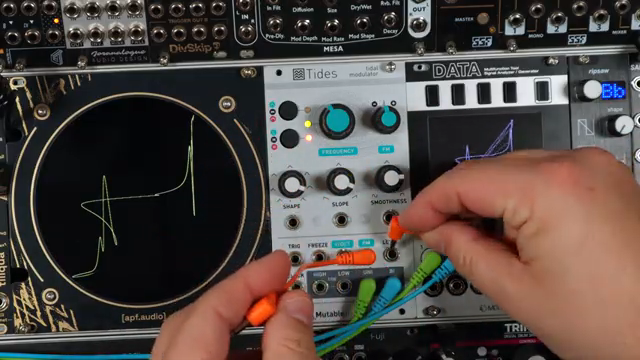
“you hold the top button for a second”
© Quote: DivKid (YouTube)
The access is refreshingly unceremonious. DivKid plugs a cable into both FM and Level; the other ends remain unconnected. According to his explanation, this interrupts the normalizations on those jacks. Then he holds the top button for about a second until the display turns yellow, again for a second until green, and finally the bottom button for a second until red. This is the sequence shown in the video for Mk1—not instructions for Tides 2.
Mutable Instruments Tides – Amazon keyword search
Search for this product on Amazon →
This link opens an Amazon keyword search. Depending on availability, other results may be shown.
Advertising – affiliate link. If you buy through this link, we may earn a commission – at no extra cost to you.
The Peacock Is Not a Freely Playable VCO
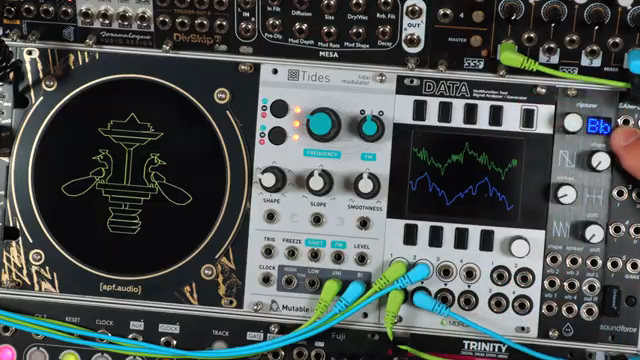
The pretty XY figure is not an animation independent of sound: two output signals are displayed as a two-dimensional shape. DivKid switches the Data to waveform view and demonstrates both sonically. He describes the unipolar output as richer in overtones, the bipolar as duller or, to use a positive term, warmer. He names B, internationally B♭, as the fixed pitch. Still, you shouldn’t expect a hidden, freely controllable oscillator here.
So the movement has to come from elsewhere. In the subsequent Peacock Techno, DivKid routes the bipolar signal through two differently modulated VCA channels, creating stereo movement. The unipolar signal runs through a rhythmically modulated bandpass. An inverted envelope causes pumping when the kick comes in. There’s also another oscillator with a seven-step pitch sequence and random rhythms. It’s the breakdown of this patch that makes the video interesting: the peacocks provide material, the arrangement is built around them.
© Screenshot: DivKid (YouTube)
“you can't frequency control them, there's no wave shaping, they are preset as an easter egg there to give the XY scope or vectorscope peacock image.”
© Quote: DivKid (YouTube)
Not Every Knob Needs Attention
© Screenshot: Lightbath (YouTube)
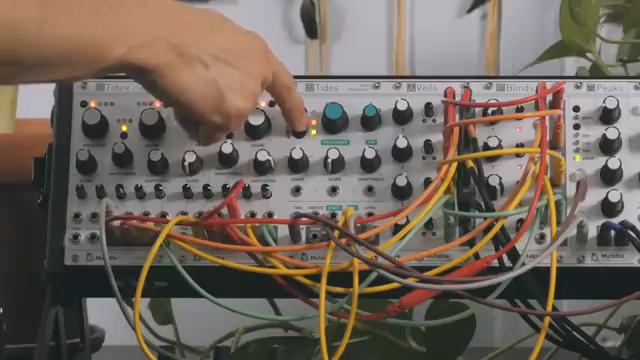
“I could be changing both of those parameters and I'm not. I'm letting them stay where they are and having that limit define this piece.”
© Quote: Lightbath (YouTube)
Lightbath also leaves a lot untouched in his video for Loom 4 from September 2018—though voluntarily and with Tides 2 in regular operation. One unit provides chord tones, a second polyrhythmic envelopes. Through Blinds, he changes their polarity. The found chord shape, rhythmic relationships, and polarization settings then form a largely fixed framework.
He doesn’t make a dogma of reduction out of it. He explicitly says that the then-new system still demanded a lot from him. Instead of wanting to master all possibilities at once, he makes music with the configuration he’s found. He still changes timbres and transposes pitches via keyboard. Fixed does not mean immobile.
The Real Work Remains Craft
How much leeway is within this framework, Lightbath shows with a specific move: before a harmony change, he removes the third. This avoids clashes between old thirds lingering in the delay and the new chord; afterwards, the voice can return. His performance choreography emerges through improvisation, more takes, and selection. The restriction doesn’t make decisions for him. It just makes them more manageable.
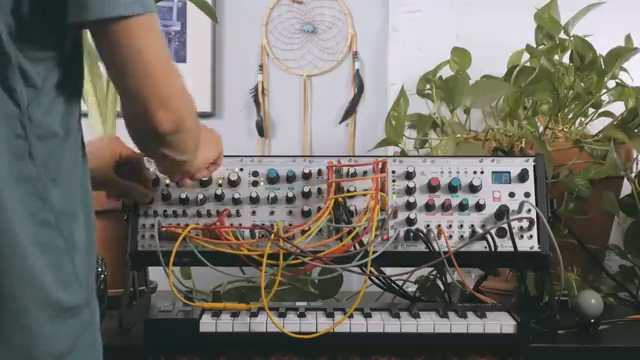
© Screenshot: Lightbath (YouTube)
“And so I did a new, another take, and kept what I liked and discarded what didn't work, and kept with that process.”
© Quote: Lightbath (YouTube)
DivKid’s peacocks don’t need to learn chords or suddenly change their pitch. Their musical value comes from what he does with them: distributing, filtering, rhythmizing. The Easter egg remains a joke—but one that asks a useful question: What can you make out of a signal if you stop demanding more functions from it?
Mutable Instruments Tides – Amazon keyword search
Search for this product on Amazon →
This link opens an Amazon keyword search. Depending on availability, other results may be shown.
Advertising – affiliate link. If you buy through this link, we may earn a commission – at no extra cost to you.
Videos for this article
All YouTube videos featuring the Mutable Instruments Tides
Primary – main topic (5)
 Mutable Instruments hid Peacocks in your modulation! // a Tides Easter Egg
 How We Remember | The Lightbath Zone - Eurorack Modular Synthesizer Masterclass
 Loom 4 (ft. Tides) | The Lightbath Zone - Eurorack Modular Synthesizer Masterclass
 Loom 4 (ft. Tides) | All Mutable Instruments Eurorack Modular Synthesizer
 Tides Parasite + Rings
Substantial coverage (5)
 The Secret of the Sliding Nuts | Eurorack Modular Synthesizer Tutorial
 Modular Monthly: Exploring ring modulation with the AJH Synth Ring SM
 Make Noise - Morphagene #13 - DivKid 4 Voice Ambient Reel #MorphageneMondays
 Loom 1 (ft. Plaits) | All Mutable Instruments Eurorack Modular Synthesizer
 Mutable Instruments - Plaits - Stereo Demo Jam