Moog Music steps into the spectral domain with their Spectravox, a device that blurs the boundaries between instrument and processor. In this official demo, Moog showcases the Spectravox’s filter bank mode, using a Roland TR-606 as the external source. The video dives into everything from gain staging and band sculpting to the innovative spectral shift and LFO modulation, revealing how Spectravox can transform even the driest drum machine into a metallic, resonant, and phaser-like beast. If you’re curious about fixed filter banks, spectral animation, and creative signal routing, this is a deep patching session worth a close listen.

17. May 2024
MILES
Moog Music’s Spectravox: Filter Bank Alchemy in Action
Spectravox: Instrument or Processor?
Spectravox is introduced as a device that sits comfortably between the worlds of instrument and processor, a rare hybrid in the Moog lineup. In this video, Moog Music focuses on its filter bank mode, which is designed to process external signals with a distinctly analog flavour.
The approach here is to treat Spectravox not just as a static filter bank, but as a dynamic tool for reshaping the frequency content of anything you feed into it. This duality is at the heart of the demo, setting the stage for a session that’s as much about creative signal manipulation as it is about classic Moog circuitry.

"Spectravox is a unique device in that it straddles the line between instrument and processor."
© Screenshot/Quote: Moogsynthesizers (YouTube)
Patching In: External Drum Machine and Gain Staging
"I want to be able to use the gain control to be able to drive the drum machine a little bit if I want to."
© Screenshot/Quote: Moogsynthesizers (YouTube)
The video demonstrates connecting a Roland TR-606 drum machine to the Spectravox’s program input, a path typically reserved for vocoder duties. This clever rerouting allows the external drum machine to become the main source for the filter bank, replacing the internal oscillator.
By using the gain control in the program section, the presenter shows how you can drive the input signal, adding anything from subtle warmth to outright coloration. This is a classic Moog move—giving users the option to push signals into new sonic territory before they even hit the filter stages.
Ten Bands, Infinite Colours: Graphic EQ and Resonance Play
With the gain set, attention turns to the Spectravox’s ten filter bands. At low resonance, these bands act much like a graphic equalizer, letting you sculpt the frequency spectrum with surgical precision. Each band’s level can be adjusted independently, allowing for both subtle mixing tweaks and dramatic frequency cuts.
The demo highlights how you can silence entire sections of the spectrum or use the bands as a mixing tool for balancing elements in a drum pattern. This flexibility makes Spectravox more than just a fixed filter bank; it’s a hands-on frequency sculptor.
Cranking up the resonance, the filter bank takes on a new character—metallic, wild, and capable of adding a sharp edge to the processed sound. The resonance control becomes a creative weapon, transforming the drum machine into something far more alien and expressive.

"With the resonance all the way down is use all 10 filter bands almost like a graphic EQ."
© Screenshot/Quote: Moogsynthesizers (YouTube)
Spectral Shift and LFO: Moving the Frequency Landscape
Moog’s Spectral Shift control is a standout feature, letting you move all ten filter bands up or down the frequency spectrum in unison. This isn’t just a static EQ; it’s a living, breathing filter landscape that can be swept across the sound source for evolving timbres.
The integrated LFO comes into play here, normalised to modulate the spectral shift. By introducing LFO movement, the demo shows how you can create sweeping, animated textures that bring the filter bank to life. This modulation can be subtle or dramatic, depending on the depth and rate settings.
Together, spectral shift and LFO modulation open up a world of spectral animation, making Spectravox a powerful tool for anyone interested in evolving, movement-rich sound design.
Resonant Tricks: Notch Filtering, Phasing, and Metallic Mayhem
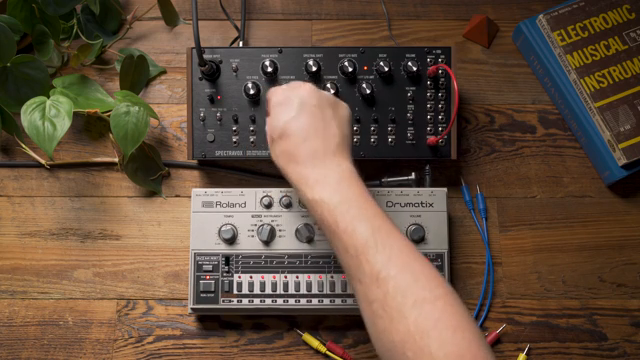
"If I eliminate most of the center bands I can create something that feels like a notch filter almost like a phaser effect."
© Screenshot/Quote: Moogsynthesizers (YouTube)
The video dives into advanced patching tricks, starting with notch filtering. By cutting out most of the centre bands, Spectravox can mimic the behaviour of a notch filter, carving out frequency holes and creating a phaser-like effect. Increasing resonance intensifies this effect, adding a swirling, almost vocal quality to the drum machine.
Another technique involves removing the top and bottom bands and opening up only select mid-frequency bands. This creates a formant-like resonance, giving the processed drums a unique, vocal timbre. The ability to space these bands apart lets you dial in everything from subtle filtering to extreme, synthetic textures.
The presenter also demonstrates how, with high resonance, Spectravox can impart a metallic sheen to the signal. Even a simple kick drum can be transformed into something reminiscent of a gong, especially when other drum elements are removed from the mix.
Finally, by reintroducing snare and hi-hats and adding a touch of LFO modulation, the Spectravox reveals its ability to blend subtle movement with complex resonance. The result is a processed drum sound that’s alive, shifting, and unmistakably shaped by Moog’s analog filter heritage.
This article is also available in German. Read it here: https://synthmagazin.at/moog-music-spectravox-filterbank-alchemie-im-einsatz/
More articles about these products:
 Tefty Music Tech Turns the MPC XL Into a Sonic Street Weapon
 Metamyther Illuminates the Moog Mind: Stephen Petoniak’s Sonic Blueprints
 Moog Music: Messenger & Spectravox – Feedback Alchemy in Action
 Moog Music’s Sound Studio Accessory Kit: Building a Modular Playground
 Moog Music’s Spectravox & Subharmonicon: Filter Bank Adventures Off the Beaten Path
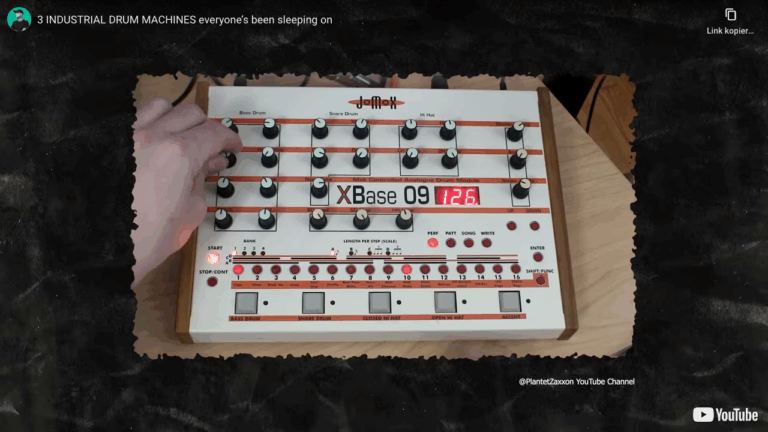 Tonepusher’s Industrial Wake-Up Call
 Moog Music’s Spectravox: A Filter Bank Voice with a Patchable Twist
 Moog Music Spectravox: Vintage Drum Machine Alchemy in a Modern Filterbank
 Moog Music Spectravox: Beyond Vocals—Vocoder Alchemy with Drum Machines
 Moog Music’s Spectravox: Analogue Vocoding with a Modular Edge
Watch on YouTube:
Latest articles
Watch on YouTube:
Visit the channel:
https://www.youtube.com/MoogSynthesizers
https://www.youtube.com/MoogSynthesizers
Links from MoogSynthesizers:
website: https://moogmusic.com
instagram: https://instagram.com/moogsynthesizers
facebook: https://www.facebook.com/moogmusicinc
twitter: https://twitter.com/moogmusicinc
Sponsored links:
If you purchase via these links, we may earn a small commission – at no extra cost to you. The link opens an Amazon keyword search, and results may vary depending on availability.
Moog Spectravox
🔗 Check price on Amazon
🔗 Check price on Amazon
Roland TR-606
🔗 Check price on Amazon
🔗 Check price on Amazon