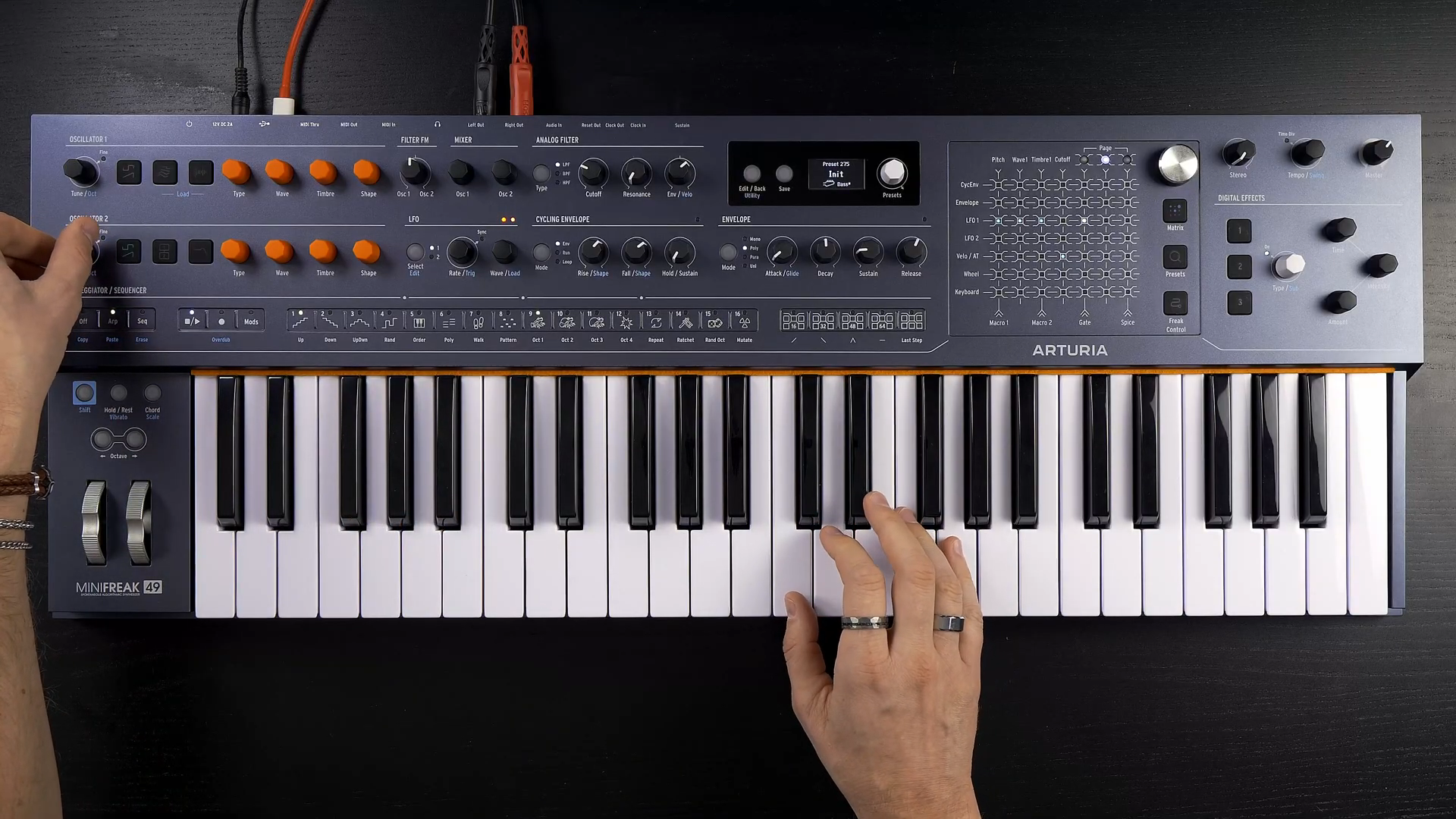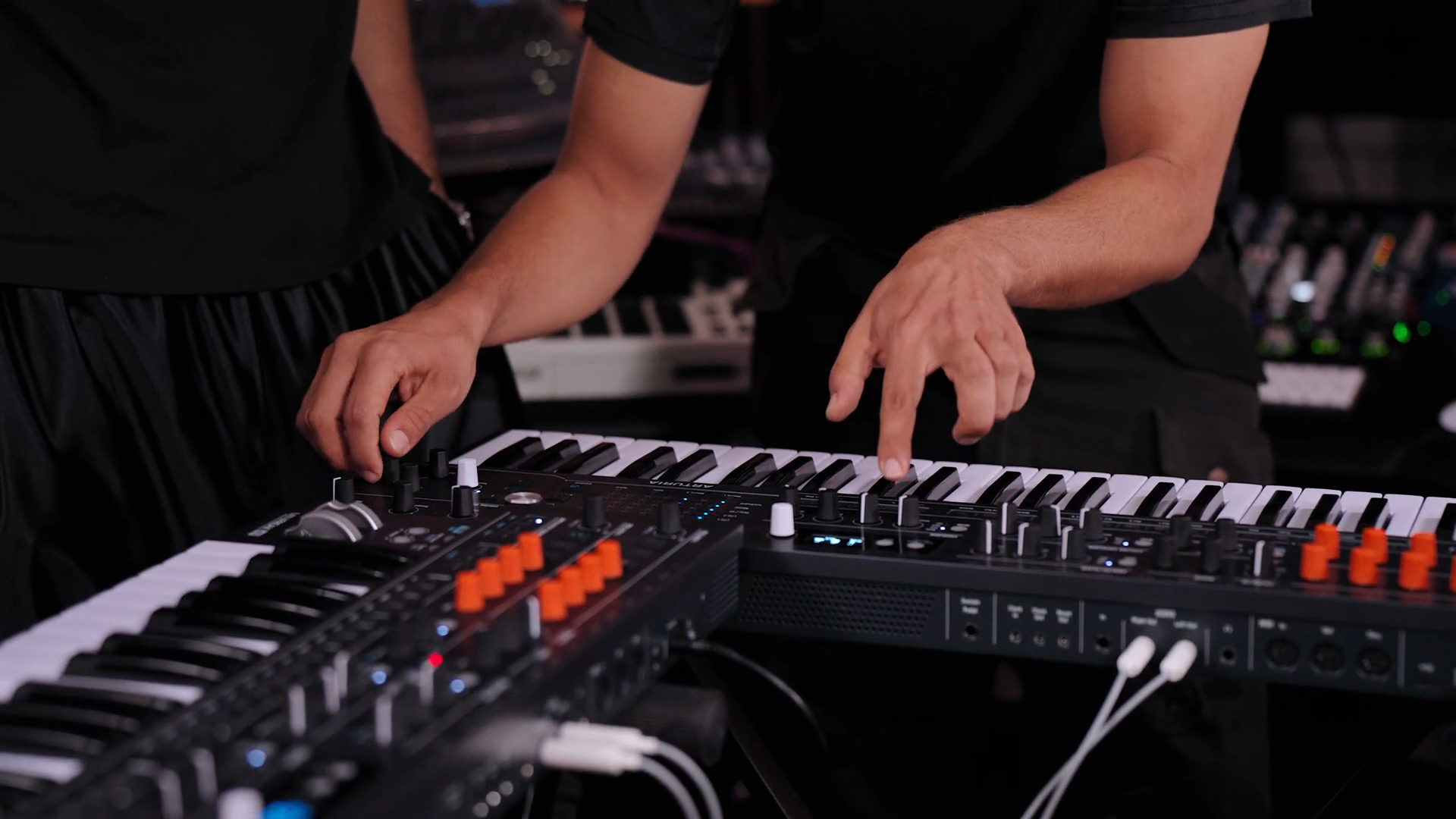
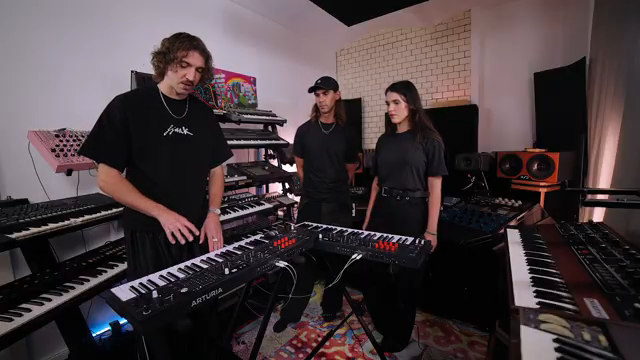
An arpeggio doesn't have to get new notes all the time to change. FJAAK and Elli Acula demonstrate this in Arturia's video "A shared aesthetic with MiniFreak 49," published on November 23, 2026. For their session, they work with two MiniFreak 49s on a complete track; preamps and software are also part of the setup. The manufacturer portrait is not an independent device review. What is interesting is how the participants create musical movement from minimal note material.
Few Notes, Lots of Movement
© Screenshot: Arturia (YouTube)
“- It's two notes. And with the spice, it's adding these randomizations.”
© Quote: Arturia (YouTube)
The concrete demonstration begins with a found sound in arpeggiator mode, which is altered using macros. The second macro here bundles cutoff, decay, release, and spice. One intervention thus changes several properties of the sound at once. The group also demonstrates triple tapping to re-roll the random variation. With additional LFOs, the participants describe the result as organic. The note sequence remains sparse; the variety comes from sound progression and variation.
That such movements do not all have to be operated individually was already shown by Matt Pike in Arturia's MiniFreak Matrix tutorial from 2022. There, he demonstrates macros with four assignments each. His useful trick: the macro itself can also be used as a modulation target. A single matrix routing can thus move up to four parameters. Musically speaking, this means shaping a joint movement instead of organizing four knob rides independently.
Arturia MiniFreak – Price & availability
Check price & availability on Amazon →
Advertising – affiliate link. If you buy through this link, we may earn a commission – at no extra cost to you.
A Nice Sound Is Not Yet a Track
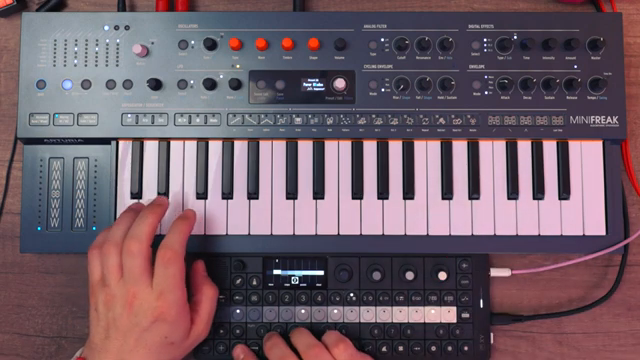
The Midlife Synthesist applies a refreshingly practical standard in his video on MiniFreak firmware 3.0, published December 18, 2024. With the patch Plastic Pluck, he first increases the release time. But he doesn't stop at the isolated sound: he has prepared a jam so that the texture can be judged in a musical context. According to his own statement, he was not paid for the video but did receive the firmware in advance from Arturia.
With the percussive patch Paper Blades, he also makes concrete decisions: one octave lower, more release so that more of the loop comes through, then back into the jam. This is the more exciting question than the mere number of available synthesis methods: what role does the texture get in the piece?
© Screenshot: The Midlife Synthesist (YouTube)
“I kind of find that when you just demo sounds in isolation, yeah you get an idea of what it can do but you don't really get a musical idea of what it can do.”
© Quote: The Midlife Synthesist (YouTube)
Different Source Material, Different Tasks
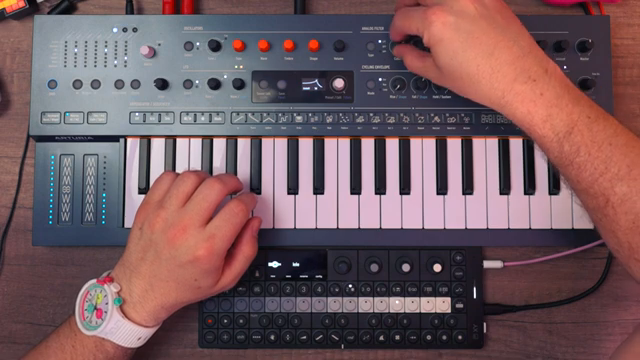
© Screenshot: The Midlife Synthesist (YouTube)
“These things make for some very very cool sound effects and percussive effects as well.”
© Quote: The Midlife Synthesist (YouTube)
In the current FJAAK and Elli Acula feature, loading your own samples is also mentioned, as is importing your own wavetables. The conversation does not provide a complete import guide. For your own production, however, this still offers an interesting approach: not just varying an existing preset, but already swapping out the source material—and then deciding what kind of movement suits this material musically.
With the Midlife Synthesist, you can follow the further processing on selected samples, though not on a documented self-import. In sample mode, he changes start point, length, and loop point and demonstrates reverse playback. With Cloud Grains, he points out LFO modulation and makes a corresponding assignment. After another sample change, he explicitly highlights percussive applications as well. So granular doesn't have to automatically end up as a floating pad.
The Dancefloor Doesn't Know the Patch
FJAAK and Elli Acula certainly do not see their session as endless sound tweaking. They describe a track with more powerful and more stripped-down chapters. Later, they show the connection with the plug-in and the recording of filter sweeps and other control movements. The spontaneous intervention is meant to become a shaped progression. Randomness provides variety; when it is needed in the arrangement remains a musical decision.
For the group, finishing also means trying out their own tracks in the club. This is discussed as a working method—not as a dancefloor test that this particular track has already passed.

© Screenshot: Arturia (YouTube)
“- It's good to test it in a club, actually, that helps you.”
© Quote: Arturia (YouTube)
The best kind of randomness is not necessarily the most spectacular. It's the one you want to keep in the track. Two notes can be enough for that. Whether it becomes tension, groove, or just busyness is not decided by the dice, but by listening.
Arturia MiniFreak – View product
Check price & availability on Amazon →
Advertising – affiliate link. If you buy through this link, we may earn a commission – at no extra cost to you.
Videos for this article
All other articles featuring the Arturia MiniFreak
 MiniFreak: The Groove Is in the Filter Too
 ADSR Mysteries Unwrapped: The Unperson Goes Full Pharaoh
 Loop Liberation: The Unperson vs. The Eternal 8-Bar Trap
 Vulture Culture Throws Down: Can You Really Not Hear the Difference in a Mix?
 Venus Theory’s OS Cage Match: Mac Neo vs Raspberry Pi 5 for Music Production
 Nu-Trix The Synth Guy Unleashes the Syntakt TwinShot: Double-Barrel Sample Mayhem
 Devin Belanger’s Synth Starter Pack: Forget the Specs, Find Your Groove
 AudioPilz Dishes the Dirt: What Your Synth REALLY Says About You
 Sampler Showdown 2026: Nu-Trix The Synth Guy Keeps It Real
 AudioPilz’s BAD GEAR Shopping Guide: Synths for Every Wallet and Weirdo
 The Unperson’s Arpeggiator Rumble: From Cheesy Triton to Mutant MiniFreak
 David Hilowitz Music’s Budget Synth Showdown: Analog Dreams for the Broke and the Brave
 Sineway’s AstroLab 37 Review: The Everything Synth or Just Everything at Once?
 Tonepusher Turns the MiniFreak into Sonic Anarchy
 sinewaymusic’s Jam Setup: The Groove Formula
 LiamKillen’s Gear Purge: Saying Bye to Old Friends
 Unleashing the MiniFreak Vocoder with AndertonsKeyboardDept
 Arturia MiniFreak Firmware 4.0: Vocoder Edition Unleashed
 sinewaymusic’s MiniFreak Revolution: Synths Made Simple
 Captain Pikant and the Radiohead Rhythm Rumble
 Devin’s Love Letter to the Arturia Minifreak
 Arturia MiniFreak 3.0: Granular Power Unleashed
All YouTube videos featuring the Arturia MiniFreak
Primary – main topic (186)
 FJAAK & Elli Acula | A shared aesthetic with MiniFreak 49
 Arturia Minifreak V5 - Sample Engines - 5 minutes With
 MiniFreak Sound Design: 12 Tricks I Use All the Time
 Neue Synths: Zu teuer für so wenig Neues? Roland Jupiter-08 & n/vision + Arturia MiniFreak 49 😠😍
 AstroLab 2.0: It's a Proper Synth Now?
 Arturia Minifreak 5.0 User Sample Patches (NO TALKING)
 User Samples Elevate the Arturia Minifreak to S Tier
 Kaitlyn Aurelia Smith: The shape of what remains with Rev OCEAN, MiniFreak and KeyStep
Show all (178 more)
 Arturia MiniFreak - Big Firmware Update 5.0!
 MINIFREAK V5 Update
 ENDLICH eigene Samples im Arturia MiniFreak! + Elektron & Korg | Synth News
 The Ancient Egyptians Invented ADSR Envelopes.
 The Arturia MiniFreak is Incredible!
 MiniFreak Neo Retro Patch Bank by Espen Kraft | Download NOW
 Recording External Synthesizers Into MPC SAMPLE Is EASY!
 Best Affordable Synthesizers? - Jack's Top Picks!
 Best Synths To Buy in 2026: Comprehensive Guide & Sound Demos
 If I started synthesizers in 2026 this is what I'd do
 The BAD GEAR Shopping Guide
 A Guide to Synthesizer Arpeggiators (and how to use them to make music)
 How to Make Synth Presets! (feat. Arturia MiniFreak)
 I turned the MINIFREAK into an INDUSTRIAL MACHINE
 Arturia Minifreak Vocoder Edition - Add Vocal Flavour To Your Synth!
 Vocoder Vibe Check: Arturia Minifreak
 Tutorials | MiniFreak - Firmware Update 4.0 | Vocoder Edition
 New Vocoder for Minifreak -Thanks @ArturiaOfficial
 NEW VOCODER! Fun, Silliness And Overview of MiniFreak's New Feature
 ARTURIA MINIFREAK 4.0 VOCODER: First Look & Walkthrough!
 Meet the Freakcoder, A vocoder built for Psytrance | MiniFreak V4
 Best Synthesizers Under $1000* (May 2025)
 Arturia Minifreak: Atmo Noisy Techno & Ambient Presets Demo
 Why the MiniFreak Is Changing the Synth Game — 2025 Review
 Why I Love The Arturia Minifreak
 What can it do? | MiniFreak V 3.0 | Thomann
 The Minifreak is the BEST Synth for Sampling on the Roland SP-404!!
 ASM Hydrasynth Explorer vs Arturia MiniFreak! Which is best for you?
 The Perfect Combo? // Beatmaking with the Arturia MiniFreak and the Roland SP-404
 Exploring MICROFREAK MINIFREAK Oscillators
 Arturia MiniFreak - Preset Pack!
 Made a grimy beat with MiniFreak 3.0 and MPC3 Beta
 Arturia Minifreak 3.0 Granular Presets. No Talk Sound Demo
 What's New? | MiniFreak FW 3.0
 The MiniFreak has Samples Now
 New Firmware Update! 3.0 Brings Granular to MiniFreak // Arturia
 Arturia MiniFreak 3.0 Granular Update Sound Demo (Factory Presets)
 Arturia MiniFreak Now With Granular - Testing The New Firmware 3.0 Engines
 ARTURIA MINIFREAK - FIRMWARE 3.0!
 Every MiniFreak Granular Mode Explored
 MiniFreak update 3.0 - new Granular engines explained
 8 MORE Reasons to LOVE the Minifreak // Version 3 Update
 Rambling About: Arturia Minifreak with tafony
 Setting up USB MIDI for the MiniFreak in @Ableton Live ( or any synth)
 The Arturia MINIFREAK OSCILLATORS complete deep dive guide tutorial
 Synth / DAWLESS gear i'm SELLING + reasons why / Too much overlap
 The Arturia MINIFREAK SEQUENCER complete deep dive guide tutorial
 Arturia MIFREAK & MINIFREAK V - 100 Presets / Patches
 The Arturia MINIFREAK complete deep dive guide tutorial
 Nu-Trix #studiotour - How to choose what to add next?
 'Centaur' Ambient with Wavestate, Iridium, Prophet 10 & Minifreak
 Arturia Minifreak 50 New Presets by Espen Kraft | Download now!
 Arturia MiniFreak "Vintage Keys Deluxe" Sound Bank
 Arturia MiniFreak - Retro styled presets
 Molten Music Monthly December 2023 / New Year
 Arturia Minifreak Firmware 2 Presets: Lead, Pad, Bass, Arp
 Arturia Minifreak V2!
 Vitalic | Defying genre-boundaries with MiniFreak
 Exploring my New Minifreak Patch Pack: Deserted Lands
 What's New? | MiniFreak - Firmware 2.0
 Walrus Audio SLÖER Stereo Ambient Reverb With Arturia MiniFreak 2.0 (Wavetable Update)
 Minifreak Firmware 2.0 - Wavetables, Super Unison and More!
 MiniFreak FW 2.0 wavetable, super unison & +
 MiniFreak V2 // Wavetables, Superunison. and other delights!
 Arturia MiniFreak V2.0 - Can it Psytrance?
 The Noise Floor - Does it Matter?
 43- The Arturia MiniFreak- Touch Strips (Left-Hand Controller)
 5 Pedals for Synthesizing Soundscapes | Keyboards & Synthesizers
 42- The Arturia MiniFreak- The terrifying truth about polyphony, paraphony, and the MiniFreak!
 How to Record Your Synth
 41-The Arturia MiniFreak- Delay Sub Types
 40- The Arturia MiniFreak- Reverb Sub-types!
 39- The Arturia MiniFreak- Effects- Delay
 38- The Arturia MiniFreak- Effects- Reverb
 Bad Gear - Arturia MiniFreak
 33- Arturia MiniFreak- Effects: Distortion
 Arturia Minifreak: Free Cinematic SFX Presets. Sound Demo
 35- The Arturia MiniFreak- Effects: 3-band EQ
 Arturia MiniFreak - Sound Explorations
 37- The Arturia MiniFreak- Effects: Multicompressor
 36- The Arturia MiniFreak- Effects: Peak EQ
 34- The Arturia MiniFreak- Effects: Bitcrusher
 32 - The Arturia MiniFreak- WHOOPS... Stereo FX examples
 31-The Arturia MiniFreak- Effects: Flanger
 30- The Arturia MiniFreak- Effects: Phaser
 29- The Arturia MiniFreak- Effects- Chorus
 Arturia Minifreak: Free Experimental Presets. Sound Demo
 28 MiniFreak LFO Waves and Wave Shaper
 Why Does the Arturia Minifreak Sound So Good? (Sound Demo, No Talking)
 27- The Arturia MiniFreak- LFOs
 26 - The Arturia MiniFreak- The Matrix
 19- The Arturia MiniFreak- Oscillators: Surgeon Filter
 24- The Arturia MiniFreak- Cycling Envelope
 Arturia Minifreak: 64 Lead Monophonic Presets. Sound Demo
 23- The Arturia MiniFreak- Analog Filter
 Best Synthesizers for Beginners 2023 – Daniel Fisher
 4 Years Later... MicroFreak 2023 Review // Plus Versus MiniFreak
 22- The Arturia MiniFreak- Oscillator types: Destroy
 21- The Arturia MiniFreak- Oscillators: Phasing Filter
 20- The Arturia MiniFreak- Oscillators: Comb Filter
 18- The Arturia MiniFreak- Oscillators: Multifilter
 17- The Arturia MiniFreak- Oscillators: FMRM
 16- The Arturia MiniFreak- Oscillators: Chords
 Arturia MiniFreak: How to Sing the Ancient Songs of the Krell
 15- The Arturia MiniFreak- Oscillators: Audio In
 Arturia Minifreak: 64 Bass Presets. Sound Demo. No Talking
 Arturia MiniFreak Sonic Deep Dive – Daniel Fisher
 14- The Arturia MiniFreak- Oscillators: Harm
 13- The Arturia MiniFreak- Oscillators: SawX
 MiniFreak vs. Hydrasynth Explorer: Which Synth is Better for You?
 12- The Arturia MiniFreak- Oscillators: Bass
 11-The Arturia MiniFreak- Oscillators: Noise
 10- The Arturia MiniFreak- Oscillators: Modal
 Create Next-Level BEATS with Drumlogue and MiniFreak - Here's How!
 09- The Arturia MiniFreak- Speech
 Patch Battle Feat. Dan Bingham - Arturia Minifreak vs ASM Hydrasynth Explorer
 MiniFreak Tutorial // Sound Design Beginners Guide (Patch From Init)
 Arturia Minifreak: 64 Patterns/Sequences+Presets. Sound Demo
 Your First Synthesizer Purchase // 6 Reasons MiniFreak IS IT
 08- The Arturia MiniFreak- Formant
 07- The Arturia MiniFreak- Two Operator FM Oscillator
 06- The Arturia MiniFreak- Oscillators: Waveshaper
 Arturia MiniFreak Unleashed! - So Much Better With Osmose and Midi Polyphonic Expression(MPE)!
 05- The Arturia MiniFreak-Oscillators: Vanalog
 Arturia MiniFreak Demo: Possibly the best new synth money can buy right now.
 04- The Arturia MiniFreak- Oscillators- Karplus Strong
 I'm a Minifreak and So Can You
 Arturia Minifreak 64 Presets: Keys, Synths, Brasses, Plucks
 03- The Arturia MiniFreak- Oscillators- Harmo
 Mood jam w/ Oxi One, MiniFreak, MicroMonsta 2, Model D, Tetra, Polymoon, Echosystem, and eurorack
 02 The Arturia MiniFreak- Oscillators- Superwave
 Synthesis 101- How to use any modulation matrix (using the Minifreak)
 01-The Arturia MiniFreak- Oscillators- Basic Waves
 Arturia Minifreak: My favorite synthesizer (Microfreak) gets an upgrade
 #Jamuary2023 - Day 27 - Arturia Minifreak
 MiniFreak Ain't Bad! My 5 Minute Review // 7 Patches I Made While Learning The Minifreak
 #arturia MiniFreak V hidden features - quick tips
 Arturia Minifreak Patches With 88 Keys!
 How to | MiniFreak / MiniFreak V - Using Macros
 How to | MiniFreak / MiniFreak V - Cinematic Patches
 #Jamuary2023 - Day 17 - Arturia Minifreak
 How to | MiniFreak / MiniFreak V - External Processing
 How to | MiniFreak / MiniFreak V - Custom LFOs
 How to | MiniFreak / MiniFreak V - Performative Arpeggios
 MiniFreak complete guide to synth and poly FX engines
 Arturia MINIFREAK - 3 Reasons why this is my favorite synth!
 #microfreak VS MiniFreak - more than 2 MicroFreaks combined!
 The Arturia MiniFreak Has a Synth Superpower Hiding in Plain Sight!
 Synth jam with Arturia MiniFreak, Dreadbox Erebus, eurorack drums, and Reason 12 synths
 Arturia Minifreak: 64 Arp Presets. Sound Demo. No Talking
 Arturia MiniFreak - Vintage Keys Sound Bank - FREE Download
 Arturia Minifreak meets MS-20 Filter. Sound and Presets Demo
 Hypnotic jam with Arturia MiniFreak, Dreadbox Erebus, Mystic Circuits IDUM, and other eurorack drums
 Arturia Minifreak: 64 Ambient Atmospheric Pad Presets. Demo
 BEST SYNTHS & MUSIC PRODUCTION GEAR 2022
 Is the Arturia MiniFreak Good for Classic Style Synth Sounds?
 Classic Style Synth Sounds on the Arturia MiniFreak (NO TALKING)
 Tutorials | MiniFreak - Modulation Matrix
 Tutorials | MiniFreak - Sound Utilities & Tutorials
 Tutorials | MiniFreak - Oscillators & Filters
 Tutorials | MiniFreak - Effects
 Friday Jam - Minifreak and Suzuki Waraku
 Hottest Gifts for Synth Players in 2022 – Daniel Fisher
 Arturia MiniFreak - SonicLAB Review
 MiniFreak Quickstart // How to Program and Edit Tones
 SynthPlex 2022: Arturia MiniFreak -Sounds Only
 Arturia Minifreak // The Evolution of DIGITAL/ANALOG Hybrid Synths
 Why is this thing so unreasonably good?
 MiniFreak meets Moogerfooger VST effect plugins
 Arturia MiniFreak Synth | Sounds-only Freak-out – Daniel Fisher
 Livestream | _Arturia Rendez-vous
 Arturia MiniFreak - First Look - Sonic LAB
 Arturia MiniFreak - Let's take a look and have a jam session!
 NEW Arturia Minifreak! - First Impressions!
 Tutorials | MiniFreak - Overview
 Arturia MiniFreak - Feature Overview and 3 Patches from Scratch!
 ARTURIA MINIFREAK: New 6-Voice Polyphonic Hybrid SYNTH - First Look
 Arturia MiniFreak Synthesizer Unboxing & Sound Demo - The Freak Enters The Polyphonic Hybrid Realm
Substantial coverage (44)
 Arturia MiniFreak 49 Review: Still a Game Changer?
 Meditative Ambient liveset – Home Concert 85 (Osmose, OB-6, Moog, Waldorf Microwave, Minifreak)
 Arturia at Superbooth 2026!
 The Only Synths I Would Buy at ANY Budget (2026)
 You Can't Hear The Difference In A Mix Is Bullsh*t
 The Musician's Guide to Leaving Windows
 #syntakt new Twinshot machine - deep dive &how to prepare samples for it
 What your SYNTH says about YOU
Show all (36 more)
 Keystep MKII as a master sequencer
 Best Beginner Analog Synth on a Budget? | Complete Buying Guide 2025
 Arturia AstroLab 37 Review – After 6 Weeks of Real Use
 Bitwig Made Hardware?! Arturia Mix Drums, FREE Plugin + More
 Easily Controlling A Wicked Setup With My Favorite Sequencers
 Ableton Move to Full Song (Part Two)
 GREAT BEGINNER SYNTHS — a guide to picking your first synthesizer! (UPDATED for 2025!)
 Roland W-30 Sequencer
 Best Synth To Buy in 2025: Comprehensive Guide & Sound Demos
 A beat makers basement! - 2024 full studio tour
 Studio Tour November 2024
 FINALLY trying MicroKORG 2 // Did Korg just make the PERFECT beginner friendly synthesizer?!
 ALABS Audio Cetus Review With Synths (MiniFreak/Muse) - This $99 Stereo Reverb Pedal Is AWESOME
 Best Synthesizers 2024 (September)
 NEW Arturia Keylab Mk3!!! 5 Coolest Features in Under 9 minutes
 If I Started Electronic Music in 2024, I’d Buy These Synthesizers
 Making Mono Synths Polyphonic with the K.O. II
 Clair de Lune - Breakdown
 Using your MPC as a digital mixer // Hybrid Setups
 BEST SYNTH TO BUY IN 2024
 Arturia V Collection X Unveiled: A First Look Into The Next Chapter.
 Arturia V Collection X: What's New?
 Getting all the details on @ArturiaOfficial V Collection X
 @Nu-trix Studio update. Which synths and groovebox did I let go?
 Osmose // The 7 Stages of Ownership
 Arturia Keylab Essentials Mk3 - Money Well Spent
 Nintendo is going to take this video down
 GREAT BEGINNER SYNTHS – a guide to picking your first synthesizer
 Beetronics Seabee
 The iPad as a multi-In/out effect processor using the @TASCAMUSA Model 16
 Rhodes 8 is now a PLUGIN! You can have MiniFreak V now - Native Instruments, KSHMR, and more!
 Nu-Trix news Jan23-future of this YTC, Roland’s concept piano + SAGA synth
 BEST SYNTH TO BUY IN 2023
 I Can't Go For That - Deconstructed
 Our Favourite Synths of 2022 Under £600!
 FREE DRUM FX, ARTURIA 😯 Antelope Zen Go, and more!
Mentioned (24)
 This $60 Synth Started the Hardware Vibe Coding Revolution!?
 How to Turn Loops Into Finished Tracks
 Rambling About: Mutable Instruments Plaits with tafony
 5 Reasons To Love KORG MINILOGUE XD
 Arturia Astrolab 37 - The Power of Analog Lab Fits in a Backpack?
 Digitone 2 + Launch Control XL 3: One System for EVERY Jam
 I claimed i'd never sell this gear...but I did // Here's why
 Redshift 6 First Impressions: THIS COULD BE BIG!
Show all (16 more)
 Oxi One MK2: FASTEST ROAD From INSPIRATION To MUSIC
 Analyzing RADIOHEAD's Rhythms - A Deep Dive into their Electronic Beats
 Speak & Glitch GND 1T // a charming synth that puts the “mental” in experimental music // Review
 microKORG 2 Production Model Review // How it competes with today’s synths // Tutorial
 SSL's NEW interface - The Next GOD Particle - FREE Autotune
 Interview with Frédéric Brun, Arturia Owner & Cofounder | Plugged In Podcast #08
 Astro Lab First Look
 Arturia Astrolab Review- 25 Years Of Synths In One Instrument
 Akai MPC Key 37 First Beat With Hardware Synths
 Arturia's NEW Piano, Free BitFlip Plugin, Free Sample Pack Creator
 Studio redesign for dawless jam and CV GATE mahem!
 My thoughts on the Akai APC64 for Ableton Live
 Arturia AudioFuse 16Rig First Look, Versus AudioFuse 8PRE And A Jam With Synthesizers
 Why the AudioFuse 16 Rig is the Must-Have Audio Interface For Synth Users
 Roland SH-4d - Brutally honest thoughts on a fun synth
 How to | Rev LX-24 - Infinite detuned reverb