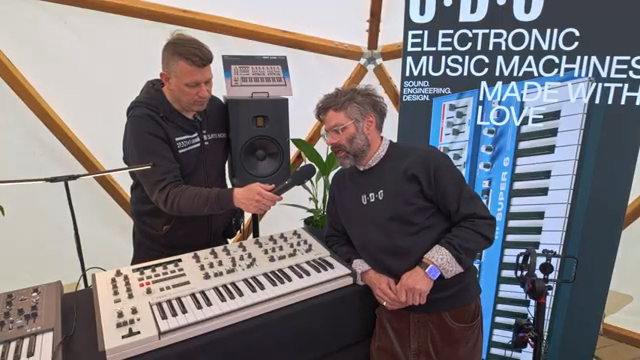
UDO Audio enters the stage with the DMNO, a hybrid synthesizer that refuses to fit neatly into classic poly or mono synth categories. SequencerTalk – known for their nerdy, analytical conversation style – put the DMNO through its paces at Superbooth 2026, exploring the boundaries between duality, chaos, and sonic architecture. Two independent engines, eight play modes, and a filter concept that delivers far more than just bread-and-butter: here, patch geometry becomes an experience. If you want to know how machine ethics and soundspaces intertwine in the DMNO, don’t miss this talk – some details can only be heard, not described.
18. May 2026
RAUMKLANG
UDO Audio DMNO: Two Minds, One Soundspace – SequencerTalk at Superbooth
Duality as Principle: Two Engines, One Body
The UDO Audio DMNO enters the field not as a mere successor to familiar UDO synths, but as an independent concept with two autonomous 4-voice engines. Each engine has its own control panel, signal path, and sonic character—a design that fuses classic polyphony with modular flexibility. The number of voices per module remains constant: four voices in standard mode, two in binaural operation.
This duality not only opens up new patch geometries but also compels us to see the DMNO less as a traditional polysynth and more as an instrument with two dialogical sound sides. The interaction between the two engines is the heart of the matter: layering, splitting, or complex routings—everything is possible. For workflow fetishists, this may seem unwieldy, but chaos aesthetes will find themselves right at home in this machine ethic.
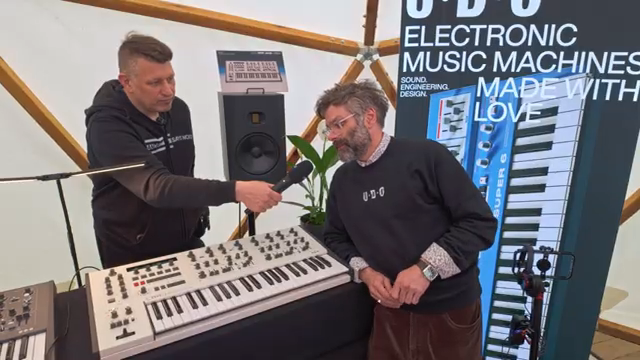
"It’s not really a monosynth, but it’s also not really designed as a polysynth—it stands somewhere in between."
("Es ist nicht wirklich ein Monosynth, aber auch nicht unbedingt als Polysynth konzipiert, sondern steht irgendwo dazwischen.")© Screenshot/Quote: Sequencertalk (YouTube)
Eight Play Modes: From Order to Chaos
"And there are random modes where you can set the probability with which the modules are triggered."
("Und es gibt Zufallsmodi, da kann man die Wahrscheinlichkeit bestimmen, mit denen die Module getriggert werden.")© Screenshot/Quote: Sequencertalk (YouTube)
With its eight play modes, the DMNO leaves the realm of the expected behind. Alongside classic modes like Single, Dual, and Split, there are experimental variants such as One-Two, Cycle, Random, Chaos, and Series. Here, it’s not just about layering or splitting—voices, timbres, and note behaviors are shifted and re-routed against each other.
Especially the random and cascade modes show that UDO sees sonic architecture as a playground. The ability to trigger modules in a ping-pong manner or define probabilities for engine triggering opens doors to unpredictable results. Those who embrace this patch geometry will discover a synth that goes far beyond bread-and-butter pads.
Filter Architecture: Multi-Core, Multi-Mode, Multi-Sense
The Dynamic Multi-Core Stereo VCF is more than just another filter in the polysynth cosmos. It offers a selection of curated filter models—from allpass to highpass, lowpass, bandpass, and even phase-shifter approaches. The filters can be routed in stereo, parallel, or series, enabling a wide range of sonic experiments.
Things get especially interesting with the Delta Cutoff function, which introduces a difference between the two filter peaks. This allows for formant-like sounds or complex stereo effects. The filter resonance compensation ensures that boosting the resonance doesn’t automatically cut the lows—a detail that opens up new soundspaces in practice. To experience the full complexity, you should watch the video—some patch geometries can only be heard.
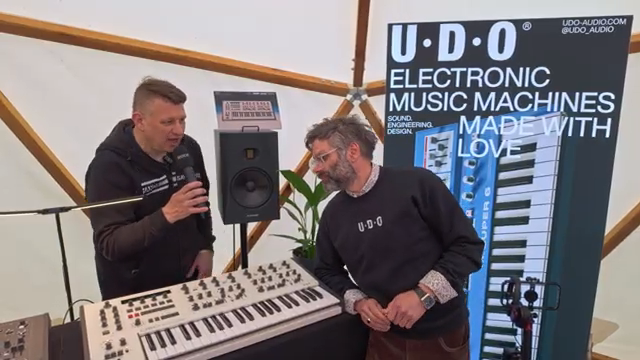
"Allpass and phase—phase we already know from the Xpander and Matrix 12, which are already quite rare."
("Allpass und Phase, Phase kennen wir ja schon von den Xpander und Matrix 12, sowieso schon eher selten.")© Screenshot/Quote: Sequencertalk (YouTube)
Binaural Mode: Spatial Sound with Two Souls
In binaural mode, the DMNO becomes a 4-voice instrument with an especially wide stereo image. Each side receives its own modulations and tunings, resulting in an extraordinary sense of space. The result: the sound folds like origami from tension and noise into the room.
Especially when combined with flexible filter routings and the Delta Cutoff function, this creates soundspaces that are hard to achieve with classic polysynths. To feel the full effect, you should check out the sound examples in the video—some aspects of machine ethics can only be hinted at in text.
SequencerTalk’s Verdict: More Than Just Another UDO
Moogulator and Dean analyze the DMNO as a creative dual-synth system that deliberately sets itself apart from previous UDO models. The combination of two independent engines, eight play modes, and a sophisticated filter architecture makes the DMNO an instrument for sound explorers and patch architects. Those with patience and an ear for the unpredictable will find a tool here that breaks classic categories and opens new spaces for musical experiments.
Translated from German. Read the original here: https://synthmagazin.at/udo-audio-dmno-zwei-koepfe-ein-klangraum-sequencertalk-auf-der-superbooth/
Watch on YouTube:
Latest articles
Watch on YouTube:
Visit the channel:
https://www.youtube.com/SequencerTalk
https://www.youtube.com/SequencerTalk
Links from SequencerTalk:
SequencerTalk Supporte uns!: https://sequencertalk.synthesizers.de
Instagram: https://instagram.com/sequencertalk
Links Moogulator: https://linktr.ee/moogulator
Links Dean: https://linktr.ee/deanfreud
Impressum: https://moogulator.com/moogulator/about
Sponsored links:
If you purchase via these links, we may earn a small commission – at no extra cost to you. The link opens an Amazon keyword search, and results may vary depending on availability.
UDO Audio DMNO
🔗 Check price on Amazon
🔗 Check price on Amazon