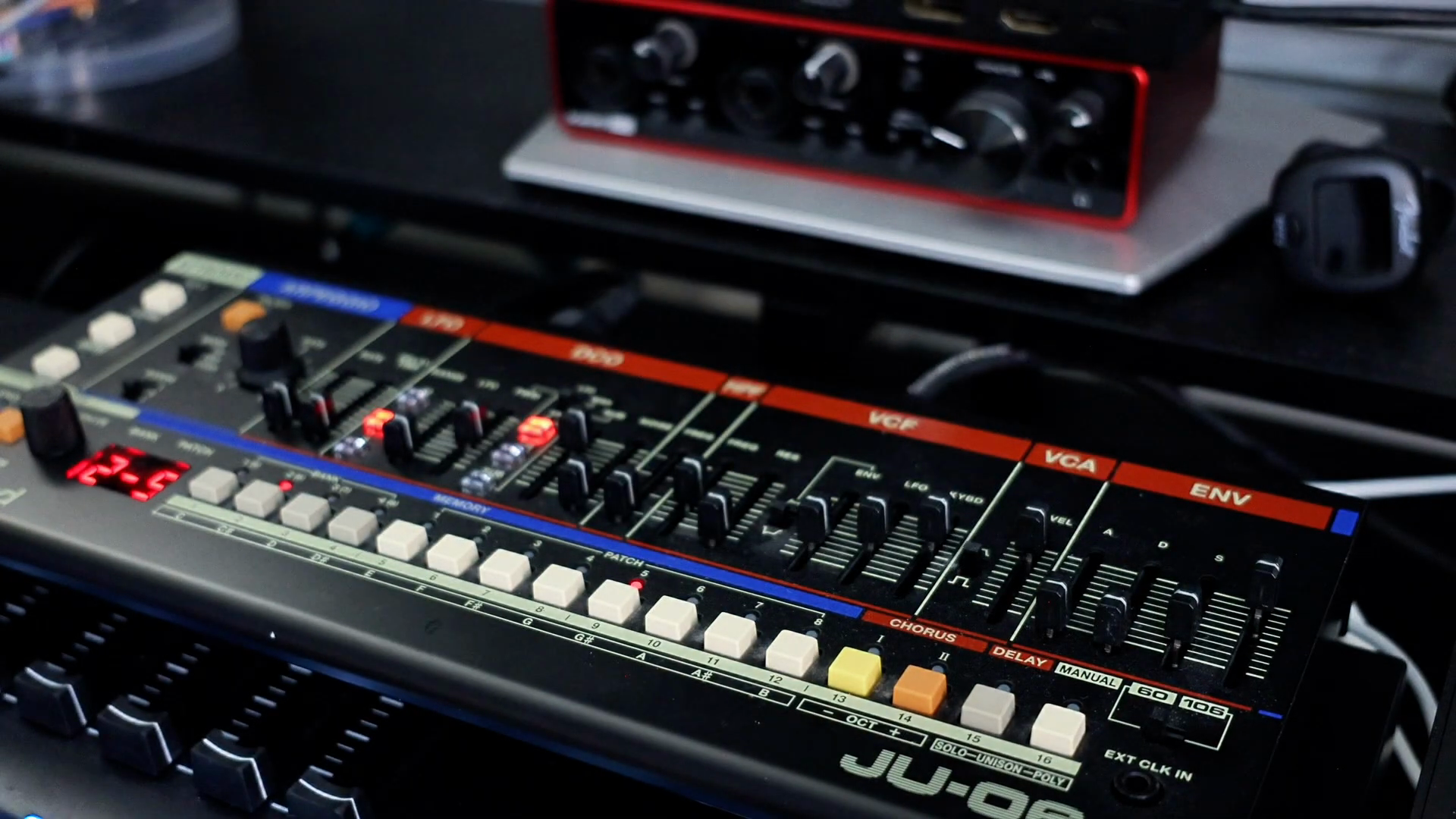
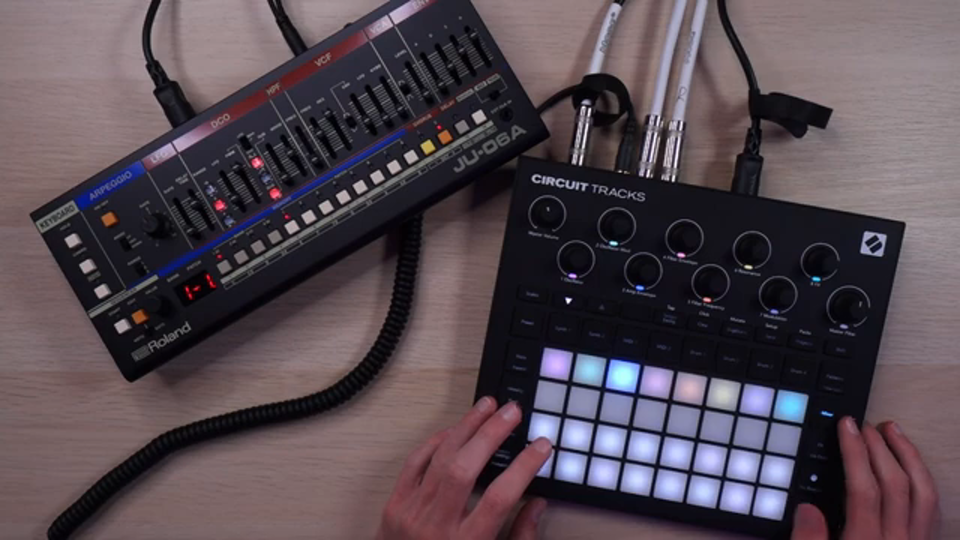
The Roland JU-06A is a compact synthesizer in Roland’s Boutique series. The creator comments collected here cover envelope shaping and external clocking, as well as four-voice polyphony and the look of the control panel.
A longer release is more than a softer ending: Defmod Network shapes it with the envelope, then uses it as a starting point for modulation.
Defmod Network
„now i want to add some sort of like a tail sound to it like when i press it it kind of sustains a little bit because that kind of sustain uh you can modulate that and could create something really interesting so you do that by uh tweaking the envelope“
Roland JU-06A: Filter sweeps with boundaries you can feel
Quadra controls the JU-06A with a motorised knob. Its MIDI profile connects 33 parameters to fine adjustments, tactile switch positions and haptic end stops.
+
A slowly opening filter can carry an entire passage. Quadra offers another way to reach into the Roland JU-06A: Kafi Devices’ external controller concentrates control on a motorised knob whose resistance adapts to the selected parameter. Slow turns produce fine steps, faster movements make larger jumps, switches gain tactile positions, and parameter ranges end against a physical-feeling stop.
The JU-06A profile covers 33 parameters. One possible performance approach is to select filter frequency, then move to the envelope, while two buttons step through programs. The display names the parameter and shows its value, with the LED ring following the movement. The companion app also lets users customise the synth profile.
The MIDI extension is implemented in code and sends simultaneously through USB and the controller’s TRS sockets. Quadra runs on additional Ratchet/NanoD++ hardware. Its musical attraction is a freely positioned, tactile control surface for focused interventions on the compact Boutique synthesizer.
Compatibility and limitations
Explicit JU-06A profile; additional Ratchet/NanoD++ controller hardware required. USB MIDI needs a computer to relay messages to the synth; the TRS MIDI sockets provide another route. Companion app for macOS.
Unknown parameter values start at the midpoint on the first turn, potentially causing jumps. According to the project, Roland does not fully document switch boundaries; Quadra uses distributed values. Firmware and companion should match. The project licence restricts commercial use.
Roland JU-06A: A MIDI map for making your own music tools
PyMidiInstrumentDefs exposes the JU-06A’s MIDI properties to Python. Its useful distinction: separate controller maps for sound-module operation and Control Surface Mode.
+
Building a personal music tool around the Roland JU-06A begins with translating its MIDI language. PyMidiInstrumentDefs supplies a machine-readable foundation drawn from manufacturer documentation. Split out from PyMidiDefs, the library combines instrument definitions with a Python loader and validation.
The JU-06A’s particular twist is its operating mode: sound-module operation and Control Surface Mode use different controller maps. The library separates 39 sound-module entries from 24 control-surface entries that only transmit. A homemade script could build on this to label incoming panel movements correctly or prepare a custom automation interface. Choosing the MIDI port and the channel actually used remains the application’s responsibility.
A concrete correction now also records note-on velocity as both transmitted and received during sound-module operation. That makes the data more accurate for applications distinguishing the two directions. The benefit is fewer manually maintained number tables and a traceable starting point for musical programming experiments.
Compatibility and limitations
Explicitly includes roland/ju_06a. Requires Python 3.10 or later, PyMidiDefs and PyYAML. A data library with loader and validator; applications must provide MIDI connectivity and message transmission.
Data derived from manufacturer documents does not establish hardware testing. The definition does not identify device firmware. Some switch values and channel behaviour in Control Surface Mode remain unresolved. The velocity correction concerns sound-module operation.
Gabe Miller calls the four-voice limit a significant restriction. For this patch, however, the ringing notes make it less noticeable to him; he adds some reverb and ping-pong delay.
„And in this case, this patch doesn't really seem to mind that we are only limited to four voice polyphony. Obviously, it's a huge bummer of a limitation in this thing. In this case, these notes ring out in a way that sounds fine to my ears, and I can add a bit of reverb, a little bit of ping pongy delay.“
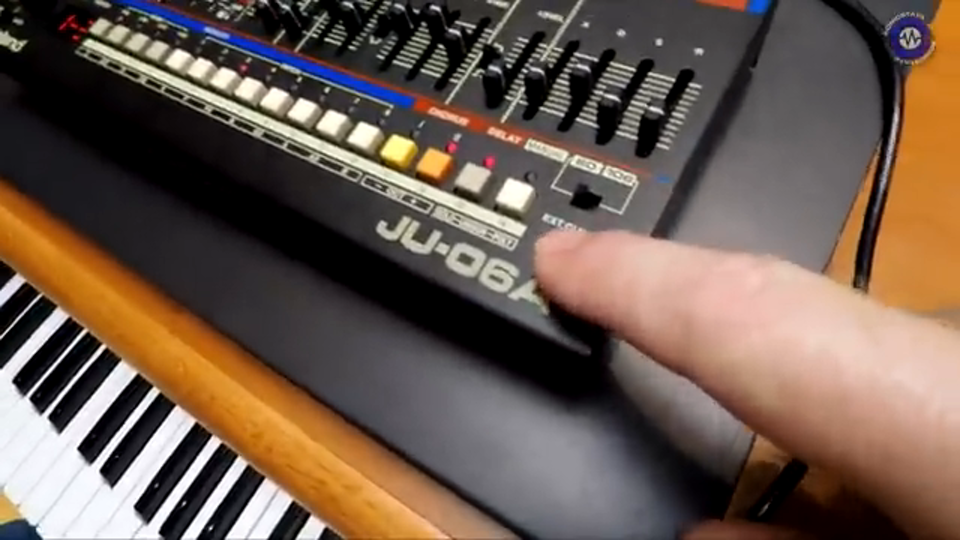
David from sonicstate explains that, as shown in his demonstration, the external clock input can be driven by a trigger output from the TR series or another gate-signal source.
„So we got an external clock input, so you can take a trigger from your trigger output of your TR series, for instance, or anything that sends a gate signal, essentially.“
The sonicstate interviewer likes the panel’s slightly dirty shade of black, which, in his view, makes the instrument look almost aged.
Read the full statement
„I really like that this is a small thing, but there's something about the shade of the panel, which is like a sort of slightly dirty black if there is such a thing. It almost looks old.“
Reddit · r/synthesizersFour voices, one Bach fugue
Are four voices enough? One JU-06A owner takes on the question with a MIDI file of the first fugue from Bach’s Well-Tempered Clavier. The four-part composition matches the voice count. Replies turn the experiment into a question of repertoire: counterpoint and expansive piano chords make different demands.
+
To try out his JU-06A, one owner chooses Bach’s first fugue from The Well-Tempered Clavier. He plays a MIDI file of the four-part composition and presents the experiment explicitly as his contribution to the discussion about the instrument’s four voices. It gives the abstract limit a concrete musical counterpart: a piece whose number of voices matches the instrument.
The replies differ. One comment sees the demands of the composition as decisive and regards limitations as a source of creative potential. Another disagrees from a pianist’s perspective: four-part fugues are a suitable use case, while the chord vocabulary of someone like Bill Evans makes different demands. The Bach experiment therefore remains a deliberately chosen example. It answers the question for this musical task; the objections point to playing styles that are less well served by the same voice count.
While exploring the JU-06A, one owner creates an organ-like texture that reminds him of a slowed-down tape loop playing backwards. He describes an inverted envelope with long settings, square wave and sub-oscillator, plus chorus, delay and a slow up-and-down arpeggio. The backwards impression is his description of the sound.
+
While exploring the JU-06A, one owner comes across an organ-like sound he has not found in his previous experiments with the SH-01A. He describes an inverted envelope with long settings; he names a square wave and sub-oscillator as the sound sources. He also has delay and chorus switched on, along with an arpeggiator moving slowly up and down.
What surprises him is the sense of movement created by this combination. The texture develops and at times seems to play backwards: his comparison is a slowed-down tape loop running in reverse. He is not describing an actual reversed recording. In a later reply, he returns explicitly to the organ sound he found. He attributes the different results he gets while tweaking, among other things, to the behaviour of the envelopes. The discovery remains a concrete sound sketch, with named settings and a subjective impression.