Behringer returns with the UB-1 Micro, a synth so compact it could get lost in your patch cable drawer, yet it promises a surprisingly vast sonic arsenal. In this official walkthrough, Behringer’s own Patchdog takes us through the UB-1 Micro’s features, from its dual oscillators to its modulation tricks, all while keeping one foot firmly in the world of hands-on synthesis. As always with Behringer, the focus is on accessibility and getting the most out of a small footprint—perfect for anyone looking to squeeze more voltage into their setup without sacrificing flexibility. Let’s see how this pint-sized powerhouse stacks up in the real world of patching and performance.

23. December 2025
MILES
Behringer’s UB-1 Micro: The Miniscule Monster Unleashed
A Tiny Titan: UB-1 Micro’s Compact Appeal
The UB-1 Micro is introduced as a remarkably compact synthesizer, earning the nickname “mega miniscule monster.” Behringer’s presentation style leans into the synth’s small size, but also its potential to punch above its weight in terms of sonic capability. The walkthrough wastes no time, jumping straight into a techno beat to showcase the instrument’s readiness for action.
Despite its diminutive form, the UB-1 Micro is positioned as a versatile tool suitable for a wide range of applications. Whether you’re looking to add a portable synth to your live rig or need a flexible sound source in the studio, the device’s design philosophy is all about maximising utility without cluttering your workspace. The emphasis here is on immediacy and hands-on control, making it an appealing option for both newcomers and seasoned patchers alike.
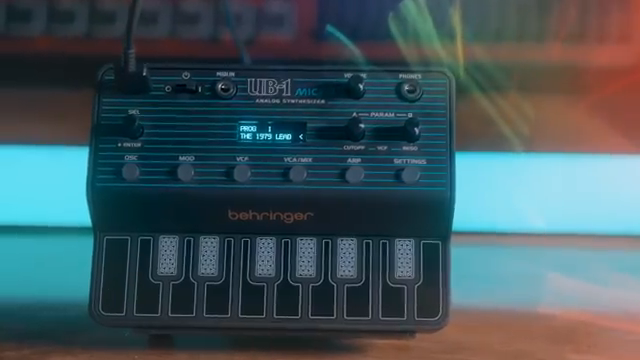
"the mega miniscule monster that is the UB1 micro."
© Screenshot/Quote: Behringer (YouTube)
Oscillators, Noise, and Sub: Building Blocks of Tone
"you've got a cutoff and you've got the resonance which can also get into some pretty aggressive territory if that's your thing."
© Screenshot/Quote: Behringer (YouTube)
The walkthrough dives into the core sound sources, starting with the dual DCOs (digitally controlled oscillators). Each oscillator offers sawtooth, triangle, and square waves, with pulse width modulation available for further timbral shaping. The interface is menu-driven, with A and B parameter controls and a selector encoder, allowing users to quickly navigate and tweak oscillator settings.
Beyond the main oscillators, the UB-1 Micro includes a noise generator and a sub oscillator, expanding its palette for everything from percussive hits to thick basses. The ability to fine-tune DCO2 and adjust octaves enables classic detuned and layered sounds, while oscillator sync is available for more aggressive, harmonically rich textures. This section of the demo highlights the synth’s ability to cover a wide sonic territory despite its small footprint.
Modulation Muscle: Dual LFOs and ADSR Envelope
Modulation is where the UB-1 Micro starts to show its depth. The synth features two LFOs: LFO1 is dedicated to pitch modulation with triangle and saw waveforms, while LFO2 offers triangle and square waves for filter modulation. Both LFOs have adjustable rate and amount, giving users precise control over modulation depth and speed.
The VCF envelope is a standard ADSR, but with the added flexibility of routing the envelope to DCO2 for pitch modulation. This opens up possibilities for dynamic, evolving sounds and snappy percussive effects. The walkthrough demonstrates how envelope amount and routing can dramatically alter the character of a patch, especially when combined with oscillator sync for those classic, biting sync tones.
Overall, the modulation section is impressively comprehensive for such a compact instrument. The dual LFOs and flexible envelope routing provide ample opportunity for intricate sound design, making the UB-1 Micro more than just a basic monosynth.

"now we can also send the envelope to DCO two if we want so let's go ahead and do that and that's obviously modulating the pitch"
© Screenshot/Quote: Behringer (YouTube)
Arpeggiator Tricks: Rhythmic Complexity in a Box
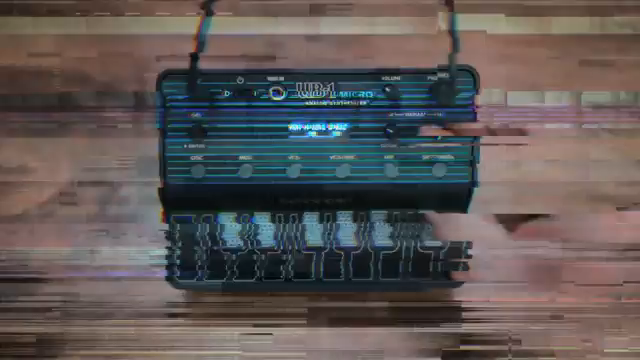
"and then we have the arpeggiator so straightforward stuff you have a hold option and we can enable it, you've got your quantize, then there's the three modes, sync options and speed"
© Screenshot/Quote: Behringer (YouTube)
Performance features are front and centre with the UB-1 Micro’s arpeggiator. The arpeggiator includes a hold function, quantize, and three distinct modes, allowing users to craft everything from simple patterns to more complex rhythmic sequences. Sync options are available for MIDI or USB, ensuring tight integration with external gear or DAWs.
Gate and swing parameters add further nuance, letting users inject groove and variation into their sequences. While the arpeggiator is straightforward in operation, its inclusion on such a small device is a welcome nod to live performers and anyone looking to add movement to their patches without external sequencers.
Studio Integration: MIDI and Customisation
The UB-1 Micro is designed to slot easily into modern studio workflows. MIDI connectivity is robust, with options for changing the keyboard octave, activating duophonic mode, and enabling MIDI CC for parameter control from a DAW. Users can set MIDI channel send and receive, toggle local control, and even initialize settings or access MIDI SysEx functions.
These features make the UB-1 Micro adaptable for a range of setups, from standalone noodling to deep DAW integration. The attention to workflow and customisation ensures that this tiny synth can play a big role in both live and studio environments, despite its modest size.
This article is also available in German. Read it here: https://synthmagazin.at/behringer-ub-1-micro-das-winzige-monster-entfesselt/
Watch on YouTube:
Latest articles
Watch on YouTube:
Visit the channel:
https://www.youtube.com/behringer
https://www.youtube.com/behringer
Links from behringer:
website: https://www.behringer.com
facebook: https://www.facebook.com/Behringer
twitter: https://twitter.com/BEHRINGER
instagram: https://instagram.com/Behringer
Sponsored links:
If you purchase via these links, we may earn a small commission – at no extra cost to you. The link opens an Amazon keyword search, and results may vary depending on availability.
Behringer UB-1 Micro
🔗 Check price on Amazon
🔗 Check price on Amazon