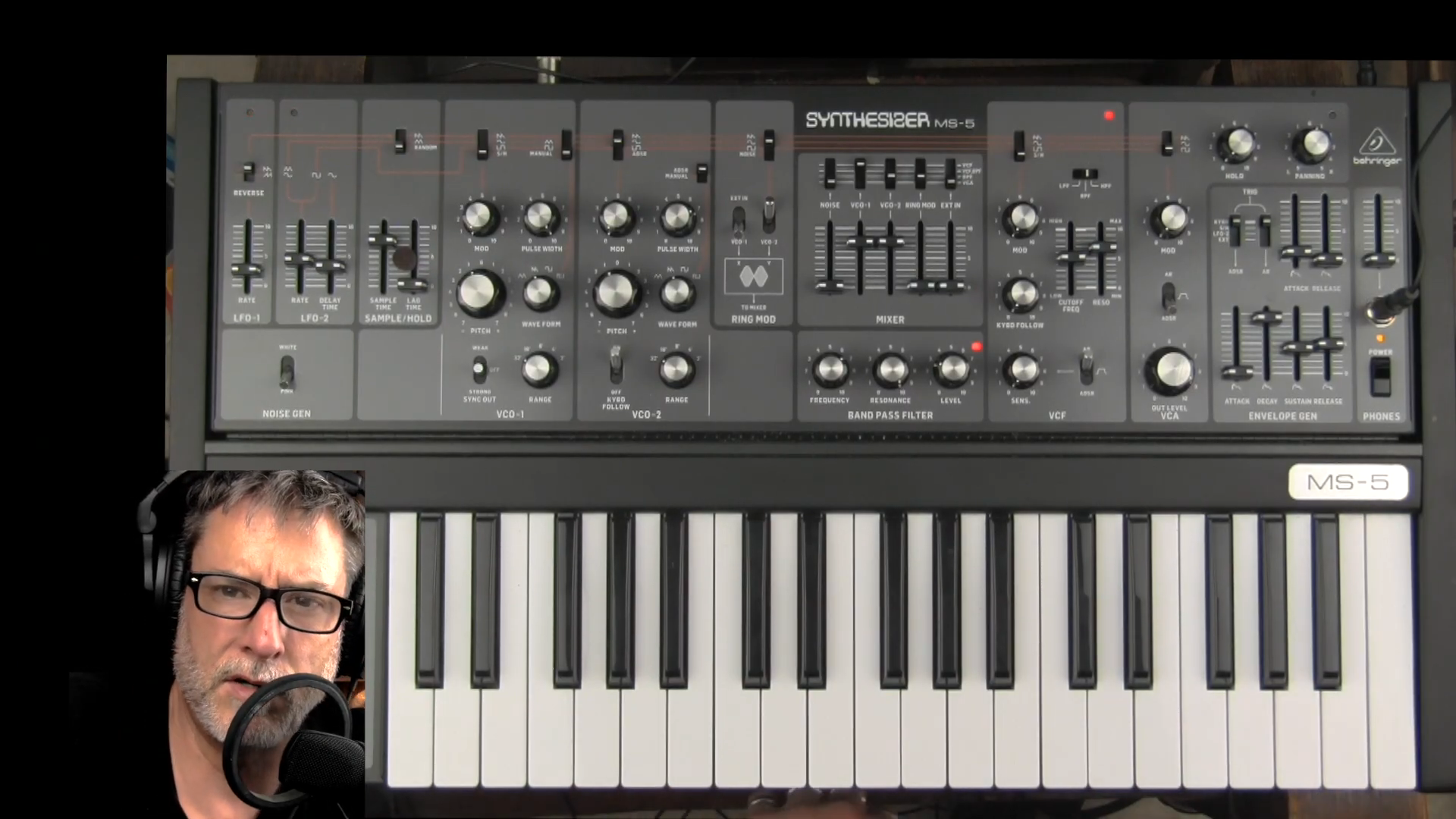
First, the synthesizer is supposed to imitate a voice. Then AutomaticGainsay demonstrates with his mouth how the synthesizer imitates his voice. This little acoustic roundabout fits his video "34-The Behringer MS-5-Formants Part 2," published on October 29, 2026: Here, it’s not just about presenting a finished patch. The creator searches, listens, doubts—and shows quite vividly how close a clever filter combination can get to vocal sounds, without quite reaching the desired goal.
Sawtooth Instead of Vocal Cords
“They sound like they're acting independently, like each oscillator is kind of like making its own vaguely voice-like thing, but them in combination is not really doing it.”
© Screenshot/Quote: AutomaticGainsay (YouTube)
His approach is easy to follow: The MS-5 has an additional bandpass, and the main filter can also be set to bandpass. AutomaticGainsay wants to use this to create two emphasized frequency regions that together form a vocal-like timbre. Instead of calculating exact vowel frequencies in advance, he works by ear. This makes the experiment accessible, but not a precisely measured vowel library.
He starts with a sawtooth, switches off key follow and envelope sensitivity on the VCF, and increases the resonance. It’s important to him to stay below self-oscillation: what he’s after is a spectral emphasis, not an additional sine tone. Then the second sawtooth oscillator gets its own path through the extra bandpass.
What’s especially revealing is his switching between areas he describes as human voice-like and those that lose this effect. But when adjusting the second filter, he remains skeptical: two individually interesting colorations don’t yet convincingly merge into a single voice for him.
The Bandpass Doesn’t Have to Speak
Starsky Carr uses the filters in his comparison "Behringer MS-5 v Roland SH 5 // The Comparison" from December 2024 for a different purpose. He routes VCO 1 through the main filter, VCO 2 through the combination of VCF and additional bandpass. Then he demonstrates a practical bass trick: turn up the bandpass level and resonance, lower the frequency. Here, the extra filter isn’t used as a second movable formant region, but to specifically boost the low end.
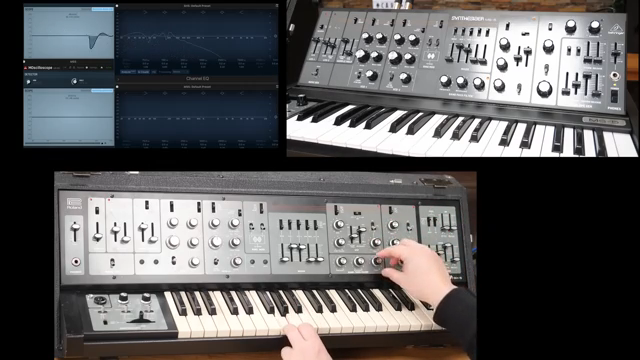
“And then we can really add bass to that by cranking up the level, cranking up the resonance and dropping the frequency of that band pass.”
© Screenshot/Quote: Starsky Carr (YouTube)
Two Envelopes, One Unfulfilled Wish
“I wish they just would have given the BAMPASS filter an envelope control.”
© Screenshot/Quote: AutomaticGainsay (YouTube)
AutomaticGainsay, on the other hand, wants to deliberately move the two frequency emphases in relation to each other. For him, this is the crucial step toward livelier vocal sounds. His wish: one envelope for the VCF, the other for the additional bandpass. Two envelopes are present; but the desired control of the second filter is missing. His disappointment is especially tangible because he is clearly enthusiastic about the instrument’s other possibilities.
That doesn’t mean that static formant colorations aren’t formants, or that the attempt has failed. In the end, he explicitly notes: with envelope movement on the VCF and an unchanged additional bandpass, vocal-like sounds are still possible. For him, it’s just less effective than having separate envelope control for both filters.
What Happens Within the Limit
Carr also points out the missing modulation for the additional bandpass. But he doesn’t stop there: in his comparison, he modulates the VCF with sample and hold and changes the bandpass manually. This isn’t a solution for AutomaticGainsay’s wish for two independently running filter envelopes. Rather, it shows that a fixed filter and a moving filter together still leave plenty of room for experimentation.
At the start of his comparison, Carr fittingly formulates a standard beyond identical timbres: for him, quirks, voice architecture, and limitations are part of the appeal of such vintage instruments.
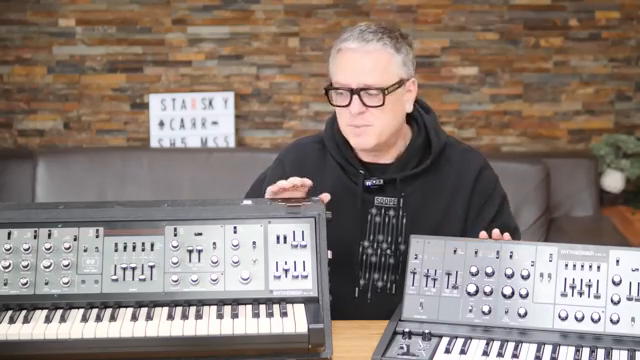
“because it's the idiosyncrasies, the voice architecture, and the limitations that give a lot of these vintage synths their charm.”
© Screenshot/Quote: Starsky Carr (YouTube)
The best thing about AutomaticGainsay’s search is therefore not the supposedly perfect vowel. It’s the distinction, worked out by ear, between an interesting coloration and the movement he still misses. The MS-5 doesn’t have to deliver a finished voice: as a reason to listen more closely and shape sound yourself, this experiment already has plenty to say.
Videos for this article
All YouTube videos featuring the Behringer MS-5
Primary – main topic (30)
 35-The Behringer MS-5-APPLICATION
 34-The Behringer MS-5-Formants Part 2
 24-The Behringer MS-5- Envelopes 3
 25-The Behringer MS-5-Mixer 1
 22-The Behringer MS-5- Envelopes 1
 21-The Behringer MS-5- VCA 3
 18-The Behringer MS-5- LFOs
 17-The Behringer MS-5- Sample and Hold 2
Show all (22 more)
 15-The Behringer MS-5- FILTERMUCK
 14-The Behringer MS-5- Bandpass 2
 11-The Behringer MS-5- Filter Modulation 1
 12-The Behringer MS-5- Filter Modulation 2
 09-The Behringer MS-5- The Bandpass Filter 2
 07-The Behringer MS-5- The Low Pass Filter
 08-The Behringer MS-5- The Bandpass Filter 1
 06-The Behringer MS-5- Oscillator 2c
 04-The Behringer MS-5- Oscillator 2
 05-The Behringer MS-5- Oscillator 2b
 03-The Behringer MS-5- Oscillator 1-c
 01-The Behringer MS-5- Oscillator 1
 02-The Behringer MS-5- Oscillator 1-b
 Behringer MS -5 , Dreadbox Artemis, KO II Synth Jam - Friday Fun
 Behringer MS-5 v Roland SH 5 // The Comparison
 Behringer MS-5 Patches: Lead Bass Pluck. No Talk Sound Demo
 Behringer MS-5 Patches: Demo with Empress Reverb (no talking)
 Behringer MS-5 review
 Take a Hardware Holiday // Why New Kit Can Be More Creative
 Behringer MS5 // Initial Impressions and Review
 Behringer MS-5 vs Roland SH-5! A deeper Comparison.
 Molten Music Monthly April 2024


