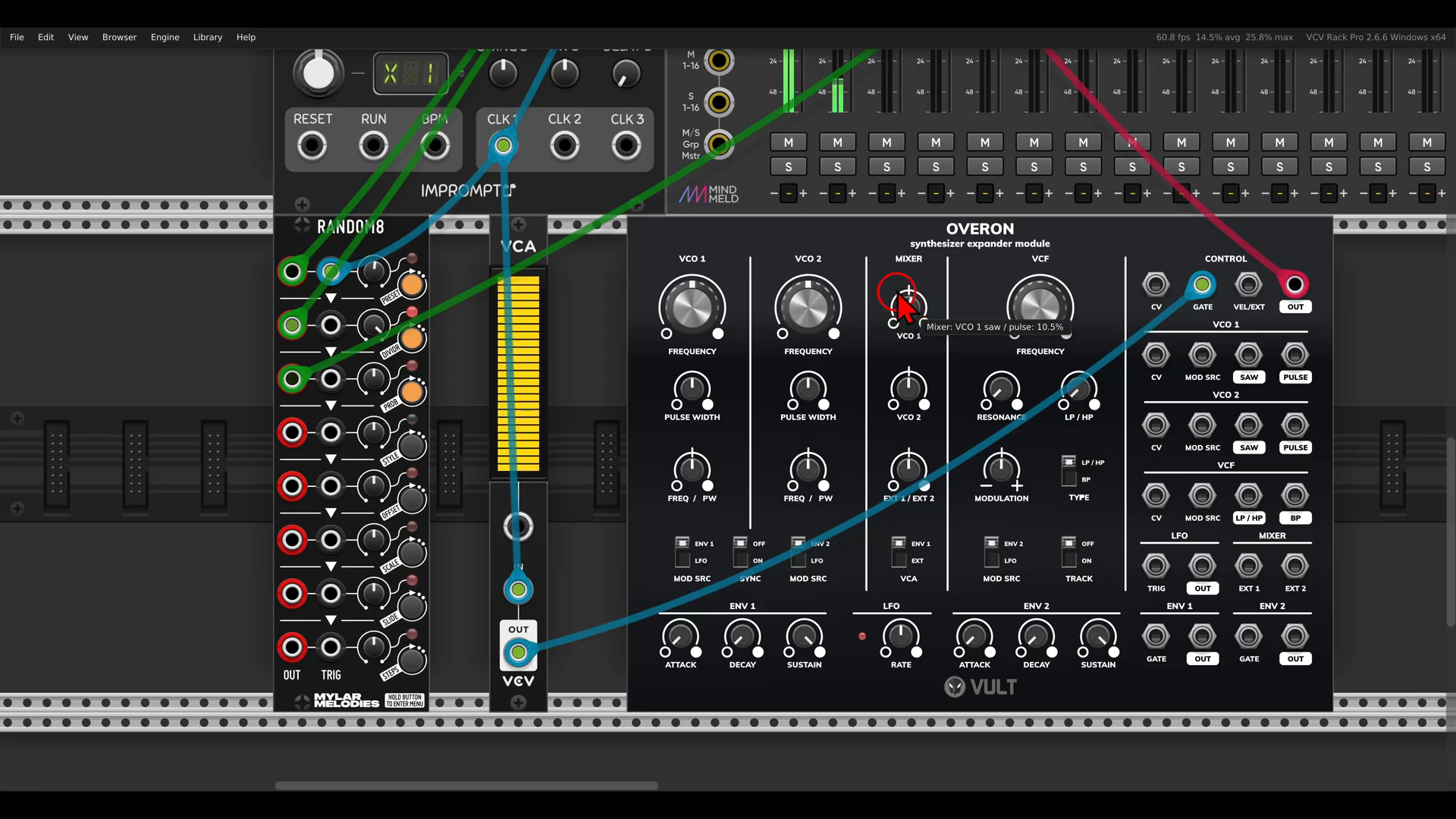
Creating a rhythm without programming in every single hit: In his video "Patch from scratch with Vult Overon and Befaco RANDOM8" published on October 26, 2026, Omri Cohen demonstrates how far a shared base pulse can take him. The VCV Rack patch grows as he experiments. One particularly revealing trick: Cohen places a VCA not before the sound, but before the gate input of the next synth voice.
Not every sixteenth gets through
“I can use another channel of random 8 to control this, and maybe have fewer steps, so not 16, but let's go with 10 steps, and lock it, and we get a rhythm,”
© Screenshot/Quote: Omri Cohen (YouTube)
Cohen starts with 132 BPM and a quadrupled clock, giving him sixteenths. Random8 receives the same tempo. For the additional Overon voice, he routes these pulses through a VCA to the gate input. Another Random8 channel now controls how far the VCA opens. So the random voltage doesn't replace the clock: it determines which of its pulses are strong enough to reach the synth.
The musical intervention comes with locking: Cohen first shortens the random sequence to ten steps and locks it. Later, he tries 15 steps because he wants a five-feel. This very change makes the experiment interesting: he doesn't just accept any result, but listens for a rhythmic idea and changes the conditions accordingly.
Accents are not new hits
Earlier, Cohen already uses Random8 for filter and velocity. For velocity, he adjusts the offset and selects the gamma random distribution. Here, it's about weighting and timbre within the grid, not about filtering out the clock. This distinction is helpful: a quieter hit and a skipped hit serve different musical purposes.
Optoproductions shows a different approach in his Random8 demo. For a drum patch, he uses the low/high style. Then, with a locked pattern, he changes the output level, creating further variations; turned all the way down, the knob also mutes. The pattern remains stored, but its effect on the connected instrument still changes. However, he adds an important caveat to his performance trick:
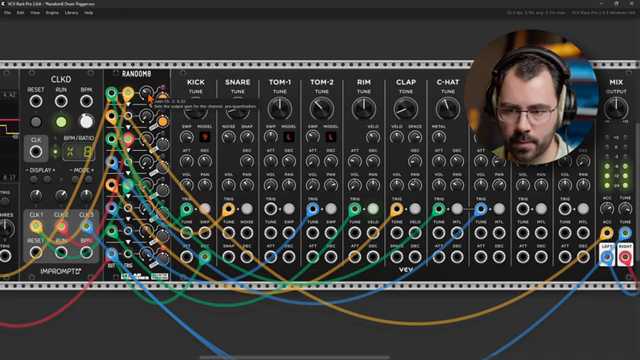
“It's not always the case, it depends a bit on the random levels, but it's cool as a performance tool.”
© Screenshot/Quote: Optoproductions (YouTube)
Letting the delay join in
“when it goes above a certain point, it's considered a gate basically, so it will gate the freeze, right, so this is another voice that we have,”
© Screenshot/Quote: Omri Cohen (YouTube)
Later, Cohen shifts event control to the Acro delay. He syncs it to dotted eighths and adds another Random8 instance, again with the same quadrupled clock. This time, its voltage is to control the freeze input. Thus, an effect function becomes an independent contribution to the arrangement, rather than just an occasional tweak on the delay.
To do this, he shifts the control voltage down before the input and turns up its range: it shouldn't always be above the effective switching threshold. This differs from the VCA patch. There, an existing pulse stream is dosed; here, the freeze input interprets the voltage itself as a gate. The extra function arises from the interplay of modules, not from a dedicated trigger output on Random8.
Eight channels, but please with clear roles
How much of this remains understandable the next time you turn it on? Robin from Molten Music Technology describes the downside of the hardware module in "Mylar Melodies Random8 Review." He enthusiastically expands his patch with more modulations, but also notes: with every additional setting, it becomes harder to track what he's already assigned to a channel.
Scaling, slide, offset, and probability share a single control surface. The knob therefore doesn't show all active settings at once. Robin's objection isn't against experimenting—he explicitly enjoys that—but against losing track. Versatility only becomes a workflow advantage when you can find your way around again.
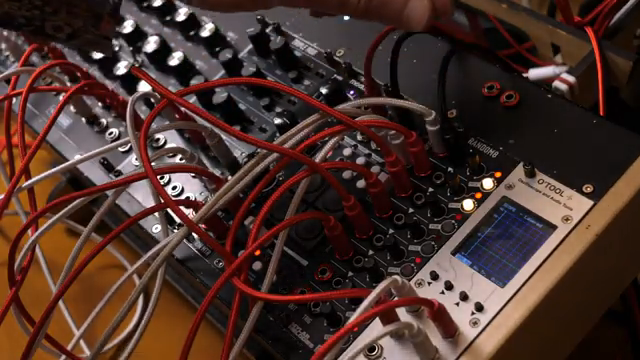
“And yet it's very difficult to know how much of each of those things I have done to that channel by looking at it.”
© Screenshot/Quote: Molten Music Technology (YouTube)
Robin's suggestion to prepare fixed channel roles and presets aims at more than just convenience. A random patch becomes playable when it's clear what the machine is allowed to decide. Cohen gives it plenty to do—and keeps the final say with the lock button.
Videos for this article
All YouTube videos featuring the Befaco Random8
Primary – main topic (6)
 Patch from scratch with Vult Overon and Befaco RANDOM8
 MEGA patching techniques with RANDOM8 in VCV Rack & Eurorack
 8 Random Sequencers with build in quantizers?? In only 8 hp!?
 The darkest drone | Vhikk X, Random8, Loki, Prok drums, Diktaat, Desmodus
 Mylar Melodies Random8 Review
 Befaco X Mylar Melodies: Random8 Random Voltage Generator - Superbooth 2026


