ALM / Busy Circuits returns with the FMco, a pint-sized two-operator FM synth voice that promises immediate playability and a surprisingly modern digital edge. In this official ALM TV walkthrough, the FMco’s blend of hands-on controls, CV modulation, and stereo output is put through its paces, showing just how much sonic territory can be covered in only 8HP. From classic plucks to evolving chords, the FMco is designed to slide straight into any Eurorack setup, offering both simplicity and depth for those who like their FM with a twist of patch cable. Let’s dissect what makes this module tick, and how it might fit into your next modular patch.
21. March 2026
MILES
ALM TV’s FMco: Compact FM Synthesis, Maximum Patchability
A Modern Take on Compact FM
ALM / Busy Circuits introduces the FMco as a compact, two-operator FM synthesizer voice, clearly designed for those who want instant access to digital FM tones without the menu-diving or parameter overload. The focus here is on immediacy and fun, with the module offering a wide palette of sounds from bright leads to percussive clangs, all in a mere 8HP.
The video sets the tone by highlighting the FMco’s playful nature—this isn’t a cold, clinical FM box, but one that encourages hands-on exploration. The design draws inspiration from ALM’s larger Akemie’s Castle, but distills the concept into something much more approachable for smaller racks or live rigs.
From the outset, it’s clear that ALM is aiming for a balance between classic digital FM character and modern workflow, with the FMco positioned as a workhorse voice module that doesn’t sacrifice depth for size.
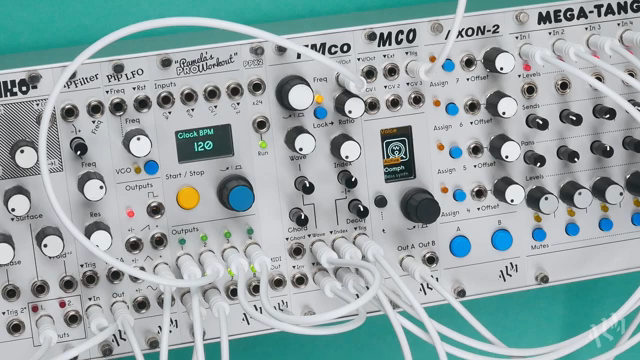
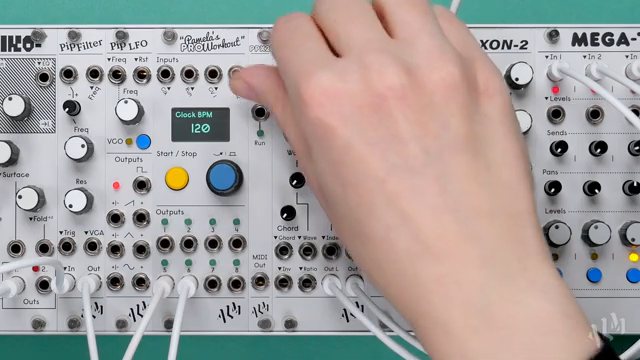
"The FMCO is a compact, two-operator FM synthesizer voice designed with fun and immediate playability in mind."
© Screenshot/Quote: Busycircuits (YouTube)
Hands-On Control: Index, Ratio, and Waveforms
"At any time, we can quickly double click the encoder to set the frequency to a bass C3 and then return to octave increments."
© Screenshot/Quote: Busycircuits (YouTube)
The FMco’s control scheme is refreshingly direct, offering both manual and voltage control over the FM index, operator ratio, and waveform selection. This means you can dial in everything from subtle harmonic shifts to full-on metallic chaos, all with a few twists and patch cables. The endless encoder for tuning is a standout: it allows precise adjustment in octaves, semitones, and cents, making it easy to land on the right pitch or quickly reset to a reference note like C3.
Voltage control is available for every key parameter, and the video demonstrates this by patching LFOs and random CV from Pamela’s Pro Workout to modulate index, ratio, and waveform. The result is a module that thrives on modulation, producing everything from evolving textures to animated percussive hits. The lock function for the ratio steps through whole number multiples, giving you harmonically stable FM timbres when you want them, or letting you go wild with inharmonic clangs when you don’t.
Built-In Envelope and VCA: Self-Contained Synthesis
A key feature that sets the FMco apart from many basic FM oscillators is its built-in decay envelope and internal VCA. This means the module can operate as a fully autonomous synth voice—just patch a trigger to the input, and you’re off. The envelope is routed both to the output level and to the FM depth, allowing for those classic FM pluck sounds and dynamic timbral shifts with a single control.
The decay time is easily adjustable, making it simple to move from snappy percussive hits to longer, evolving tones. This plug-and-play approach is ideal for quick jams or for those who want to keep their patching streamlined without sacrificing expressiveness.
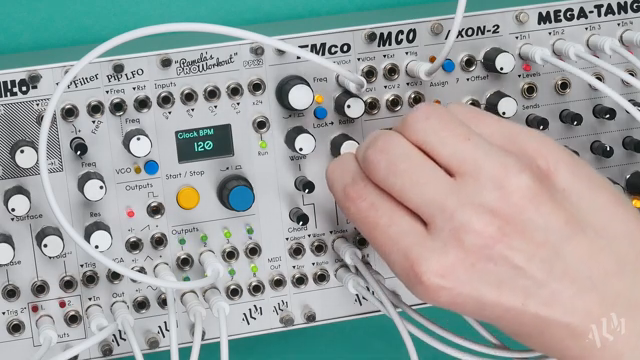
"This simple envelope is directly connected to an internal level VCA, allowing the FMCO to function as a self-contained synth voice."
© Screenshot/Quote: Busycircuits (YouTube)
Chords, Tuning, and Polyphonic Tricks
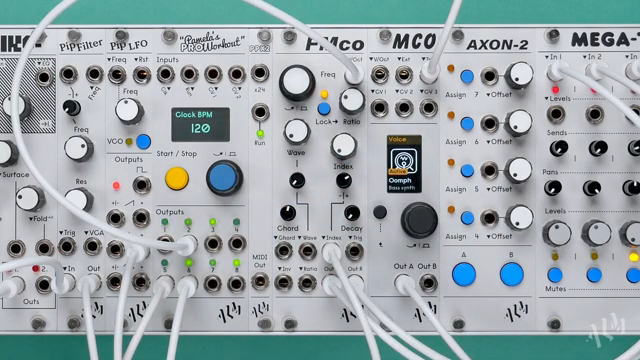
"The invert CV input allows us to control the inversion of a chord, shifting each note up an octave as the CV level increases."
© Screenshot/Quote: Busycircuits (YouTube)
FMco isn’t just about single-note FM—ALM has squeezed in CV-controlled four-voice chords, with a selection of classic chord shapes and unison detune options. The chord control lets you morph from stacked intervals to thick unison sounds, and the invert CV input can shift chord inversions on the fly, opening up a range of harmonic possibilities in a single patch.
The encoder-based tuning system deserves special mention. It’s not just about getting in tune; it’s about making pitch adjustments fast and accurate, whether you’re stepping through octaves, semitones, or fine-tuning by cents. The ability to quickly reset to a reference note is a small but thoughtful touch, especially in a live or improvisational context.
Stereo Output and Modulation Playground
Despite its compact size, the FMco delivers a stereo-widened output, giving patches an immediate sense of space and depth. This is particularly noticeable when using the chord and unison modes, where the stereo field helps separate voices and adds a lushness not often found in small-format modules.
The video closes with a jam that shows off the FMco’s range: animated chords, shifting timbres, and plenty of modulation from external sources. It’s a reminder that, while the FMco is easy to use, it’s also a serious sound design tool for those willing to experiment with CV and creative patching.
This article is also available in German. Read it here: https://synthmagazin.at/alm-tvs-fmco-kompakte-fm-synthese-maximale-patchbarkeit/
Watch on YouTube:
Latest articles
Watch on YouTube:
Visit the channel:
https://www.youtube.com/busycircuits
https://www.youtube.com/busycircuits
Links from busycircuits:
website: https://busycircuits.com
instagram: https://instagram.com/busycircuits
soundcloud: https://soundcloud.com/busycircuits
Sponsored links:
If you purchase via these links, we may earn a small commission – at no extra cost to you. The link opens an Amazon keyword search, and results may vary depending on availability.
FMco
🔗 Check price on Amazon
🔗 Check price on Amazon
Pamela's Pro Workout
🔗 Check price on Amazon
🔗 Check price on Amazon