Step into the magnetic haze of digital nostalgia as Starsky Carr unveils the Waldorf Protein—a synth that exhales the spectral breath of the 80s and 90s while inviting us into a modern, tactile interface. In this immersive review, Starsky’s signature clarity meets the Protein’s lo-fi shimmer, revealing a machine that doesn’t just emulate its ancestors but reinvents their spirit. From stepped wavetables to multitimbral layering, the Protein becomes a vessel for sonic ghosts and future dreams alike. Prepare to drift through gritty textures, lush pads, and the subtle magic that only true wavetable synthesis can conjure. For those who seek character over clinical perfection, this is a journey worth taking.

9. January 2026
LUMINA
Waldorf Protein: Starsky Carr Guides Us Through Digital Nebulae
Echoes of the Past, Touch of the Future
The Waldorf Protein stands as a bridge between eras—a vessel channeling the spectral DNA of the PPG and Microwave, yet sculpted for the hands of today. Starsky Carr guides us through its form, a lightweight body with a metal face, tactile controls, and a screen that becomes our window into its digital soul. The interface is stripped of the daunting labyrinths of its ancestors, inviting us to shape sound without fear of getting lost in endless menus.
Gone are the eight-stage envelopes and sprawling mod matrices of the past; in their place, a streamlined palette of two LFOs, three ADSR envelopes, and a modulation matrix that feels more like a painter’s brush than a programmer’s code. The Protein’s architecture is familiar yet fresh—two oscillators, digital filters, and effects, all within reach. This is not a clone, but a new constellation in the Waldorf sky, where classic grit meets modern clarity.
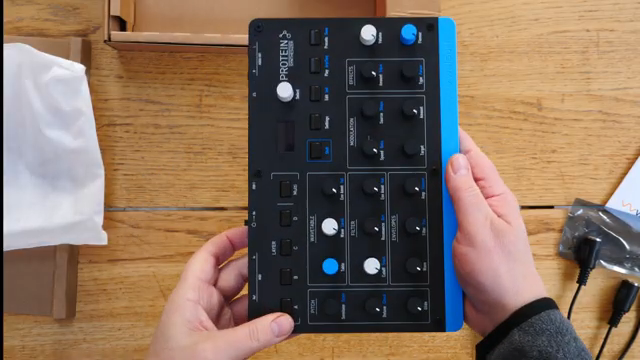
"In this, we have direct PPG lineage, as just like on the PPG and Microwave I, II, and the XT, this contains the eight-bit versions of those wavetables, so we have that classic gritty tone."
© Screenshot/Quote: Starskycarr (YouTube)
Grit, Ghosts, and 8-Bit Dreams
"So again, that gives this another bit of a gritty flavor."
© Screenshot/Quote: Starskycarr (YouTube)
At the heart of the Protein lies its 8-bit, 128-sample wavetables—sonic fossils that shimmer with aliasing and stepped movement. Each note blooms with harmonic complexity, impossible to summon from analog realms. Starsky demonstrates how these digital artifacts are not flaws but living textures, infusing every sound with a sense of haunted nostalgia. The stepping between waves, the subtle digital noise, and the melodic high frequencies become the synth’s signature, painting landscapes that are both familiar and uncanny.
It’s in these imperfections that the Protein finds its voice: not polished, but alive, with each octave revealing new spectral details. The synth’s sound is a nebula of grit and shimmer, where every patch becomes a story—sometimes smooth, sometimes fractured, always evocative. For those who long for the magic of early digital synthesis, the Protein is a time machine with a modern engine.
Layers of Light: Multitimbral Magic
The Protein’s multitimbral engine is a tapestry of possibility—four layers, each a distinct voice, weaving together basslines, arpeggios, leads, and textures. Starsky Carr reveals how easily these layers can be combined, split across MIDI channels, and shaped into complete arrangements. The synth becomes a playground for genre-fluid exploration, from trance to ambient, techno to IDM, each layer a thread in the sonic fabric.
Programming is refreshingly immediate: pads bloom with chorus and tremolo, electric pianos morph through wavetables, and effects are shared or sculpted per layer. The ease with which new sounds emerge—sometimes by accident, sometimes by design—makes the Protein a companion for both structured composition and spontaneous creation. Here, complexity is not a barrier but an invitation to dive deeper.
"You don't really have to work at it to get nice things from it. Just play around and nice things pop out."
© Screenshot/Quote: Starskycarr (YouTube)
The Grit Remains
Despite its streamlined design, the Protein never abandons the magnetic resonance of its lineage. The 8-bit wavetables and stepped transitions conjure the same spectral grit that defined the PPG and Microwave, yet the interface is reborn for the present. This is a machine that wears its digital scars with pride, letting us drift inside its fractured light.
Sound Design as Story: An Invitation
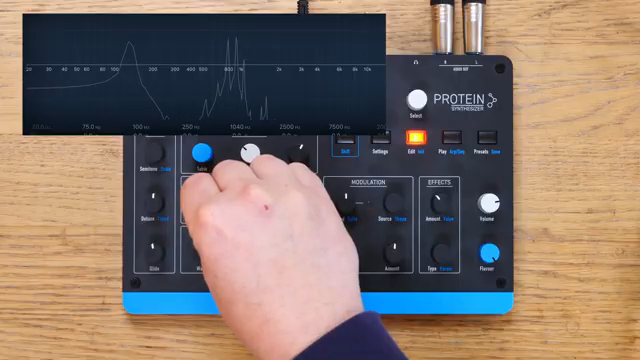
"Yeah, that's cool, I like it. So I've had a lot of fun with this. It's a really nice sounding little synth."
© Screenshot/Quote: Starskycarr (YouTube)
Starsky Carr’s review is not just a technical walkthrough—it’s an invitation to explore. Through practical demonstrations, he reveals how easily MIDI CC mapping, effects routing, and the enigmatic blue flavor dial can transform a patch from static to cinematic. The Protein’s quirks—shared effects, per-patch MIDI assignments, and the absence of USB audio—become part of its character, not limitations.
Yet, words can only sketch the outlines of this sonic landscape. The true depth of the Protein’s nebula drones and spectral pads is best experienced with headphones and open ears. Starsky’s hands-on approach encourages us to experiment, to let accidents become inspiration, and to discover the stories waiting within each wavetable. For those who crave sound that breathes and mutates, the Protein is a portal—one best entered by watching, listening, and drifting inside.
This article is also available in German. Read it here: https://synthmagazin.at/waldorf-protein-starsky-carr-fuehrt-uns-durch-digitale-nebelwelten/
Watch on YouTube:
Latest articles
Watch on YouTube:
Visit the channel:
https://www.youtube.com/StarskyCarr
https://www.youtube.com/StarskyCarr
Links from StarskyCarr:
Patreon: https://patreon.com/starskycarr
Instagram: https://instagram.com/starskycarr
Facebook: https://facebook.com/StarskyCarrOfficial
Sponsored links:
If you purchase via these links, we may earn a small commission – at no extra cost to you. The link opens an Amazon keyword search, and results may vary depending on availability.
Waldorf Protein
🔗 Check price on Amazon
🔗 Check price on Amazon