Thinking of jumping into the modular synth rabbit hole but don’t fancy selling a kidney? Underdog Electronic Music School’s latest video slices through the confusion with a no-nonsense look at why semi-modular gear is the ultimate first hit for aspiring patch-heads. Oscar’s got the Moog DFAM, Intellijel Plonk, and XAOC Sarajewo delay all lined up, showing how a few clever connections can turn a simple groovebox into a rave bunker. If you’re tired of reading manuals and want to see real-world patching that actually slaps, this one’s for you.

13. January 2026
SPARKY
Underdog Electronic Music School: Semi-Modular – Your Gateway Drug to Eurorack Mayhem
Semi-Modular: The Sensible First Hit
Let’s be honest: full modular is a money pit and a time sink if you’re just starting out. Underdog Electronic Music School wastes no time laying it out—semi-modular is the way in if you don’t want to end up with a pile of useless modules and zero sound. The video kicks off with a cheeky drinking game (take a shot every time Oscar says ‘synthesis’), but the real point is clear: modular can be overwhelming, and semi-modular gives you a fighting chance to actually make music, not just collect shiny panels.
Oscar drops a car-building metaphor that actually lands: with modular, you’re buying parts and hoping they’ll drive. With semi-modular, you get a working car, but you can still soup it up with new parts when you’re ready. No more buying a sequencer and realising you can’t even make a sound. For beginners, that’s a game-changer. The message is simple—get something that works out of the box, but leaves the door open for future chaos.

"You're going to buy a synthesizer which is a tool that already has an architecture underneath the hood."
© Screenshot/Quote: Oscarunderdog (YouTube)
Moog DFAM: The Sonic Street Weapon
"It's almost impossible to play a proper melody with it, it's almost impossible to play something that music theoretically makes sense."
© Screenshot/Quote: Oscarunderdog (YouTube)
Enter the Moog DFAM—a semi-modular beast that doesn’t care if you’re a newbie or a seasoned patch pirate. Oscar shows off how the DFAM can live in its own case or be yanked out and slammed into a Eurorack setup, ready to play with others. The setup’s dead simple: power it up, plug in your audio interface, and you’re off to the races. No menu-diving, no firmware updates, just pure, hands-on filth.
The DFAM’s architecture is classic: two oscillators, a filter, an amp, and a step sequencer that’s always eight steps—no more, no less. It spits out loopy, bleepy, percussive sequences that don’t care about music theory. Quantised melodies? Forget it. This thing is for dirty, atonal grooves and dissonant messes—exactly what you want when you’re building a bunker-worthy beat. And with those patch points, you’re just a cable away from total sonic mayhem.
Intellijel Plonk: Patch and Multiply
Why stop at DFAM? Oscar plugs in the Intellijel Plonk, a physical modelling module that instantly multiplies your sound palette. Instead of just using the DFAM’s built-in oscillators, you can hijack its sequencer to drive the Plonk, opening up a world of new textures. Suddenly, you’re not just stuck with triangle and square waves—you’ve got hand drums, metallic hits, and all sorts of weirdness at your fingertips.
The real magic comes when you start patching the DFAM’s pitch and velocity outputs into the Plonk. Now, every step can trigger a new sound, with evolving pitch, decay, and more. Oscar keeps it moving, swapping cables and tweaking knobs, showing just how quickly you can go from basic loops to complex, evolving patterns. It’s modular without the misery—plug, play, and get lost in the groove.
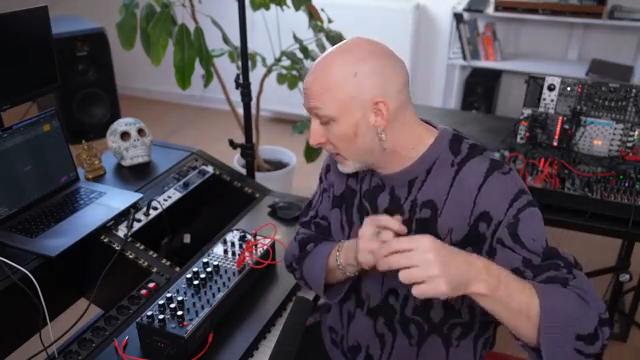
"By adding in one external unit and that exponentially opens up the space of exploration."
© Screenshot/Quote: Oscarunderdog (YouTube)
XAOC Sarajewo: Delay for Days

"There's yet another exponential territory of sound design that we can explore now, literally the only limit is yourself."
© Screenshot/Quote: Oscarunderdog (YouTube)
Next up: the XAOC Sarajewo delay. Oscar patches the Plonk’s output through the Sarajewo, and suddenly everything gets a whole lot deeper. Echoes bounce, feedback spirals, and the groove takes on a new life. The Sarajewo isn’t just an add-on—it’s a portal to dubby, psychedelic territory where every tweak can send your sound into orbit.
Oscar’s advice is spot on: keep one hand on the feedback knob, or risk blowing your speakers (and your eardrums). The Sarajewo’s controls are immediate, and the results are wild—speed up the echoes, crank the feedback, and you’re in full-on rave mode. But honestly, you’ve got to watch the video to really feel the chaos. Words don’t do justice to the swirling, feedback-laden madness that erupts when you start pushing this delay.
Patch, Play, Repeat: The Joy of Semi-Modular Exploration
The real takeaway? Semi-modular isn’t just a stepping stone—it’s a playground. Oscar wraps up by hammering home the point that these systems are about personal taste, creative process, and pure exploration. Once you’ve got the basics down, you can swap modules, reroute signals, and chase whatever sound is rattling around in your head. The only limit is how weird you’re willing to get.
Underdog’s style is all about demystifying the gear and encouraging experimentation. Forget the manuals—just patch something and see what happens. If you want to see how these setups actually sound (and trust us, you do), the video’s full of jams and knob-twiddling that’ll make you want to dive right in. Semi-modular is the gateway drug, and Underdog Electronic Music School is your dealer.
This article is also available in German. Read it here: https://synthmagazin.at/underdog-electronic-music-school-semi-modular-dein-einstieg-in-eurorack-chaos/
Watch on YouTube:
Latest articles
Watch on YouTube:
Visit the channel:
https://www.youtube.com/OscarUnderdog
https://www.youtube.com/OscarUnderdog
Links from OscarUnderdog:
underdog.brussels: https://underdog.brussels
Underdog instagram: https://instagram.com/oscarunderdog
Underdog facebook: https://facebook.com/underdogbrussels
Sponsored links:
If you purchase via these links, we may earn a small commission – at no extra cost to you. The link opens an Amazon keyword search, and results may vary depending on availability.
Intellijel Plonk
🔗 Check price on Amazon
🔗 Check price on Amazon
Moog DFAM
🔗 Check price on Amazon
🔗 Check price on Amazon
XAOC Sarajewo
🔗 Check price on Amazon
🔗 Check price on Amazon