UDO Audio returns with a patchwork challenge, this time tasking Hazel Mills to recreate the distinctive synth textures of CARIBOU’s ‘Honey’ using the Super 8. True to UDO’s ethos of hands-on playability and rich, spacious sound, the video dives deep into the art of sound recreation—analysing, tweaking, and layering to capture the essence of the original track. Hazel’s methodical approach, from sawtooth stabs to square wave bass, showcases the Super 8’s strengths as both a creative and analytical tool. For those who obsess over envelopes and filter sweeps, this is a masterclass in patching with purpose.
21. November 2024
MILES
UDO Audio’s Super 8: Patchwork Precision with CARIBOU’s ‘Honey’
Patchwork Begins: Super 8 Meets CARIBOU
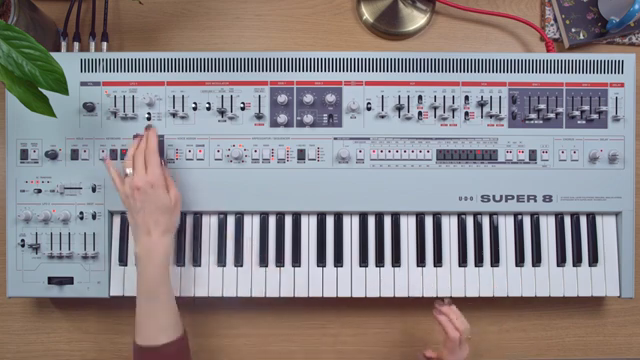
The video opens with Hazel introducing her mission: to recreate the key synth sounds from CARIBOU’s ‘Honey’ using the UDO Super 8. With two layers at her disposal, Hazel sets out to capture both the syncopated chord stabs and the distinctive bass, demonstrating the Super 8’s versatility as a sound design instrument.
UDO Audio’s Super 8 is presented not just as a polysynth, but as a tool for sonic experimentation. The focus here is on listening, analysing, and iteratively tweaking parameters—a process familiar to anyone who’s tried to reverse-engineer a favourite track. This approach highlights the Super 8’s suitability for both performance and forensic patchwork.
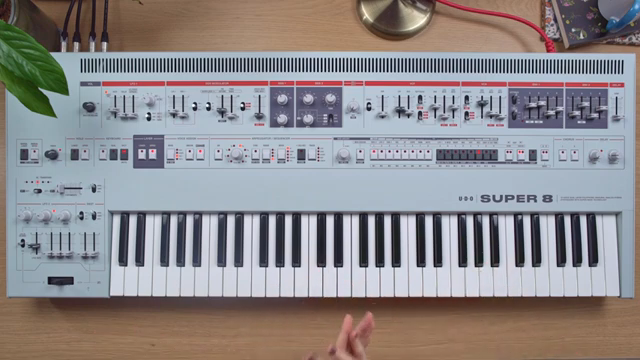
"The chord stabs, the syncopated chord stabs and also the synth bass sound."
© Screenshot/Quote: Udo Audio (YouTube)
Chord Stabs: Sawtooth Sculpting and Filter Craft
"I'm also gonna give it a little bit of instability in terms of its tuning and just have it slightly detuned."
© Screenshot/Quote: Udo Audio (YouTube)
Hazel begins with the chord stabs, starting from an initialised patch on the upper layer. She opts for sawtooth waveforms on both oscillators, introducing a touch of detune for width. The filter is closed down to tame the brightness, and envelope one is drafted in to modulate the filter, with no sustain and a short decay to shape the snappy, percussive character.
The amplitude envelope is also trimmed for brevity, with just a hint of release to avoid abrupt cutoffs. Hazel notes that the attack is short and the sustain is minimal, but the real shaping comes from the filter envelope. This careful interplay between filter and amp envelopes is what gives the stabs their punchy, yet organic feel.
To add further authenticity, Hazel introduces slow pitch modulation and a dash more detune, mimicking the subtle instability heard in the original track. The result is a sound that’s close, but not quite finished—inviting further micro-adjustments and reinforcing the idea that sound design is as much about nuance as it is about broad strokes.
Sequencing and Variation: Precision with a Human Touch
Programming the chord stabs as a sequence, Hazel explores how the original’s rhythmic precision is integral to its character. She observes that the sequence’s note timing and envelope behaviour contribute to the track’s signature feel, even if certain effects—like ratcheting—can’t be perfectly replicated on the Super 8’s sequencer.
Hazel suggests experimenting with loop modes and envelope variations to inject spontaneity and expressiveness. This process demonstrates a workflow where precision and playfulness coexist, encouraging users to embrace both accuracy and happy accidents in their patches.
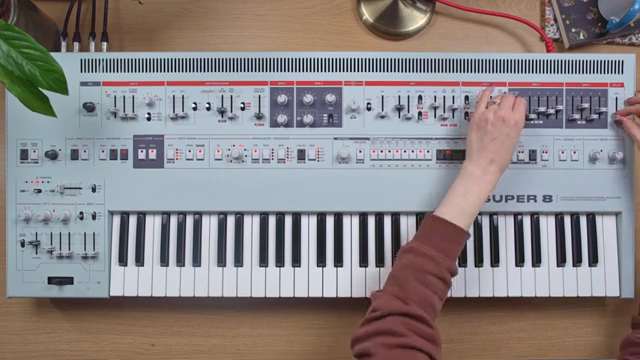
"If you listen to the track these variations do have an element of spontaneity in them."
© Screenshot/Quote: Udo Audio (YouTube)
Bass Foundations: Square Waves and Envelope Finesse
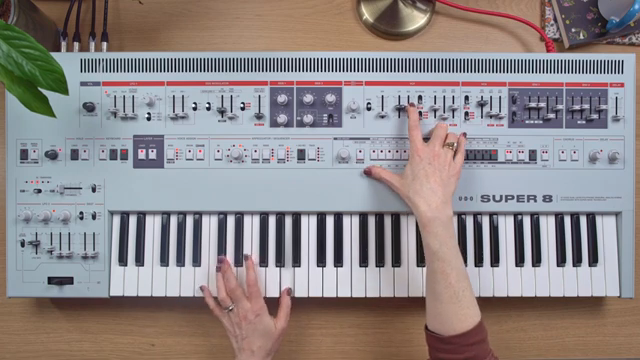
"It's just really subtle. A tiny bit of release just so that it's not completely off."
© Screenshot/Quote: Udo Audio (YouTube)
Switching to the bass, Hazel resets the lower layer and zeros in on a classic square wave for oscillator one. The filter is initially too open, so she dials it back and uses an envelope to shape the tone, quickly arriving at a sound that’s tonally close to the original.
The bass patch is refined with subtle envelope tweaks: sustain is removed, attack is slightly lengthened for a gentle ‘wha’ effect, and a touch of resonance is added—just enough to give character without veering into squelch territory. A small amount of release ensures the notes don’t cut off too sharply, rounding out a bass that’s simple yet effective.
Patchwork Community: Inviting the Next Challenge
The video closes with an invitation for viewers to suggest future patch challenges, reinforcing UDO Audio’s community-driven approach. By encouraging feedback and participation, the presentation positions the Super 8 not just as a synthesizer, but as a platform for collective exploration and shared learning.
This article is also available in German. Read it here: https://synthmagazin.at/udo-audio-super-8-patchwork-praezision-mit-caribous-honey/
Watch on YouTube:
Latest articles
Watch on YouTube:
Visit the channel:
https://www.youtube.com/udo_audio
https://www.youtube.com/udo_audio
Links from udo_audio:
website: https://www.udo-audio.com
instagram: https://www.instagram.com/udo_audio
Sponsored links:
If you purchase via these links, we may earn a small commission – at no extra cost to you. The link opens an Amazon keyword search, and results may vary depending on availability.
UDO Super 8
🔗 Check price on Amazon
🔗 Check price on Amazon