UDO Audio, known for their lush, hands-on polysynths, have slotted the Super 8 neatly between their flagship Super 6 and the mighty Super Gemini. In this official first-impressions video, Hazel Mills takes the Super 8 for a spin, building sounds from scratch and exploring its dual-layer architecture. The focus is on real-world patching and performance, with plenty of modulation, layering, and effects to showcase the instrument’s creative potential. If you’re curious about how the Super 8 behaves in a musician’s hands, this is a revealing, patch-oriented dive into UDO’s latest hybrid.
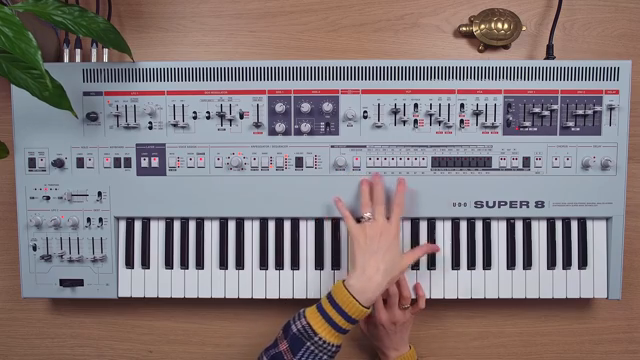
Super 8: The New Middle Child
UDO Audio’s Super 8 arrives as a bridge between the Super 6 and Super Gemini, both in terms of form factor and sonic ambition. Hazel Mills immediately notes the visual and operational similarities to its siblings, pointing out the familiar interface and the presence of dual layers—a nod to the Gemini’s more complex structure. This positioning makes the Super 8 a tempting prospect for those who want more than the Super 6 but don’t need the full heft of the Gemini.
The video hints at cross-compatibility, with Hazel mentioning that Super Gemini patches and performances can be loaded onto the Super 8. This suggests a thoughtful continuity in UDO’s design ethos, making it easier for users to move between instruments. The Super 8’s role is clearly to offer deep sound design and layering, while remaining approachable for hands-on exploration.
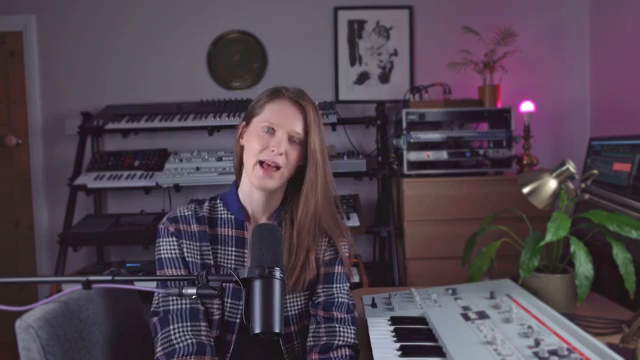
"It's somewhere in between the Super 6 and the Super Gemini."
© Screenshot/Quote: Udo Audio (YouTube)
Building from Scratch: Waveforms and Modulation
"It looks exactly the same as the Super Gemini and very similar to the Super 6."
© Screenshot/Quote: Udo Audio (YouTube)
Hazel Mills begins her exploration by starting from an initialized patch—a blank canvas that encourages experimentation. She quickly brings in noise and explores the wave morphing capabilities, using the modulation matrix to assign LFOs and subtly animate the sound. The workflow is reminiscent of both the Super 6 and Gemini, with a layout that invites instinctive patching rather than menu-diving.
The Super 8’s flexible oscillator section allows for a variety of waveforms and blends, with Hazel morphing between noise and alternative shapes. Modulation is at the heart of this process, as she demonstrates how easily LFOs can be routed to different parameters for evolving textures. The instrument’s design encourages users to follow their curiosity, layering modulation sources for organic movement.
Layering Up: Dual-Layer Design in Action
One of the Super 8’s standout features is its dual-layer functionality, which Hazel puts to immediate use by stacking sounds on the upper and lower layers. She crafts a simple sine-based patch on the upper layer, then adds a sawtooth and square wave on the lower, adjusting registers to create a rich, evolving timbre. This approach allows for complex soundscapes that would be cumbersome on a single-layer synth.
The ability to swap registers and blend layers on the fly gives performers a powerful tool for live expression and studio sound design. Hazel demonstrates how the two layers can interact, with the lower layer creeping in gradually for dramatic effect. The Super 8’s architecture is clearly designed for those who want to merge contrasting textures and timbres in a single patch.
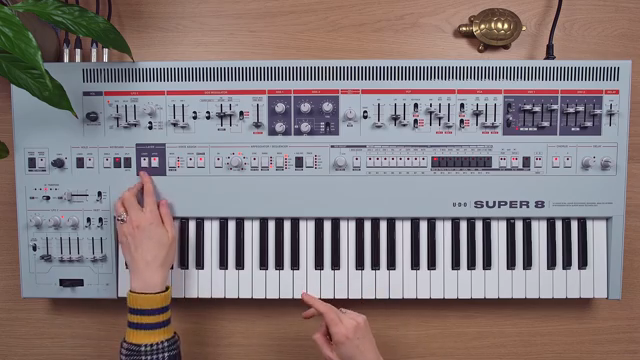
"I'm gonna swap them over in terms of register so that the lower layer is actually lower."
© Screenshot/Quote: Udo Audio (YouTube)
Chorus, Delay, and Creative Workflows
Effects are central to the Super 8’s sonic identity, and Hazel wastes no time engaging the onboard chorus and delay. These effects add width and depth, transforming simple patches into lush, spacious textures. The workflow is immediate—effects can be dialed in and tweaked as part of the sound design process, rather than as afterthoughts.
Hazel’s approach is to use effects not just for polish, but as integral components of the patch. She layers chorus and delay to enhance movement, then manipulates timing and feedback for evolving atmospheres. This hands-on, performance-friendly effects section supports creative workflows, allowing users to shape and reshape their sounds in real time.
Expressive Modulation and the Arpeggiator: Endless Exploration
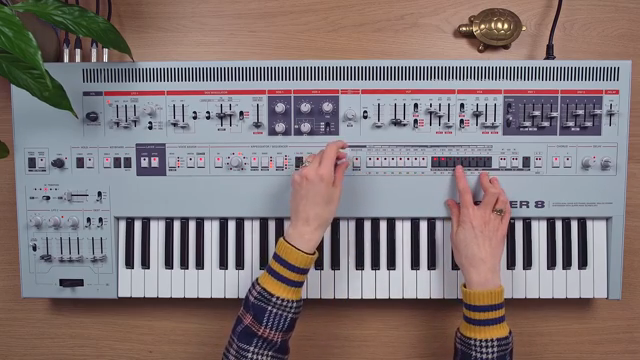
"Let's have after touch modulating the mix."
© Screenshot/Quote: Udo Audio (YouTube)
The Super 8’s modulation capabilities and arpeggiator are highlighted as tools for expressive performance. Hazel demonstrates aftertouch modulation, stereo phase manipulation, drift, and key tracking—all easily accessible and assignable via the modulation matrix. These features enable nuanced control over dynamics and timbre, making the instrument highly responsive to touch and gesture.
The arpeggiator adds rhythmic complexity, while modulation sources can be layered for intricate, evolving patterns. Hazel’s patching results in sounds reminiscent of shakers and hi-hats, with movement and brightness shaped by aftertouch and filter modulation. The overall impression is of an instrument designed for exploration, rewarding those who dig into its modulation and performance features with a vast palette of sonic possibilities.
This article is also available in German. Read it here: https://synthmagazin.at/udo-audio-super-8-zwischen-giganten-und-im-klangabenteuer/
Watch on YouTube:
Latest articles
Watch on YouTube:
Visit the channel:
https://www.youtube.com/udo_audio
https://www.youtube.com/udo_audio
Links from udo_audio:
website: https://www.udo-audio.com
instagram: https://www.instagram.com/udo_audio
Sponsored links:
If you purchase via these links, we may earn a small commission – at no extra cost to you. The link opens an Amazon keyword search, and results may vary depending on availability.
UDO Audio Super 8
🔗 Check price on Amazon
🔗 Check price on Amazon