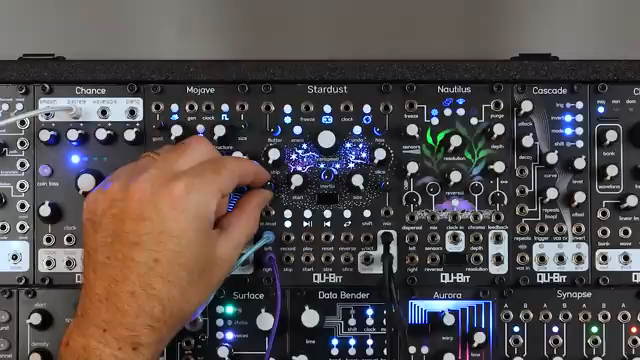
Qu-Bit returns with Stardust, a stereo tape looper module that promises to launch your modular rig into new sonic galaxies. In this official overview, the team walks through Stardust’s unique approach to capturing and manipulating audio layers, blending classic tape techniques with digital flexibility. As with previous Qu-Bit releases, the focus is on hands-on, performance-friendly controls and a distinctly exploratory workflow. If you’re curious about how Stardust fits into a patch, its looping tricks, and the cosmic depths of its effect section, this video lays out the essentials—and a few surprises—for any modular tape enthusiast.
14. November 2024
MILES
Qu-Bit Stardust: A Cosmic Take on Tape Looping for Eurorack
Stardust Enters the Modular Cosmos
Qu-Bit introduces Stardust as their latest foray into the world of modular tape looping, positioning it as a stereo looper with a cosmic twist. The module is designed to capture and replay layers of audio, inviting users to construct new sonic textures from simple recordings. This isn’t just a utilitarian looper—it’s pitched as a creative tool for building complex soundscapes, much like assembling a constellation from individual stars.
From the outset, Stardust is framed as a device for sonic exploration, with Qu-Bit promising a range of manipulation options that go well beyond basic looping. The video sets the stage for a deep dive into both the tactile controls and the more esoteric features, hinting at a module that’s as much about experimentation as it is about traditional looping duties.
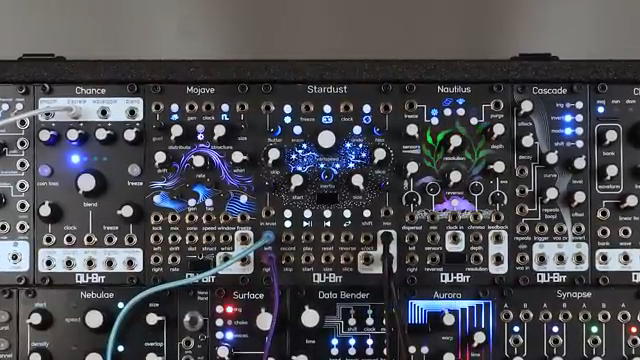
"Stardust is a stereo tape looper of cosmic proportions."
© Screenshot/Quote: Qubitelectronix (YouTube)
Front Panel: Hands-On Loop Crafting
"Turning the knob to the right from center introduces a warm tape saturation to the incoming signal, which gets more extreme as the knob reaches the far right position."
© Screenshot/Quote: Qubitelectronix (YouTube)
The front panel of Stardust is dominated by the illuminated Galaxy LEDs, a visual feedback system reminiscent of Qu-Bit’s Mojave and Aurora modules. These LEDs serve as both eye candy and functional indicators for various controls, making it easier to keep track of what’s happening during a performance or patch session.
Key controls start with In Level and Mix. In Level not only sets the gain for incoming audio but also introduces tape-style saturation as you push it past the center position—a nod to classic tape machines. The Mix knob blends dry and wet signals, and its curve can be adjusted via Qu-Bit’s Narwhal web app, offering flexibility for different mixing preferences.
Recording is handled by a dedicated button, with playback managed via Play/Pause and Reset. The workflow is straightforward: set levels, hit record, and loop away. The video demonstrates how easy it is to lay down a loop, adjust mix, and toggle playback, with the Galaxy LEDs providing constant visual cues. This hands-on approach is clearly aimed at performers who want immediate, tactile control over their loops.
Manipulation: Reverse, Undo, Erase, Size, and Varispeed
Stardust isn’t content with simple looping. The module offers a suite of manipulation tools that encourage creative risk-taking. Reverse playback is a one-touch affair, instantly flipping the loop’s direction and opening up classic tape tricks. Undo and Erase functions provide a safety net, letting users remove or restore layers without fear of losing work—until a new recording is made, at which point changes become permanent.
Loop boundaries are set with Start and Size controls, allowing precise definition of which part of the buffer is looped. The Size knob can shrink the loop down to as little as five milliseconds, enabling everything from long ambient washes to rapid-fire microloops. This flexibility is crucial for those who want to move beyond static, repetitive looping.
Varispeed is a central feature, controlling both playback speed and pitch in true tape fashion. The range is broad—1/16th to 8x speed, spanning four octaves down to three up. A one-volt-per-octave input allows melodic sequencing, while the Inertia knob introduces tape lag for more natural, analog-feeling speed changes. These features combine to make Stardust a playground for both precise and chaotic loop manipulation.
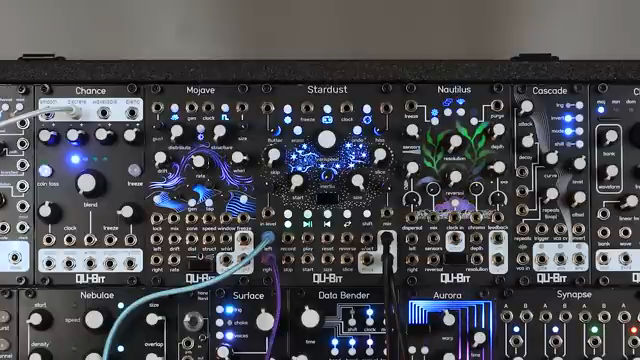
"Stardust is a tape inspired varus speed looper."
© Screenshot/Quote: Qubitelectronix (YouTube)
Skip, Slice, and Effects: Deep Space Sound Design
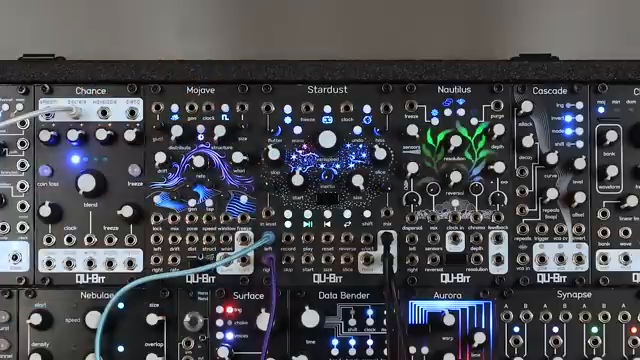
"When slice is active, skip will begin referencing the splice points along the loop point for its manipulations."
© Screenshot/Quote: Qubitelectronix (YouTube)
Stardust’s Skip and Slice controls push the module into experimental territory. Skip divides the loop into nine transformation zones, each introducing new behaviors like random reversals, octave jumps, or altered stereo images. Slice exponentially increases the number of splice points, allowing for intricate rearrangements and glitchy textures. When combined, these controls let users deconstruct and reassemble loops in real time, with visual feedback from the Galaxy LEDs marking each new zone or slice amount.
The module’s effect section offers four DSP modes: tape emulation (with wow, flutter, and hiss), digital artifacts (sample rate and bit crushing), lush reverb, and a dual filter (high-pass and low-pass). Each effect is selected via a dedicated button, with the Flutter and Hiss knobs repurposed for different parameters depending on the mode. This section is clearly designed for end-of-chain processing, letting users sculpt their loops with everything from subtle tape coloration to full-on digital destruction.
Freeze, another Qu-Bit signature, locks the tape head and repeats a tiny fraction of the loop, creating stutter and granular effects. The combination of these features means Stardust is as much a sound design instrument as it is a traditional looper, capable of everything from ambient washes to aggressive glitching.
Nova Output and Modular Integration
Integration is a key theme as the video wraps up. Stardust features a Clock input for syncing loop actions to external clocks, ensuring tight timing in complex modular setups. Activating Clock mode allows controls like Skip, Slice, and Record to operate in sync with incoming pulses, making the module suitable for both freeform and grid-based workflows.
The Nova Output is a unique addition, generating gate signals every time the tape head passes a loop or splice point. This output can be used to trigger events elsewhere in the system, opening up new possibilities for inter-module interaction. Qu-Bit hints at further customization via their Narwhal app, suggesting that Stardust’s role in a rack can be tailored to fit a wide range of creative needs.
This article is also available in German. Read it here: https://synthmagazin.at/qu-bit-stardust-kosmische-tape-looping-power-fuer-eurorack/
Watch on YouTube:
Latest articles
Watch on YouTube:
Visit the channel:
https://www.youtube.com/QuBitElectronix
https://www.youtube.com/QuBitElectronix
Links from QuBitElectronix:
Sponsored links:
If you purchase via these links, we may earn a small commission – at no extra cost to you. The link opens an Amazon keyword search, and results may vary depending on availability.
Qu-Bit Stardust
🔗 Check price on Amazon
🔗 Check price on Amazon