OXI Instruments returns with a deep dive into the OXI ONE’s CV and gate modulation prowess, showing just how much control this sequencer can exert over a modular setup. In this official walkthrough, the Spanish manufacturer demonstrates dynamic modulation, accent tricks, and advanced clocking—all with the OXI ONE as the command centre. If you’re curious about how this box handles real-world patching, from acid lines to polyphonic voice allocation, this video lays out the workflow with hands-on examples and patch-by-patch logic. It’s a practical look at how the OXI ONE can drive everything from drums to evolving soundscapes, with a workflow that’s as immediate as it is flexible.
10. October 2024
MILES
OXI Instruments OXI ONE: Mastering CV & Gate Modulation for Modular Mayhem
Buchla Easel, MetaFX, MetaModel Live, OXI Coral, Oxi One, Sample Drum, T Networks
The OXI ONE as Modulation Brain
The video opens by positioning the OXI ONE as a central hub for CV and gate modulation, setting the stage for a hands-on exploration of its capabilities. OXI Instruments makes it clear that this device isn’t just a sequencer—it’s designed to be the brain of a modular or hybrid setup, handling everything from melodic sequencing to nuanced modulation duties.
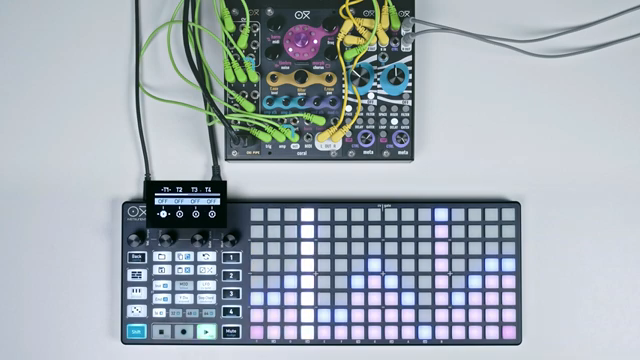
Right from the start, the acid patch example hints at the kind of dynamic control on offer. The OXI ONE’s ability to send out multiple CV and gate signals means it can shape timbre, trigger accents, and even drive effects, all from a single interface. This approach is about more than just triggering notes; it’s about sculpting the entire patch in real time.
"With these two tutorials you'll be a master of CVGate."
© Screenshot/Quote: Oxiinstruments (YouTube)
Modulation and Accent: Beyond Simple Sequencing
"The accent will go into Coral Amp Input to add accents on the acid engine just like a 303 would."
© Screenshot/Quote: Oxiinstruments (YouTube)
Diving into the modulation lanes, the video demonstrates how CV outputs can be assigned to modulate parameters like timbre on the Coral module. The workflow is direct: select a mod lane, assign it to a CV output, and then shape the modulation either manually, with randomisation, or by drawing curves by hand. This flexibility allows for expressive, evolving sound design that goes far beyond static step sequencing.
Accents are handled with similar finesse. By routing gate outputs to accent inputs—such as the amp input on Coral—the OXI ONE injects rhythmic variation reminiscent of classic acid lines. The accent function is not just a binary on/off; it’s tied to velocity and threshold settings, so the intensity of each accent can be tailored to the patch, adding that extra bit of groove and character.
Thresholds, Clocks, and Modulation Depth: Real-Time Control
Threshold functions are shown as a way to trigger events based on modulation levels—when a mod lane crosses a set value, a gate is sent to another module, such as triggering a sweat parameter on MetaFX. This opens up possibilities for patches that respond dynamically to evolving modulation, rather than just fixed step events.
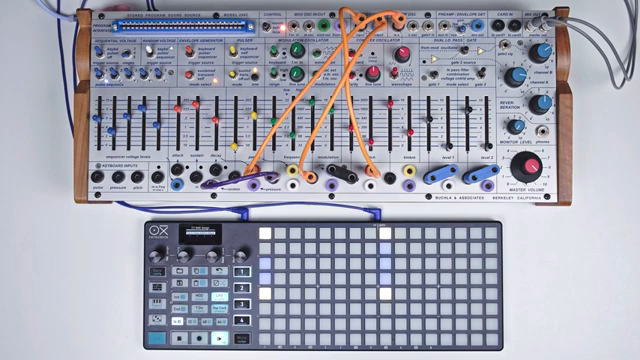
Clocking is also addressed, with the OXI ONE able to send different time divisions to external gear. For example, the Buchla Easel can be synced to a slower clock division than the main sequence, allowing for polyrhythms or complex timing relationships. The ability to adjust these divisions in real time means the OXI ONE isn’t just a static brain—it’s a live performance tool for shaping the pulse of a modular system.
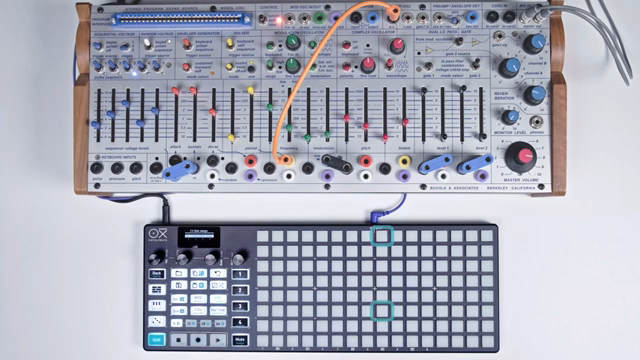
"Here we can define the time division, we want a slower one to sync our easel pulsar to the defined division."
© Screenshot/Quote: Oxiinstruments (YouTube)
Patch Bay Playground: Integrating Drums and Modules
The video then shifts to a practical demonstration of connecting the OXI ONE to a variety of modules and drum voices. Each gate output is patched to trigger different elements—sample drums, hats, toms, and even the Coral module’s trigger input. CV outputs are assigned to pitch and modulation duties, showing how the sequencer can control both rhythm and melody across multiple voices.
This section underlines the OXI ONE’s role as a patching powerhouse. Assigning tracks to different drum voices or melodic parts is as simple as selecting the right sequencer lane and output. The workflow encourages experimentation, letting users quickly reassign outputs or layer modulation for more complex textures. It’s a modular playground, with the OXI ONE at the centre.
Polyphony and Voice Allocation: Sequencing Beyond Monophonic Lines
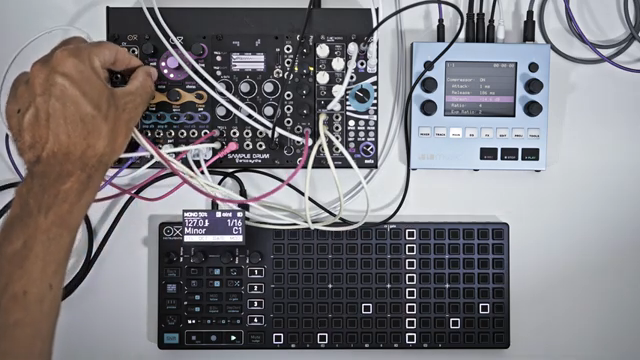
"If you want to sequence chords and polyphonic melodies on your modular system, using the voice pitch allocation is very easy, straightforward and flexible as it gets, because you can select the number of voices you want to output."
© Screenshot/Quote: Oxiinstruments (YouTube)
Finally, the video explores polyphonic sequencing and voice allocation. The OXI ONE allows users to select how many voices to output, making it straightforward to set up chords or polyphonic melodies in a modular environment. This is a significant step beyond the typical monophonic sequencing found in many Eurorack setups.
Voice allocation modes—such as last recently used (LRU) and unison—are explained, highlighting how the OXI ONE distributes notes across available CV and gate pairs. This flexibility is crucial for those looking to sequence complex arrangements or layer multiple voices without manual repatching.
The tutorial wraps up by reinforcing the OXI ONE’s strengths as a CV/gate master, capable of handling everything from acid basslines to polyphonic soundscapes. The workflow remains hands-on and immediate, with voice allocation and modulation tools that invite creative patching and real-time experimentation.
This article is also available in German. Read it here: https://synthmagazin.at/oxi-instruments-oxi-one-cv-gate-modulation-fuer-modulare-kontrolle-im-detail/
Watch on YouTube:
Latest articles
Watch on YouTube:
Visit the channel:
https://www.youtube.com/oxiinstruments
https://www.youtube.com/oxiinstruments
Links from oxiinstruments:
website: https://oxiinstruments.com
instagram: https://www.instagram.com/oxiinstruments
facebook: https://www.facebook.com/oxiinstruments/
support: https://oxiinstruments.com/support
Sponsored links:
If you purchase via these links, we may earn a small commission – at no extra cost to you. The link opens an Amazon keyword search, and results may vary depending on availability.
Buchla Easel
🔗 Check price on Amazon
🔗 Check price on Amazon
MetaFX
🔗 Check price on Amazon
🔗 Check price on Amazon
MetaModel Live
🔗 Check price on Amazon
🔗 Check price on Amazon
OXI Coral
🔗 Check price on Amazon
🔗 Check price on Amazon
Oxi One
🔗 Check price on Amazon
🔗 Check price on Amazon
Sample Drum
🔗 Check price on Amazon
🔗 Check price on Amazon
T Networks
🔗 Check price on Amazon
🔗 Check price on Amazon