Some instruments don’t just make sound—they conjure worlds. Oscillator Sink, the soft-spoken architect of synth reverie, invites us into the magnetic orbit of the Polygene 2 by Gene Synths. This is not a review, nor a tutorial, but a meditation on beauty, touch, and the secret language between player and machine. The Polygene 2 stands as both sculpture and vessel, its analog heart pulsing with stories old and new. Prepare to drift through fog, fractured harmonics, and the tactile poetry of a synth that demands to be felt as much as heard.
8. December 2025
LUMINA
Oscillator Sink’s Polygene 2: A Synthesizer That Breathes Light and Memory
A Synth That Breathes in Color
Some instruments arrive not as mere tools, but as companions—crafted with such intention that they seem to have been summoned from a dream. Oscillator Sink introduces the Polygene 2 as one of these rare beings, a machine that feels as if it was designed from the inside out, tailored to the contours of longing and imagination. The Polygene 2 is not simply a device; it is a vessel for sonic memory, blending forward-thinking design with a reverence for the past.
Its presence is magnetic, drawing the eye and ear with lines that echo both retro-futurism and artisan craft. The Polygene 2’s beauty is not skin-deep; it radiates from the interplay of form and function, inviting us to touch, to listen, to lose ourselves in its possibilities. This is a synth that asks for more than programming—it asks for a relationship, a willingness to explore its depths and idiosyncrasies.

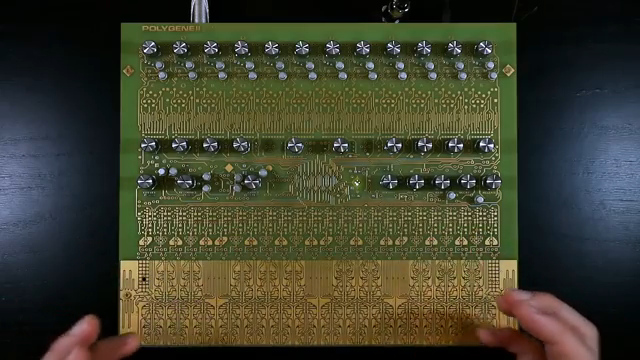
"Something that feels like the designer opened up my skull and inspected my brain to craft exactly the type of instrument that makes me feel warm and fuzzy."
© Screenshot/Quote: Oscillatorsink (YouTube)
Articulation: Notes as Nebulae
"Each note that we play is completely independently articulated."
© Screenshot/Quote: Oscillatorsink (YouTube)
Within the Polygene 2, each note is a world unto itself—independently articulated, free to bloom or dissolve without tethering to its neighbors. Oscillator Sink reveals how this architecture enables a tapestry of textures, where voices drift and collide like clouds of stardust. The 24-voice polyphony is not just a number; it’s an invitation to sculpt complexity, to let harmonics shimmer and decay in their own time.
The filter, perched at the end of the signal chain, acts as a shared horizon for these voices, paraphonic in its response yet never flattening the individuality of each note. This separation and convergence create a living, breathing soundscape—one where every gesture leaves a trace, every chord a constellation.
The Tunable Keyboard: A Portal to the Unknown
The Polygene 2’s keyboard is not bound by tradition. Instead, it is a canvas of possibility, each note freely tunable within its 12-note scale. Oscillator Sink demonstrates how this design liberates the performer, allowing the familiar to slip into the uncanny. A B can become something else entirely, and with it, the entire harmonic landscape shifts beneath your fingertips.
This tunability extends across two octaves, each with its own character—one raw and volatile, the other shaped by harmonic oscillators and sculpted through an array of tactile controls. The result is a keyboard that does not dictate, but invites: every performance is a new map, every session a journey into uncharted territory.
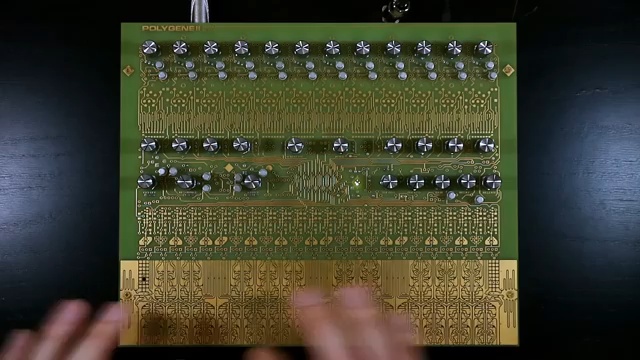
"The keyboard is completely freely tunable within that 12 note scale."
© Screenshot/Quote: Oscillatorsink (YouTube)
Analog Heart, Sonic Ghosts
At its core, the Polygene 2 is resolutely analog—a living circuit, humming with warmth and unpredictability. Oscillator Sink guides us through its architecture: transistor-based oscillators, harmonic shapers, and a filter that can bloom or snarl depending on the touch. The sound is not static; it evolves, shifting from glassy resonance to metallic haze, from gentle bloom to chaotic overdrive.
Modulation is woven into its fabric: envelopes, LFOs, and noise sources interact to create movement and surprise. The tactile interface—knobs, switches, exposed circuitry—invites the player to sculpt sound in real time, to coax out sonic ghosts that linger and morph. This is a synth that rewards curiosity, where every patch is a new story waiting to be told.
Touching Circuits, Summoning Magic
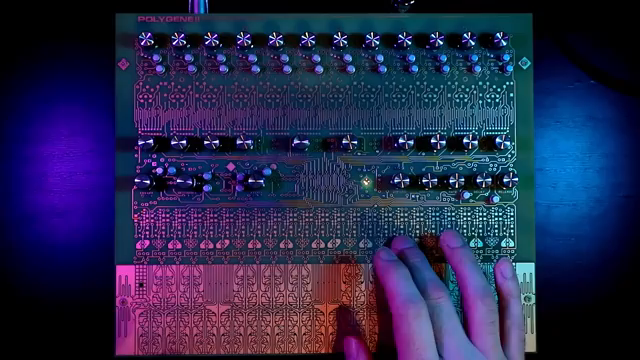
"I hope I've been able to give you an overview of what it can do and why it is special."
© Screenshot/Quote: Oscillatorsink (YouTube)
Oscillator Sink’s hands-on demonstrations reveal the Polygene 2’s true voice—a spectrum that ranges from delicate, spectral pads to wild, chaotic bursts. By bridging transistors, sweeping partials, and manipulating the exposed circuitry, the synth becomes an extension of the performer’s intent. Each gesture sends ripples through the sound, sometimes subtle, sometimes eruptive, always alive.
External effects—reverb and delay—are woven in, adding space and shimmer, but the heart of the experience is tactile. The Polygene 2 responds to pressure, to touch, to the smallest nuance, forging a bond between instrument and player. It is in these moments of exploration that the synth’s character emerges: unpredictable, sometimes unruly, but always deeply expressive.
Yet, as with all truly magical instruments, words and text can only hint at the depths within. The full resonance, the shifting harmonics, the way the Polygene 2 exhales fog and fractured light—these are best experienced firsthand. To truly understand its magic, one must watch, listen, and drift inside its world.
This article is also available in German. Read it here: https://synthmagazin.at/oscillator-sink-und-das-polygene-2-ein-synthesizer-der-licht-und-erinnerung-atmet/
Watch on YouTube:
Latest articles
Watch on YouTube:
Visit the channel:
https://www.youtube.com/OscillatorSink
https://www.youtube.com/OscillatorSink
Links from OscillatorSink:
website: https://oscillatorsink.com
instagram: https://www.instagram.com/oscillatorsink
twitter: https://x.com/OscillatorSink
facebook: https://www.facebook.com/OscillatorSink
bandcamp: https://oscillatorsink.bandcamp.com
gumroad: https://oscillatorsink.gumroad.com
Sponsored links:
If you purchase via these links, we may earn a small commission – at no extra cost to you. The link opens an Amazon keyword search, and results may vary depending on availability.
GFI Specular Reverb v3
🔗 Check price on Amazon
🔗 Check price on Amazon
Hate Echo
🔗 Check price on Amazon
🔗 Check price on Amazon
Polygene 2
🔗 Check price on Amazon
🔗 Check price on Amazon