Verbos Electronics returns with a deep-dive into the Voltage Multistage 10, their 10-step sequencer that thrives on the unexpected interplay of odd and even sequence lengths. In this video, the Berlin-based team demonstrates how contrasting step counts can inject a patch with evolving rhythmic complexity, far beyond the usual four-bar grid. With a focus on modulation, filter sculpting, and layered control voltages, the presentation is a patch-builder’s delight—showing not just what the module can do, but how it wants to be used in a real-world Eurorack setup. If you’re after static loops, look elsewhere; this is about organic, shifting patterns and the subtle art of voltage choreography.
27. January 2026
MILES
Odd over Even: Verbos Electronics Explores the Voltage Multistage 10
Bark Filter, Complex Oscillator, Harmonic Oscillator, Multi-Delay, Voltage Multistage 10
Why Ten Steps? The Philosophy of Odd-Length Sequencing
The Voltage Multistage 10 is introduced not just as a sequencer, but as a deliberate design choice—ten steps, neither the classic eight nor a neat sixteen. Verbos Electronics highlights how this odd length is intended to break away from the rigid, divisible structures that dominate much of electronic music. By choosing ten steps, the module naturally encourages patterns that refuse to loop predictably, opening the door to subtle rhythmic evolution.
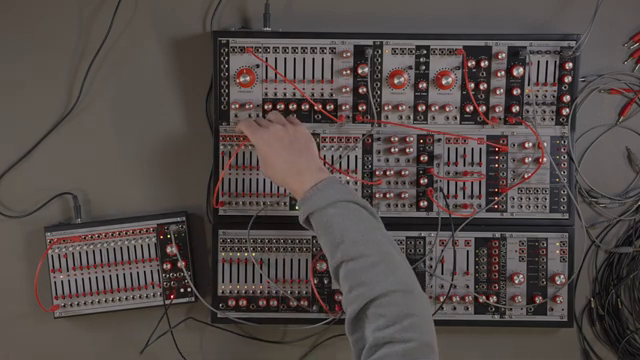
In the patch, two voices are controlled by separate sequences, with the top row modulating decay time and the bottom row handling filter cutoff. The video sets the stage for exploring how these odd and even sequence lengths, when paired, create a fertile ground for micro-variation and evolving textures. It’s a clear invitation to think beyond the bar line, letting the sequencer’s structure drive musical unpredictability.
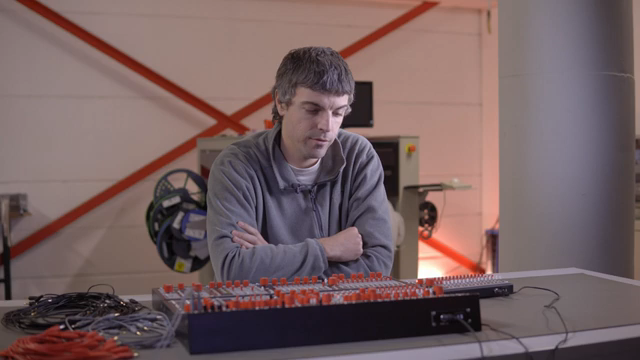
"Sequence of an odd length that contrasts with something that's divisible by 4, 8, 16, 32, which is the way that a lot of our music is organized."
© Screenshot/Quote: Verboselectronicsgmbh (YouTube)
Phasing Patterns: Contrasting Odd and Even Sequences
"The relationship is going to become offset in such a way that it repeats it takes a long time for them to actually get back to where they're repeating at the beginning again if that makes sense."
© Screenshot/Quote: Verboselectronicsgmbh (YouTube)
The core of the demonstration lies in pairing sequences of different lengths—one ten steps, the other sixteen. By syncing their clocks but offsetting their step counts, Verbos Electronics shows how the resulting patterns drift in and out of phase. This creates a constantly shifting relationship between the two voices, as their cycles only occasionally align before diverging again.
The effect is most apparent when both sequences are set to the same length: the patch loops in a predictable, even manner. But as soon as one sequence is extended by a single step, the interplay becomes far more complex. The video makes it clear that this approach is about generating organic variation, with the phasing of odd and even sequences acting as the engine for evolving, non-repetitive grooves.
Modulating Decay and Filter: Shaping Texture in Motion
A key feature of the patch is the use of the sequencer’s rows to modulate both decay time and filter cutoff. The top row of each sequence is routed to control the decay of its respective voice, while the bottom row shapes the filter cutoff. This dual modulation approach allows for intricate sculpting of each sound’s envelope and timbre, with the sliders providing hands-on control over how each step behaves.
The video demonstrates how these modulations interact: longer decay times on certain steps can create moments of sustained resonance, while filter cutoff changes add further movement. Importantly, the presenter notes that opening the filter on a step with a very short decay may have little audible effect—a reminder that envelope and filter modulation are deeply interdependent in shaping the final sound. The result is a patch that’s static in timbre but alive with micro-variation.
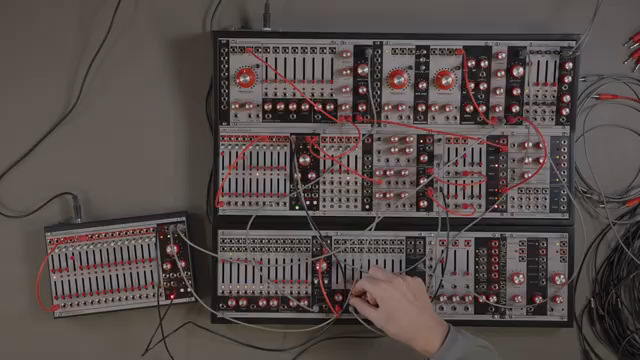
"If you're opening the cut off on a step which has a really short decay, it's not going to be very obvious what the difference is."
© Screenshot/Quote: Verboselectronicsgmbh (YouTube)
Beyond the Grid: Integrating Harmonic and Complex Oscillators
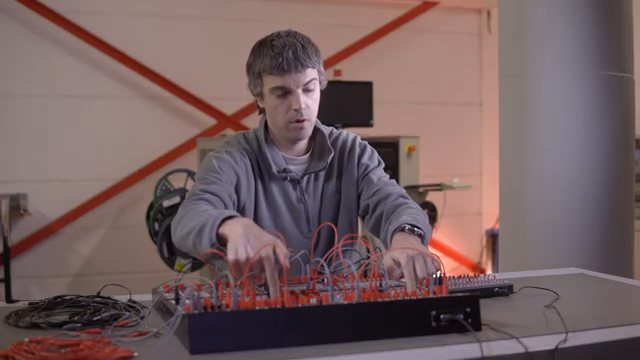
"At home a lot I would be using a MIDI to CV converter with an external sequencer connected to the volt per octave inputs."
© Screenshot/Quote: Verboselectronicsgmbh (YouTube)
The demonstration moves into sound design territory by integrating both harmonic and complex oscillators into the patch. The harmonic oscillator is routed through the Bark filter, while the complex oscillator takes a more direct path. The use of quantized random modulation on the Bark filter’s width and center parameters introduces a new layer of unpredictability, with each pulse generating a fresh value in sync with the sequence.
Further complexity is added through audio-rate modulation—amplitude modulation on the complex oscillator and frequency modulation on the harmonic oscillator—resulting in textures that range from bit-crushed to discordant. The video notes that no melodic information is present, giving the patch a droning, atonal character. However, the presenter suggests that introducing external sequencers and volt-per-octave control could easily transform this into a more melodic, harmonically rich setup.
Layered Modulation: Building Richness with Control Voltage
The final section explores the potential for layered modulation and complex control voltage interplay. By stacking quantized random, unquantized looping envelopes, and sequence-driven CV, the patch achieves a dense, evolving soundscape. The polyphonic envelope is used to sweep oscillator pitch, introducing whooping effects that are intentionally out of sync with the main sequences, adding another dimension of unpredictability.
The use of a sequence selector and additional CV routing to the VCAs allows for further dynamic control, such as holding the volume high on certain steps. Throughout, the video underscores how the foundation of mismatched sequence lengths supports this layered approach, enabling patches that are rich in variation and resistant to repetition. It’s a compelling argument for the creative power of the Voltage Multistage 10 when used as the backbone of a complex modular rig.
This article is also available in German. Read it here: https://synthmagazin.at/odd-over-even-verbos-electronics-erforscht-den-voltage-multistage-10/
Watch on YouTube:
Latest articles
Watch on YouTube:
Visit the channel:
https://www.youtube.com/VerbosElectronicsGmbH
https://www.youtube.com/VerbosElectronicsGmbH
Links from VerbosElectronicsGmbH:
website: https://www.verboselectronics.com
tech_cards: https://www.verboselectronics.com/tech-cards
instagram: https://www.instagram.com/verboselectronics
Sponsored links:
If you purchase via these links, we may earn a small commission – at no extra cost to you. The link opens an Amazon keyword search, and results may vary depending on availability.
Bark Filter
🔗 Check price on Amazon
🔗 Check price on Amazon
Complex Oscillator
🔗 Check price on Amazon
🔗 Check price on Amazon
Harmonic Oscillator
🔗 Check price on Amazon
🔗 Check price on Amazon
Multi-Delay
🔗 Check price on Amazon
🔗 Check price on Amazon
Voltage Multistage 10
🔗 Check price on Amazon
🔗 Check price on Amazon