Novation’s Circuit Tracks is more than just a groovebox—it’s a compact laboratory for musical evolution. In this official NovationTV walkthrough, Dylan demonstrates how a simple melodic phrase can blossom into a dynamic track by leveraging the Pattern Mutation feature. The video is a hands-on exploration of how to break free from repetition, using Circuit Tracks’ sequencing, pattern chaining, and real-time mutation tools. For producers and performers seeking fresh workflows, this session offers a clear look at how digital architecture and tactile control combine to inspire spontaneous, ever-changing music.
1. August 2025
LYRA
Novation Circuit Tracks: Pattern Mutation and the Art of Evolving Grooves
From Simple Seeds to Full Arrangements
The session opens with Dylan introducing Circuit Tracks as his tool of choice for transforming a basic melodic idea into a more complete musical statement. The initial phrase, played on one of the synth tracks, sets a distinct mood and serves as the foundation for further development. Circuit Tracks’ interface, with its step buttons and pattern management, is immediately put to use as Dylan prepares to layer drums and bass over the melody.
This approach highlights the groovebox’s core strength: quickly moving from a spark of inspiration to a structured composition. The workflow is tactile and direct, with pattern length and track selection easily visible on the hardware. Novation’s artist-focused design philosophy is evident here, encouraging users to build up arrangements organically and intuitively, without getting bogged down in menu-diving or DAW dependency.
Pattern Mutation: Controlled Chaos
Pattern Mutation is the star of this walkthrough, offering a clever way to inject variation without losing the essence of the original phrase. By duplicating patterns and applying mutation, Dylan demonstrates how Circuit Tracks shuffles note positions within a pattern, creating new rhythmic or melodic contours while preserving the underlying notes. This is not randomization in the traditional sense—no new notes are introduced, and the musical DNA remains intact.
The process is playful yet precise: users can repeatedly mutate a pattern until something musically satisfying emerges. This feature is especially useful for creating fills, turnarounds, or subtle evolutions in a sequence, all without manual reprogramming. The result is a workflow that rewards experimentation and reduces the risk of creative stagnation, a recurring theme in Novation’s design ethos.
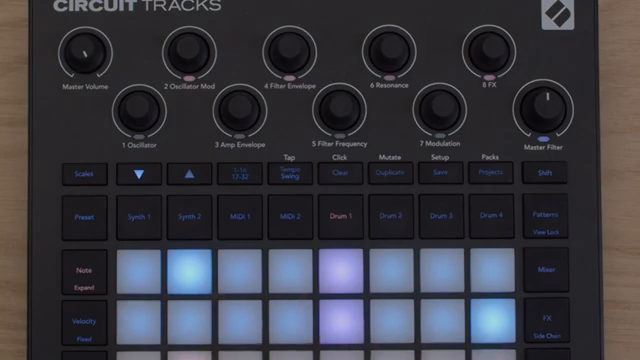
"It basically takes all the notes in the pattern and just shuffles them around."
© Screenshot/Quote: Novationtv (YouTube)
Building and Mutating Drum, Bass, and Melodic Layers
Dylan’s track-building process is methodical yet exploratory. He starts by programming a straightforward 16-step drum pattern, layering kick, snare, and hi-hat. Each drum track is duplicated multiple times, setting the stage for variation. The fourth iteration of each drum pattern becomes a playground for mutation, with fills and rhythmic twists emerging from the shuffle process. This technique brings life to otherwise static loops, making transitions and breakdowns feel organic.
The same philosophy is applied to melodic and bass parts. By duplicating and mutating synth and bass patterns, Dylan crafts evolving phrases that interact in interesting ways. He occasionally adds or tweaks notes before mutating, showing how even small changes can lead to dramatically different results. The ability to listen to mutated patterns in context with the rest of the track highlights Circuit Tracks’ strength as a performance and composition tool, not just a static sequencer.
Chaining Patterns: Seamless Transitions and Evolving Sequences
Pattern chaining is presented as a key workflow for creating longer, more engaging musical passages. By linking multiple pattern variations—originals and their mutated counterparts—Dylan constructs sequences that evolve naturally over time. This is particularly effective for building tension and release, as listeners are guided through familiar motifs and unexpected twists.
The video demonstrates how chaining can be used to structure a track: three repetitions of a core groove followed by a fill, or alternating between original and mutated melodic lines. This approach minimizes repetition fatigue and opens up possibilities for live performance, where on-the-fly pattern selection and chaining can keep sets dynamic and unpredictable. Circuit Tracks’ interface makes this process accessible, with clear visual feedback and minimal menu navigation.
Spontaneity and Discovery: Breaking the Loop
"I hope that shows you how you can use pattern mutation to take simple ideas and extend them into more interesting phrases and sequences."
© Screenshot/Quote: Novationtv (YouTube)
The session closes with an emphasis on creative spontaneity. Dylan encourages users to embrace mutation and pattern chaining as tools for escaping the trap of static loops. By combining duplication, mutation, and real-time arrangement, Circuit Tracks becomes a platform for discovery, where happy accidents are not only possible but encouraged.
This hands-on approach aligns with Novation’s broader mission: to empower producers to move quickly from idea to finished track, whether in the studio or on stage. While the video focuses on surface-level features, it’s clear that Circuit Tracks’ digital architecture is designed for fluid, iterative music-making. The potential for deeper exploration—modulation, effects, integration—remains, but even at this level, the workflow is inspiringly open-ended.
This article is also available in German. Read it here: https://synthmagazin.at/novation-circuit-tracks-pattern-mutation-und-die-kunst-der-groove-entwicklung/
Watch on YouTube:
Latest articles
Watch on YouTube:
Visit the channel:
https://www.youtube.com/NovationTV
https://www.youtube.com/NovationTV
Links from NovationTV:
website: https://novationmusic.com
instagram: https://instagram.com/wearenovation
twitter: https://twitter.com/WeAreNovation
facebook: https://facebook.com/NovationMusic
Sponsored links:
If you purchase via these links, we may earn a small commission – at no extra cost to you. The link opens an Amazon keyword search, and results may vary depending on availability.
Novation Circuit Tracks
🔗 Check price on Amazon
🔗 Check price on Amazon