Noise Engineering, the Los Angeles boutique known for its inventive Eurorack modules, introduces the Opp Ned—a compact four-channel arpeggiator designed to inject melodic complexity into even the tightest racks. In this official video, the team showcases how Opp Ned’s blend of pre-programmed patterns, hands-on editing, and flexible CV control can transform simple sequences into intricate, evolving textures. With independent channel advancement, a full suite of pattern management features, and a panel that’s as intuitive as it is compact, Opp Ned looks ready to become a staple for anyone seeking more than just basic up-and-down arps. Let’s see how this module fits into the ever-growing Noise Engineering ecosystem.
22. March 2024
MILES
Noise Engineering’s Opp Ned: Four-Channel Arpeggiation in 8HP
Compact Power: Four Channels in 8HP
Noise Engineering’s Opp Ned is pitched as the answer for anyone searching for a compact arpeggiator module that doesn’t skimp on creative potential. At just 8HP wide, it manages to squeeze in four independent arpeggiator channels, making it a strong contender for smaller racks or live setups where space is at a premium. The video opens by highlighting how Opp Ned is designed to inspire new melodic ideas, offering both simplicity and depth for patchers keen to explore beyond basic sequences.
The module’s layout and feature set are clearly aimed at those who want to add melodic movement and complexity to their modular patches without dedicating half a row to sequencing. By focusing on real-world patching scenarios, Noise Engineering demonstrates that Opp Ned isn’t just about cramming features into a small panel—it’s about providing immediate, hands-on access to arpeggiation that can be flexibly integrated into any system.
Preset Patterns and Custom Creativity
Opp Ned ships with 12 pre-programmed arpeggios, giving users a quick starting point for everything from classic tetrads to pentatonic and minor third patterns. The video details how these presets are distributed across the module’s memory slots, with the first eight covering various tetrads—including a rather cheeky degenerate tetrad made entirely of major thirds—while the remaining four offer major, pentatonic major, minor third, and pentatonic minor options.
For those who prefer to roll their own, Opp Ned’s Load/Edit/Save workflow is straightforward. Users can load a pattern, edit it note-by-note using the encoder and switches, and save their creations to any of the 12 slots. The process is visually guided by the panel’s LEDs, which double as both note indicators and pattern slot markers. If you ever want to revert to the factory settings, a quick firmware flash via the Noise Engineering portal restores all original patterns. This flexibility, paired with the ability to transpose patterns on the fly via CV, makes Opp Ned equally suited to improvisation and pre-planned performance.
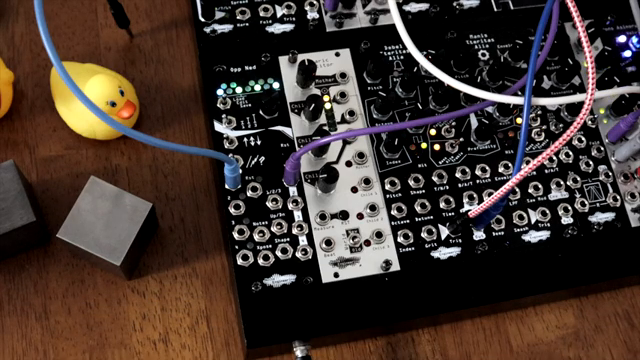
"The module ships with 12 of our favorite arpeggios to get you started."
© Screenshot/Quote: Noiseengineering (YouTube)
Independent Channels and Configurable Playback
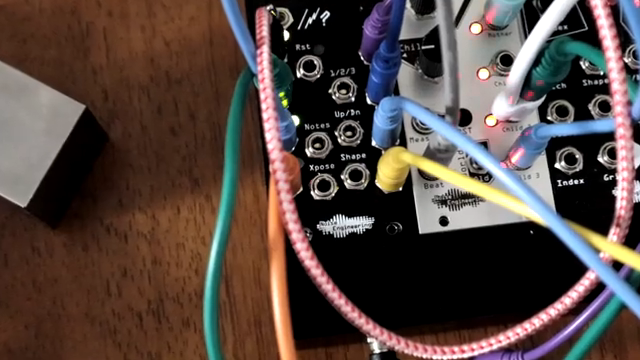
"The same arpeggio runs on all 4 channels, each advancing independently based on its trigger input."
© Screenshot/Quote: Noiseengineering (YouTube)
A standout feature of Opp Ned is its four independent outputs, each capable of advancing through the same arpeggio pattern at its own pace. By feeding different trigger signals to each channel, users can create intricate, interlocking melodic lines or send arpeggios to multiple oscillators for thick, harmonically rich textures. The video demonstrates how each output can be patched to separate destinations, with triggers advancing notes independently—a boon for anyone who enjoys polyrhythmic or generative approaches.
Beyond simple note advancement, Opp Ned offers deep configurability. Octave range can be set from one to three octaves, while the direction switch lets you choose between ascending, descending, or up-and-down movement. The pattern switch provides further variety, with options for sequential (Plane), zigzag (Zig), and random playback. All of these parameters are not only accessible from the panel but also CV-controllable, opening the door to evolving, hands-free arpeggiation that responds to modulation elsewhere in your patch.
Trigger, Reset, and Creative Control
Opp Ned’s trigger and reset inputs are central to its flexibility in a modular context. Each of the four trigger inputs advances its corresponding channel, allowing for truly independent rhythmic patterns across outputs. The reset input brings all channels back to their first step on the next advance, ensuring tight synchronization when needed. Holding the reset button freezes all channels on their current note, only releasing them to the first step when the button is let go—a handy trick for live performance or dramatic transitions.
This level of control means Opp Ned can serve as both a straightforward arpeggiator and a more experimental pattern generator, depending on how you patch it. Whether you’re after classic arpeggiated lines or want to inject a bit of unpredictability into your sequences, the module’s input scheme supports a wide range of creative workflows.
"When pressing the reset button, or using the reset input, all four channels will reset to their first step on the next advance."
© Screenshot/Quote: Noiseengineering (YouTube)
LED Navigation and Pattern Management
Navigating Opp Ned’s features is made intuitive by its LED system, which provides clear visual feedback for both note selection and pattern slot management. The top row of LEDs represents an octave on a keyboard, making it easy to see which notes are active in a pattern. When loading or saving, these same LEDs indicate which of the 12 slots you’re working with, streamlining the process of managing multiple arpeggios.
This interface, combined with the tactile encoder and switches, allows users to quickly build, modify, and recall complex arpeggiated sequences. The video walks through several patch examples, showing how easy it is to edit patterns, change playback modes, and route outputs to various destinations. For those who value both immediacy and depth, Opp Ned’s panel design strikes a balance between hands-on control and the ability to dive deep into custom sequence creation.
This article is also available in German. Read it here: https://synthmagazin.at/noise-engineering-opp-ned-vierkanal-arpeggiator-in-8hp-kompakt-vielseitig-patchbar/
Watch on YouTube:
Latest articles
Watch on YouTube:
Visit the channel:
https://www.youtube.com/NoiseEngineering
https://www.youtube.com/NoiseEngineering
Links from NoiseEngineering:
website: https://noiseengineering.us
instagram: https://instagram.com/noiseeng
twitter: https://x.com/noiseeng
facebook: https://facebook.com/noiseeng
reason: https://bit.ly/noiseeng-reason
Sponsored links:
If you purchase via these links, we may earn a small commission – at no extra cost to you. The link opens an Amazon keyword search, and results may vary depending on availability.
Noise Engineering Opp Ned
🔗 Check price on Amazon
🔗 Check price on Amazon