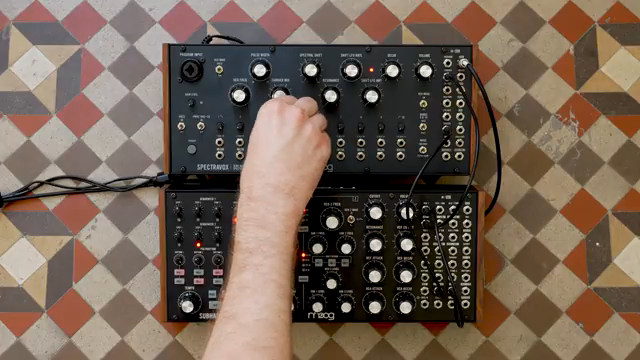
Moog Music’s latest demo dives headlong into the modular deep end, pairing the Subharmonicon’s polyrhythmic sequencing with the spectral wizardry of the Spectravox filter bank. This official manufacturer video isn’t just a dry walkthrough—it’s a showcase of how classic Moog building blocks can be patched together for genuinely unorthodox results. Expect a journey from traditional lowpass filtering to the wild territory of unsynced sub-oscillator modulation, revealing how these two instruments can conjure up shifting, interference-rich soundscapes. If you’re curious about the real-world patching potential of Moog’s modern classics, this is a must-watch.
20. September 2025
MILES
Moog Music’s Spectravox & Subharmonicon: Filter Bank Adventures Off the Beaten Path
Spectral Synergy: Subharmonicon Meets Spectravox
The video opens with Moog Music combining two of their modern analog instruments—the Subharmonicon and Spectravox—to explore new realms of filter bank modulation. Rather than sticking to familiar subtractive synthesis, the focus here is on how these devices can be patched together to create something less predictable. By routing the Subharmonicon’s VCO1 into the Spectravox’s carrier input, the stage is set for a deep-dive into spectral manipulation, using all ten of Spectravox’s filters as a playground for sonic experimentation.
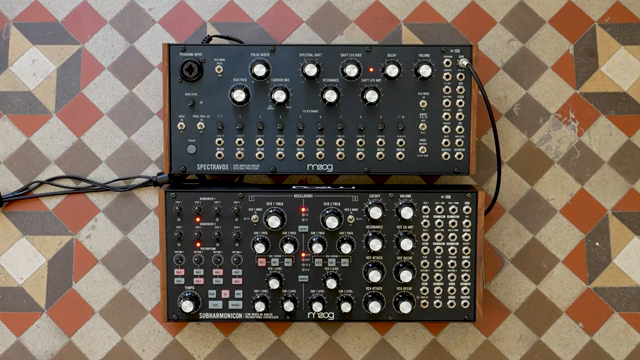
"use the 10 filter bands of Spectrovox and the ability to modulate all of them to bring a simple sequence into uncharted waters."
© Screenshot/Quote: Moogsynthesizers (YouTube)
Sequencing Foundations and Filter Bank Routing
Moog demonstrates the initial patching steps, starting with Subharmonicon’s VCO1 as the audio source and sending it directly to Spectravox’s carrier input. With Spectravox set to Filter Bank mode, the VCO1 signal is distributed across all ten filter bands, opening up a wide palette for spectral shaping. The Subharmonicon’s dual sequencer comes into play here: Sequencer 1 is assigned to VCO1, while Sequencer 2’s output is patched into VCO1’s input, effectively chaining the sequencers for longer, more intricate step patterns.
Once the sequence is running, the Spectravox’s internal VCA is engaged by switching its mode to EG, allowing its envelope to shape the amplitude. Further integration is achieved by patching the Subharmonicon’s Sequencer 1 clock output to Spectravox’s trigger input, ensuring the envelope is triggered in sync with the sequence. This setup lays the groundwork for both classic and unconventional modulation techniques.
From Classic Lowpass to Subharmonic Mayhem
"Spectral Shift moves the frequencies of all 10 filters so if we're only listening to the low pass filter it will function as a typical cutoff knob."
© Screenshot/Quote: Moogsynthesizers (YouTube)
The video then explores a classic subtractive approach by turning down all Spectravox filter levels except for Filter 1. This effectively transforms the filter bank into a single lowpass filter, with the Spectral Shift control acting as a traditional cutoff knob. To add envelope-driven movement, the Subharmonicon’s VCF envelope is patched to Spectravox’s Shift input, allowing filter sweeps reminiscent of standard analog synth techniques.
However, things quickly veer into more experimental territory. Moog leverages the Subharmonicon’s sub-oscillators—each with independent division settings—to modulate the levels of individual Spectravox filters. By patching, for example, VCO2’s sub-oscillator 2 output to Filter 10’s level, the video demonstrates how unsynced subharmonic modulation can create evolving, off-kilter patterns. The result is a filter bank behaving less like a static EQ and more like a living, breathing spectral organism.
Dynamic Movement and Interference Patterns
As the patch grows in complexity, the interplay between Subharmonicon’s envelopes and sub-oscillators brings the sound to life. The video highlights how the two envelopes from Subharmonicon can be routed to different Spectravox filters, each contributing unique movement. Notably, these envelopes don’t always reset to zero with each trigger, resulting in overlapping, organic modulation curves that add depth and unpredictability.
By patching the VCA envelope generator to control Filter 5, and distributing the remaining sub-oscillators to other filters, the system produces rich interference patterns. The lack of synchronization between the sub-oscillators and the main sequence means that modulation cycles drift and collide, generating textures that are both intricate and unstable—a hallmark of modular unpredictability.
Pushing Sonic Boundaries: Complex Landscapes Unleashed
The final minutes of the video are a showcase of the sonic possibilities unlocked by this hybrid setup. With multiple modulation sources patched into the Spectravox’s filter levels, and envelopes shaping both amplitude and spectral content, the resulting soundscape is anything but static. The patch demonstrates how interference between sequencer-driven notes, drifting sub-oscillator modulations, and shifting filter frequencies can yield a constantly evolving spectrum.
Moog’s demonstration makes it clear that the combination of Subharmonicon and Spectravox is more than the sum of its parts. By embracing non-standard routing and letting modulation sources interact freely, the system pushes well beyond traditional synthesis. The result is a complex, animated sonic landscape—a testament to the creative potential lurking in even the most classic analog designs when patched with a bit of curiosity.
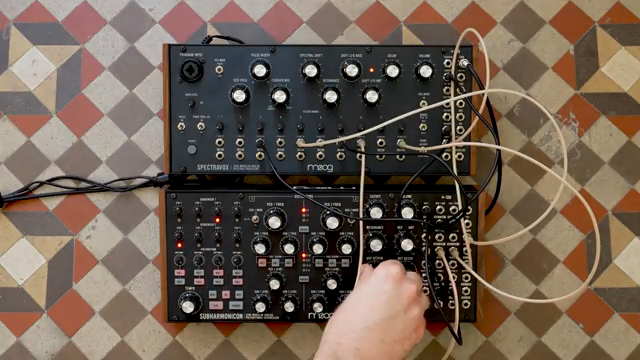
"these patterns can really come to life with Spectrovox's ability to modulate, manipulate, and mangle the frequency spectrum of a sound."
© Screenshot/Quote: Moogsynthesizers (YouTube)
This article is also available in German. Read it here: https://synthmagazin.at/moog-music-spectravox-subharmonicon-filterbank-abenteuer-abseits-der-norm/
Watch on YouTube:
Latest articles
Watch on YouTube:
Visit the channel:
https://www.youtube.com/MoogSynthesizers
https://www.youtube.com/MoogSynthesizers
Links from MoogSynthesizers:
website: https://moogmusic.com
instagram: https://instagram.com/moogsynthesizers
facebook: https://www.facebook.com/moogmusicinc
twitter: https://twitter.com/moogmusicinc
Sponsored links:
If you purchase via these links, we may earn a small commission – at no extra cost to you. The link opens an Amazon keyword search, and results may vary depending on availability.
Moog Spectravox
🔗 Check price on Amazon
🔗 Check price on Amazon
Moog Subharmonicon
🔗 Check price on Amazon
🔗 Check price on Amazon