Moog Music, a name synonymous with analog warmth, takes a bold dive into the world of frequency modulation with the Muse. In this official video, Moog demonstrates how Muse’s trio of analog oscillators, flexible FM routing, and programmable envelopes open up new territory for analog FM synthesis—territory usually reserved for digital machines. The video walks through tuning, cross-modulation, and dynamic envelope control, all while highlighting the unique sonic character that emerges from Muse’s fully analog signal path. For those curious about how classic FM techniques translate to the analog domain, this is a revealing look at what Muse brings to the modular table.
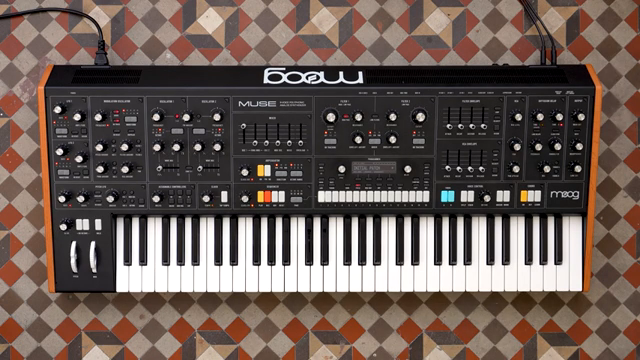
Muse and the Analog FM Frontier
The video opens with a brief history lesson, reminding us that frequency modulation synthesis was once a digital stronghold, largely due to the stability and complexity required of its oscillators. Moog Music positions Muse as a bridge between these worlds, offering the classic warmth of analog circuitry with a feature set designed to make FM synthesis not just possible, but genuinely engaging in the analog domain.
Muse’s voice path is fully analog, but it’s the routing options and programmable envelopes that set it apart. The manufacturer is keen to point out that while digital FM synths are known for their cold, metallic timbres, Muse brings a different flavour—one that’s inherently more organic and unpredictable. This sets the stage for a hands-on exploration of FM synthesis, with the promise of sonic results that are both familiar and refreshingly new.
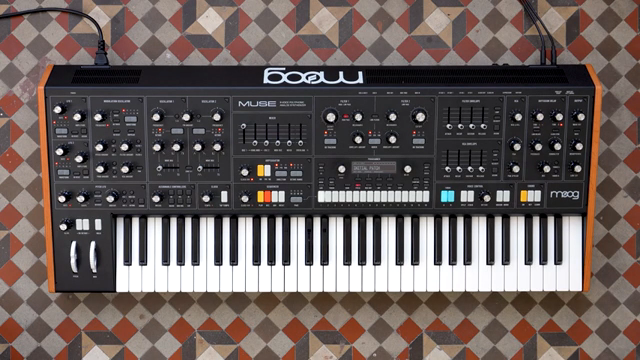
"We've packed Muse with a number of features that make performing FM synthesis in the analog domain uniquely interesting and fun to explore."
© Screenshot/Quote: Moogsynthesizers (YouTube)
Oscillator Architecture: Three’s Company
At the heart of Muse are its three analog oscillators: two main voices and a dedicated modulation oscillator. The video demonstrates how to set all three to triangle waves, a classic choice for FM due to their low harmonic content. Tuning is straightforward, with the modulation oscillator brought in line with the main pair using key tracking and fine adjustment controls.
Moog highlights the importance of harmonic ratios, tuning oscillator two a perfect fourth above oscillator one to create musically rich interactions. The process is hands-on, involving both coarse and fine tuning, and sets up the oscillators for classic FM pairings. This foundational step is crucial for achieving the harmonic complexity that FM synthesis is known for, even before any modulation is applied.
Dynamic FM and Cross-Modulation Workflows
"In FM synthesizers you have the frequency modulation going through a VCA basically, which opens and closes the modulation with an envelope."
© Screenshot/Quote: Moogsynthesizers (YouTube)
With the oscillators tuned, Muse’s FM routing comes into play. The video shows how oscillator two can modulate oscillator one, with the FM amount dynamically controlled by the filter envelope. This approach mimics the classic FM workflow, where a VCA shapes the modulation depth, resulting in those signature metallic and percussive sounds.
Cross-modulation is introduced by enabling bidirectional FM between oscillators one and two, dramatically increasing the harmonic content. Muse allows independent scaling of FM amounts in both directions, letting users tame or accentuate specific frequency interactions. Adjustments to minimum and maximum FM levels, as well as octave shifts, provide further control, making Muse a flexible tool for sculpting complex analog FM textures.
Modulation Routing and Envelope Flexibility
The final section explores Muse’s deeper modulation capabilities. A third operator—the modulation oscillator—can be routed to modulate either main oscillator, with its pitch amount also envelope-controlled. The video demonstrates swapping between filter and VCA envelopes for different dynamic shapes, and even enabling velocity sensitivity for expressive FM depth control.
Muse’s mod map interface reveals the various routings at a glance, encouraging experimentation with envelope assignments and modulation depths. By combining analog FM with features like analog filters and diffusion delay, Muse offers a playground for intricate sound design. The flexibility of its envelopes and modulation paths makes it a compelling choice for those seeking to push analog FM synthesis beyond its traditional boundaries.
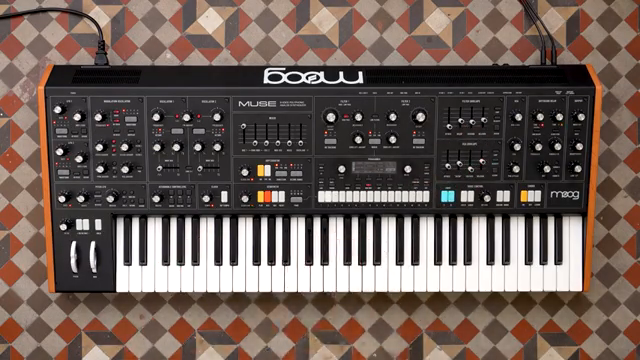
"We can use both envelopes of Muse to give different shapes to the different dynamic FM paths we have going on here."
© Screenshot/Quote: Moogsynthesizers (YouTube)
This article is also available in German. Read it here: https://synthmagazin.at/moog-music-muse-analoge-fm-synthese-entfesselt/
Watch on YouTube:
Latest articles
Watch on YouTube:
Visit the channel:
https://www.youtube.com/MoogSynthesizers
https://www.youtube.com/MoogSynthesizers
Links from MoogSynthesizers:
website: https://moogmusic.com
instagram: https://instagram.com/moogsynthesizers
facebook: https://www.facebook.com/moogmusicinc
twitter: https://twitter.com/moogmusicinc
Sponsored links:
If you purchase via these links, we may earn a small commission – at no extra cost to you. The link opens an Amazon keyword search, and results may vary depending on availability.
Moog Muse
🔗 Check price on Amazon
🔗 Check price on Amazon