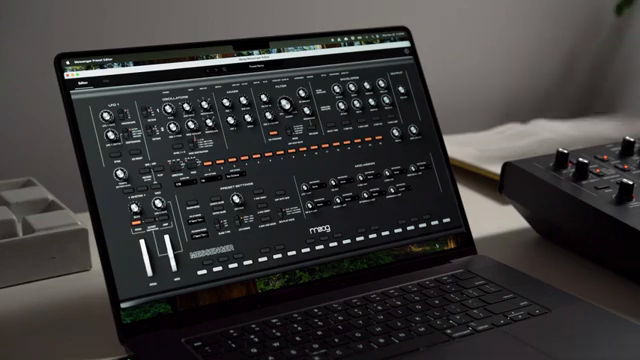
Moog Music steps into the digital workflow arena with the Messenger Preset Editor, a free desktop tool designed to give Messenger synth owners deep, visual access to their instrument’s sound engine and preset management. This official Moog video walks through how the editor bridges hardware and software, offering real-time control, advanced modulation, and a streamlined librarian for organizing sounds. With the addition of new firmware features like duophonic mode, Moog aims to keep the hands-on spirit alive while expanding creative possibilities for both studio and stage. We take a closer look at how this editor redefines the Messenger experience for modern synth users.
27. November 2025
LYRA
Moog Music Messenger Preset Editor: Digital Control Meets Analog Character
A New Era: Introducing the Messenger Preset Editor
Moog Music opens this demo by positioning the Messenger Preset Editor as a powerful software companion for the Messenger hardware. The editor is designed to streamline workflows, whether you’re editing presets, tweaking sequences, or managing the entire preset structure on the instrument. This isn’t just about convenience—it’s about making the process of sound design and preset management more intuitive and accessible for both stage and studio contexts.
The video emphasizes that the editor’s ultimate goal is to let users focus on the creative side of music-making, rather than getting bogged down in technicalities. By integrating the editor with the Messenger, Moog aims to preserve the classic hands-on workflow while adding a layer of digital efficiency that modern musicians expect. The result is a hybrid approach that keeps the fun in playing music front and center.
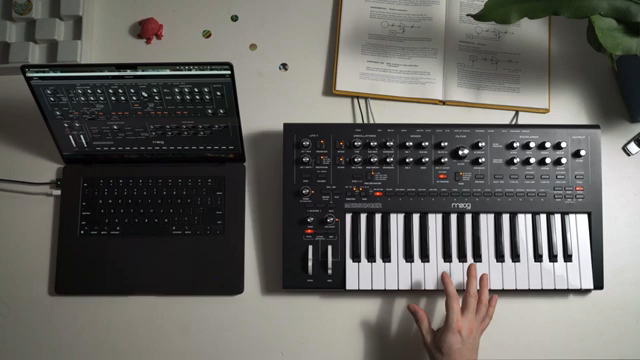
"Its goal is to make using Messenger easier and more intuitive so that whether you're on stage or in the studio, all you need to focus on is the fun part, which is playing music."
© Screenshot/Quote: Moogsynthesizers (YouTube)
Real-Time Visual Control: Hardware and Software in Sync
"As I navigate through presets on the hardware, I can see the editor update to show me the knob settings of any given sound that I load."
© Screenshot/Quote: Moogsynthesizers (YouTube)
One of the standout features demonstrated is the real-time synchronization between the Messenger hardware and the Preset Editor. As users navigate through presets on the hardware, the editor instantly updates to reflect the current knob positions and sound engine settings. This visual feedback is invaluable for understanding how a particular sound was crafted, especially when dissecting patches from other designers.
The workflow is bidirectional: tweaking a hardware knob updates the software display, while adjustments made in the editor are immediately audible on the instrument, even if not mirrored on the physical panel. This tight integration demystifies the underlying architecture of each patch, making it easier to reverse-engineer sounds and fine-tune parameters with precision.
Deeper Modulation and Streamlined Sound Design
The Messenger Preset Editor unlocks modulation and sound design options that are less accessible—or more cumbersome—on the hardware alone. Parameters that would typically require menu-diving or long button presses are now visually laid out at the bottom of the editor interface. This includes comprehensive access to modulation assignments: users can select modulation sources, destinations, and set bipolar depths with a few clicks.
The editor also exposes additional preset settings, such as arpeggiator note behavior, sequencer play modes, envelope characteristics, LFO ranges, and glide behaviors. This streamlined interface encourages experimentation with complex sound structures, allowing users to quickly map out and manipulate intricate modulations that might otherwise go unnoticed on the hardware panel.
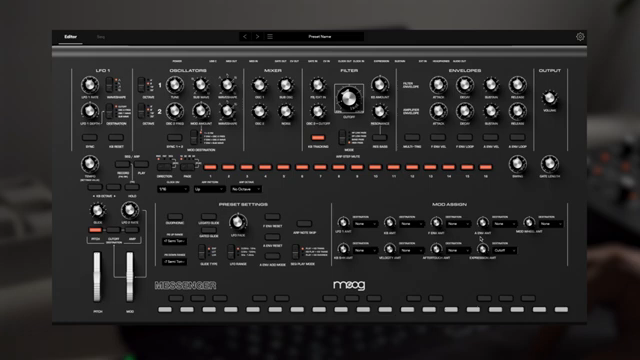
"I can see every single modulation source that I have available within a patch, and then I can go to a source, open up a dropdown menu and select the destination that I want to modulate."
© Screenshot/Quote: Moogsynthesizers (YouTube)
Expressive Expansion: Duophonic Mode and Advanced Sequencing
A major highlight in this update is the introduction of duophonic mode, available via the new firmware and accessible directly from the editor. With a simple click, users can enable duophony, allowing two notes to be played simultaneously. The hardware reflects this change with a blinking sync button, and the video notes that while the Messenger remains paraphonic—sharing a filter and VCA—this new mode significantly expands expressive potential.
Beyond duophony, the editor provides deep access to sequence editing. Users can view and adjust every step in a sequence, including note values, velocities, modulation destinations, and probability settings. The interface allows for real-time visualization of sequences, making it easy to follow along, transpose notes, and create complex, evolving patterns.
Perhaps most impressively, the editor lets users assign different panel parameters to each step, enabling intricate modulations and dynamic movement within a sequence. This level of control is difficult to achieve from the hardware alone, underscoring the editor’s role as a creative catalyst for Messenger owners.
Preset Librarian: Tag, Filter, and Manage with Ease
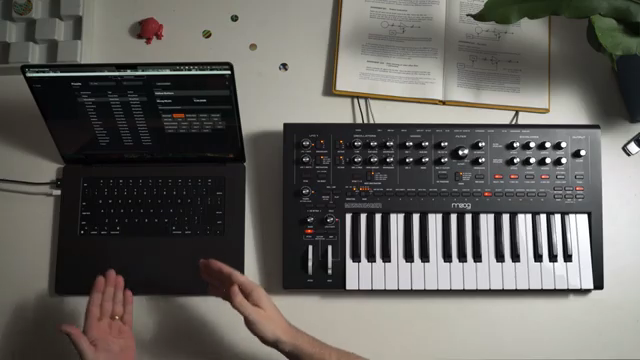
"You can store your own preset bank and then use rental messenger and very easily be able to move all of your presets onto that messenger."
© Screenshot/Quote: Moogsynthesizers (YouTube)
Rounding out the feature set is the integrated preset librarian, which brings modern organization tools to the Messenger ecosystem. Users can assign tags to presets, filter by categories like classic bass, and quickly load or save patches to any position in the hardware’s memory. This makes auditioning and organizing sounds far more efficient, especially for users with large libraries or those preparing for live sets.
The librarian also facilitates sharing and portability—touring musicians can easily transfer their entire preset banks to rental units, or exchange patches with friends. This workflow-centric approach to preset management aligns with the needs of contemporary synth users, making the Messenger a more flexible and future-proof instrument.
This article is also available in German. Read it here: https://synthmagazin.at/moog-music-messenger-preset-editor-digitale-kontrolle-trifft-analogen-charakter/
Watch on YouTube:
Latest articles
Watch on YouTube:
Visit the channel:
https://www.youtube.com/MoogSynthesizers
https://www.youtube.com/MoogSynthesizers
Links from MoogSynthesizers:
website: https://moogmusic.com
instagram: https://instagram.com/moogsynthesizers
facebook: https://www.facebook.com/moogmusicinc
twitter: https://twitter.com/moogmusicinc
Sponsored links:
If you purchase via these links, we may earn a small commission – at no extra cost to you. The link opens an Amazon keyword search, and results may vary depending on availability.
Messenger Preset Editor
🔗 Check price on Amazon
🔗 Check price on Amazon
Moog Messenger
🔗 Check price on Amazon
🔗 Check price on Amazon