Moog Music’s official channel continues its educational odyssey with Lesson 6 of ‘Synthesizing with Moog’, this time plunging headfirst into the world of carriers, modulators, and the wild textures they can conjure. The video, hosted by Chris Miller, unpacks the mechanics and musicality of Frequency Modulation (FM), Amplitude Modulation (AM), and the creation of harmonics through both classic and creative means. Expect a blend of historical nods, hands-on patching, and a gentle nudge to break the rules. If you’ve ever wondered how a triangle wave can become a snarling beast or what happens when you push an LFO into audio territory, this is a Moog masterclass worth patching into.

13. November 2025
MILES
Moog Music Explores the Sonic Frontier: FM, AM and Harmonic Alchemy
From Vibrato to Sonic Mayhem: FM and AM Unleashed
The lesson opens with a reflection on the early ambitions of electronic instruments—were they merely meant to mimic acoustic sounds, or did they have a more radical destiny? Moog Music’s team sets the scene by recalling the 1960s, when Bob Moog and his contemporaries were inspired by musique concrète and the avant-garde, seeking not just to recreate, but to invent new sonic languages. The synthesizer, they argue, quickly outgrew its role as a mere imitator, evolving into a tool for forging entirely new timbres and textures.
This episode’s focus is on modulation as a gateway to these new sounds. The video demonstrates how a simple vibrato, achieved by modulating oscillator pitch with a triangle LFO, can be pushed into uncharted territory by increasing the LFO’s frequency into the audio range. Suddenly, the familiar warble transforms into a dense, harmonically rich texture—the hallmark of Frequency Modulation (FM). The team also hints at Amplitude Modulation (AM) as another path to complex sonic results, setting the stage for a deep dive into these techniques.
Harmonics: The Building Blocks of Synthesis
The video methodically breaks down how harmonics are generated through modulation. When an audio-rate modulator interacts with a carrier oscillator, sidebands emerge—new frequencies mathematically related to the original signals. The number and strength of these sidebands depend on both the modulation depth and the waveforms involved. For instance, triangle waves, with their sparse harmonic content, yield a different spectrum of sidebands compared to sawtooth waves, which are already harmonically dense.
The Moog team explains that FM synthesis typically favours simple waveforms like sines or triangles, as these provide a blank canvas for harmonic creation. By contrast, starting with harmonically rich waveforms can quickly lead to sonic chaos. The lesson also covers how the modulation depth—how far the carrier’s frequency is pushed—affects the resulting sound, with deeper modulation producing more sidebands and, consequently, more complex timbres.
Beyond FM, the video explores AM and its unique characteristics. Unlike FM, AM always retains the carrier frequency, reinforcing the tonal centre even as new harmonics are introduced. The team demonstrates how raising an LFO into the audio range for amplitude modulation yields a distinctly different flavour, and they touch on the creative possibilities of modulating other parameters, like filter cutoff, at audio rates for further harmonic sculpting.
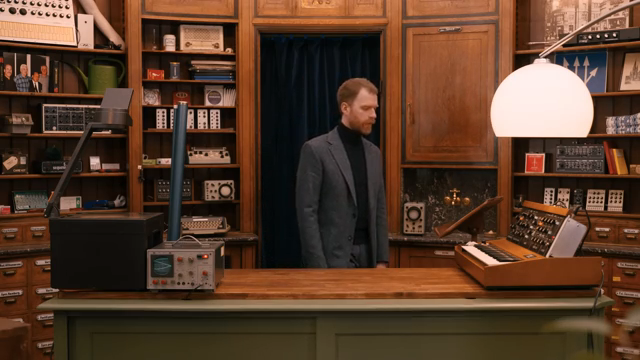
"With a carrier of 200 hertz and a modulator of 100 hertz, our brain will perceive both frequencies. But it won't only perceive those two frequencies."
© Screenshot/Quote: Moogsynthesizers (YouTube)
Programming FM and Envelope Modulation: The Messenger in Action
"By adding more oscillators and envelopes to control the modulation depth, Chowning birthed an entirely new field of synthesis, one that went on to define the sound of the 1980s and '90s."
© Screenshot/Quote: Moogsynthesizers (YouTube)
With the theory in place, the video shifts to practical patching on the Moog Messenger. The host walks through programming FM by routing oscillator 1 to modulate oscillator 2, with both set to triangle waves for maximum clarity. This setup produces a broad palette of FM sounds, ranging from subtle shimmer to aggressive clangour, depending on the modulation depth.
Envelope modulation is then introduced as a means to dynamically control FM depth. By assigning the filter envelope to the modulation amount, the Messenger can mimic the evolving articulations of classic ’80s and ’90s FM bass tones. Tweaking the envelope parameters yields a variety of attack and decay shapes, showcasing how modulation can breathe life into otherwise static patches.
The demonstration also touches on the interplay between FM and other forms of modulation, hinting at the layered complexity possible when combining envelope, LFO, and audio-rate sources. The Messenger’s interface is shown to facilitate these explorations, making it a flexible platform for both beginners and seasoned patchers.
Distortion, Wavefolding, and the Joy of Experimentation
The lesson pivots to the world of distortion and wavefolding, highlighting how these processes generate harmonics through non-linear means. Saturation, as found in classic Moog circuits like the CP3 mixer, introduces asymmetrical clipping, transforming a triangle wave into a more complex, square-like shape as the gain increases. This approach adds musical distortion and a wealth of new overtones.
Wavefolding, inspired by the West Coast synthesis tradition, is presented as another route to harmonic abundance. Instead of simply clipping the waveform, wavefolding bends and folds the peaks back onto themselves, creating intricate timbral variations. The Messenger’s wavefolding circuit is demonstrated, with dynamic modulation via the filter envelope adding further movement. The video encourages viewers to stack modulation sources and effects, reinforcing the idea that synthesis is as much about exploration as it is about precision.
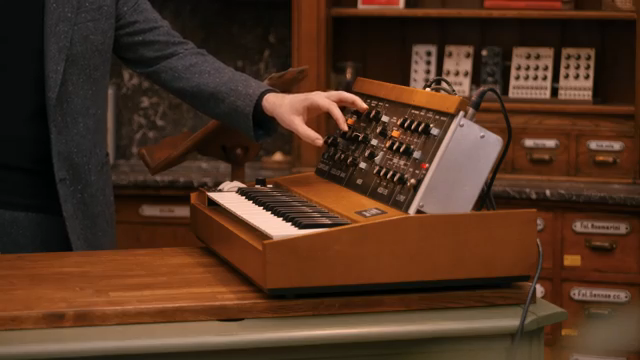
"Saturation creates harmonics through the distortion that occurs when an input signal exceeds the headroom of an electronic device."
© Screenshot/Quote: Moogsynthesizers (YouTube)
Beyond Rules: The Synthesizer as Sonic Playground
In the closing moments, the Moog team delivers a philosophical reminder: there are no hard rules in sound synthesis, only opportunities for discovery. Drawing an analogy to the Situationist concept of the dérive—a meandering, goal-free walk through a city—they urge users to let curiosity and their ears guide their patching decisions.
The synthesizer, they conclude, is a tool for transcending the limitations of acoustic instruments, offering a vast landscape for creative expression. Whether chasing classic tones or stumbling upon happy accidents, the real legacy of synthesis lies in its capacity to inspire and surprise.
This article is also available in German. Read it here: https://synthmagazin.at/moog-music-erforscht-die-klanglichen-grenzen-fm-am-und-harmonische-alchemie/
Watch on YouTube:
Latest articles
Watch on YouTube:
Visit the channel:
https://www.youtube.com/MoogSynthesizers
https://www.youtube.com/MoogSynthesizers
Links from MoogSynthesizers:
website: https://moogmusic.com
instagram: https://instagram.com/moogsynthesizers
facebook: https://www.facebook.com/moogmusicinc
twitter: https://twitter.com/moogmusicinc
Sponsored links:
If you purchase via these links, we may earn a small commission – at no extra cost to you. The link opens an Amazon keyword search, and results may vary depending on availability.
CP3 mixer
🔗 Check price on Amazon
🔗 Check price on Amazon
Minimoog
🔗 Check price on Amazon
🔗 Check price on Amazon
Moog Messenger
🔗 Check price on Amazon
🔗 Check price on Amazon