In the third lesson of Moog Music’s educational series, the legendary synth manufacturer dives deep into the bedrock of synthesis: oscillators. This episode demystifies how these circuits generate vibrations, shape sound, and underpin the entire sonic architecture of a synthesizer. With Moog’s signature clarity and a dash of historical context, viewers are guided through tuning, layering, and the harmonic richness of classic waveforms. Whether you’re new to patch cables or a seasoned modular explorer, this video offers a grounded, hands-on look at the oscillator’s role in crafting everything from mellow tones to cosmic textures.
23. October 2025
MILES
Moog Music Explains Oscillators: Vibrations, Harmonics, and the Art of Layering
Vibrations: The Genesis of Sound in Synthesis
Moog Music opens this lesson by grounding us in the physics of sound: vibrations in the air are the root of all music, and synthesizers offer a uniquely electronic way to generate these vibrations. The video draws a clear line from ancient sound-making methods—striking, plucking, or vocalizing—to the 20th-century revolution of electronic sound creation. This sets the stage for understanding why oscillators are so fundamental in the world of synthesis.
The oscillator is introduced as the synthesizer’s primary sound source, responsible for generating the raw tones that all other circuits will later shape. Moog’s approach here is refreshingly direct: the oscillator vibrates a speaker cone at a constant rate, producing a single tone that forms the bedrock of any patch. The lesson emphasizes that, while we can imagine music in our heads, it’s the act of creating real vibrations—whether by hand or by voltage—that brings music into the world and gives synthesizers their creative power.

"On the synthesizer is the oscillator, and it's the basic bed of tone that all the other circuits of the synthesizer shape."
© Screenshot/Quote: Moogsynthesizers (YouTube)
Tuning, Layering, and Harmonics: The Oscillator’s Toolbox
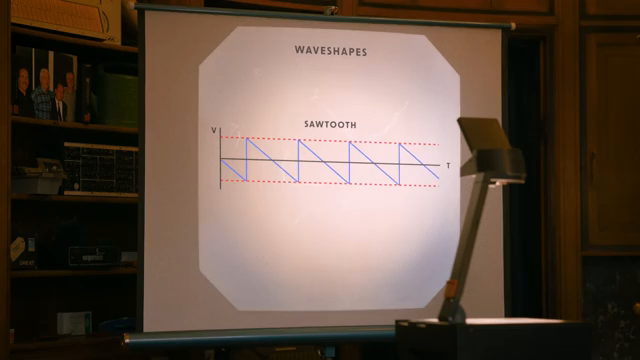
"But the shape of the oscillation is a very important feature in determining the timbre of a sound."
© Screenshot/Quote: Moogsynthesizers (YouTube)
The video moves into the practicalities of oscillator control, highlighting the essential parameters that shape pitch and timbre. Moog demonstrates how keyboards send precise voltages to oscillators, allowing for accurate tuning to semitones, while fine-tune controls and octave switches provide further flexibility. These features are shown as crucial for both solo playing and ensemble work, ensuring oscillators can be matched or intentionally offset for creative effect.
Attention then turns to the concept of harmonics. By explaining how oscillators swing between voltage extremes, the lesson reveals how different wave shapes—each with their own harmonic content—define the character of a sound. The discussion of harmonics is rooted in both acoustic and electronic contexts, drawing parallels between plucked strings and voltage-controlled oscillators. This section underscores that the shape of the oscillation is as important as its frequency, directly influencing the resulting timbre.
Waveform Character: Sine, Triangle, Sawtooth, and Square
Moog Music takes a methodical tour through the classic oscillator waveforms, each with its own sonic fingerprint. The sine wave is presented as the purest form, containing only the fundamental frequency and no harmonics—ideal for mellow tones or as a starting point for further processing. The triangle wave, with its pointed peaks, adds a touch more harmonic content but remains fundamentally smooth and subdued.
The sawtooth wave is highlighted for its abrupt voltage jumps, which generate a wealth of harmonics and result in a characteristically buzzy sound. The square wave, a symmetrical cousin to the pulse wave, is shown to be equally rich in harmonics thanks to its sharp transitions. Moog’s demonstration makes it clear that sharper corners in a waveform mean more harmonic complexity, while smoother shapes yield gentler, simpler tones. These distinctions are not just academic—they’re the palette from which every synth patch is painted.
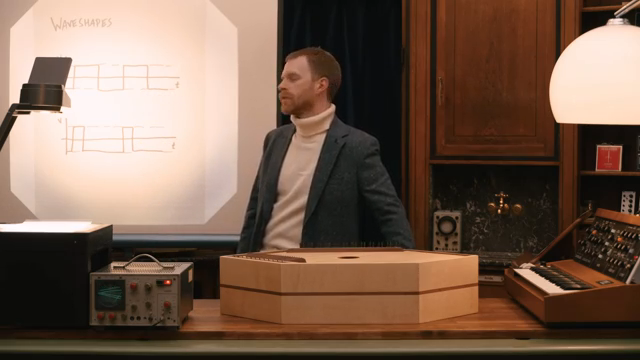
"Sharp corners and sudden discontinuities create a lot of harmonics, whereas smoother waves create far less."
© Screenshot/Quote: Moogsynthesizers (YouTube)
Layering Oscillators: Detuning, Beats, and Beyond
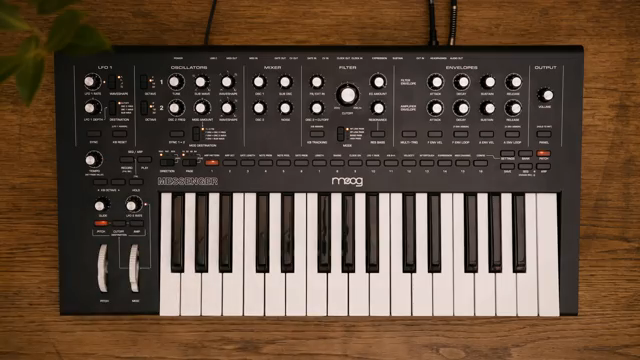
"This detuning thickens up a sound and creates the sensation of a chorus of oscillators making a sound feel much more vibrant and alive."
© Screenshot/Quote: Moogsynthesizers (YouTube)
The lesson shifts to practical synthesis techniques, showcasing how layering oscillators can dramatically expand sonic possibilities. By combining two oscillators through a mixer, the video demonstrates that identical frequencies and shapes simply reinforce each other, but detuning one oscillator introduces interference patterns—beats and phasing—that thicken and animate the sound. This is the classic trick for achieving that lush, vibrant chorus effect beloved in both vintage and modern synth patches.
Moog also explores further creative uses, such as detuning to musical intervals like a perfect fifth or employing octave switches to broaden the range. The inclusion of sub-oscillators for extra bass content and noise generators for unpitched textures is touched upon, rounding out the oscillator’s role as the heart of both melodic and percussive synthesis. The underlying message is clear: by experimenting with layering and detuning, even simple patches can yield complex, evolving results.
This article is also available in German. Read it here: https://synthmagazin.at/moog-music-erklaert-oszillatoren-schwingungen-obertoene-und-die-kunst-des-layerings/
Watch on YouTube:
Latest articles
Watch on YouTube:
Visit the channel:
https://www.youtube.com/MoogSynthesizers
https://www.youtube.com/MoogSynthesizers
Links from MoogSynthesizers:
website: https://moogmusic.com
instagram: https://instagram.com/moogsynthesizers
facebook: https://www.facebook.com/moogmusicinc
twitter: https://twitter.com/moogmusicinc
Sponsored links:
If you purchase via these links, we may earn a small commission – at no extra cost to you. The link opens an Amazon keyword search, and results may vary depending on availability.
Moog-Synthesizer
🔗 Check price on Amazon
🔗 Check price on Amazon