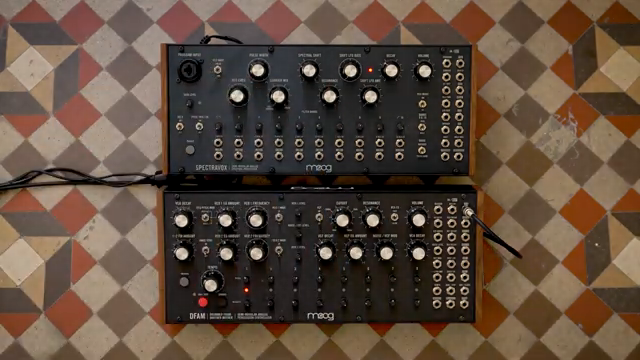
Moog Music takes a deep dive into the world of physical modeling synthesis, pairing the DFAM and Spectravox for a modular twist on acoustic emulation. In this official demo, Moog demonstrates how the DFAM’s percussive envelopes and oscillators can serve as a dynamic excitation source, while the Spectravox’s ten resonant filters stand in for the resonating body of an instrument. The video is a methodical exploration of how these two devices interact, focusing on patching techniques, signal flow, and the subtle art of sculpting electronic sounds that echo the behaviour of real-world drums and struck objects. For those obsessed with patch cables and filter banks, this is a showcase of modular synthesis at its most hands-on and sonically rich.
6. September 2025
MILES
Moog Music: DFAM and Spectravox – Physical Modeling Goes Modular
Physical Modeling: Modular Style
Moog Music opens the session by framing physical modeling as a synthesis approach that mimics the behaviour of acoustic instruments, breaking it down into two core components: the exciter and the resonator. Unlike classic subtractive synthesis, which relies on sustained oscillators shaped by filters, physical modeling focuses on short, harmonically rich bursts that excite a resonant structure. This analogy is made concrete with a demonstration of various ways to strike a drum, illustrating how the method and point of contact affect the resulting sound.
The video sets the stage for a modular interpretation of this concept, using the DFAM to generate the excitation signal and the Spectravox as the resonator. By drawing parallels between acoustic and electronic signal paths, Moog positions these devices as tools for exploring not just synthetic timbres, but the nuanced dynamics of real-world instruments within a modular workflow.
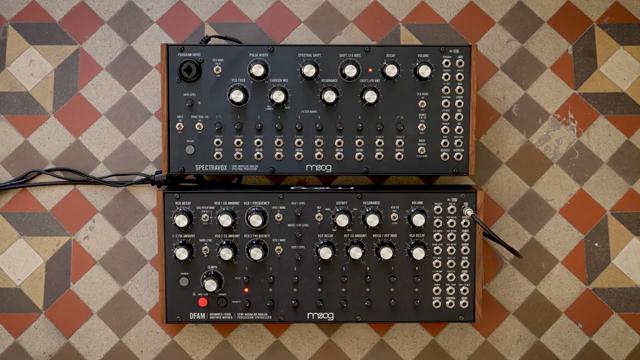
"Physical modeling is an approach to synthesis that seeks to model how acoustic instruments work."
© Screenshot/Quote: Moogsynthesizers (YouTube)
Exciters and Resonators: Patching the Process
"So in this case, we can use DFAM to create a very short excitation signal, and then send it to the 10 bands of Spectrovox, which will be our resonator."
© Screenshot/Quote: Moogsynthesizers (YouTube)
The synthesis chain begins with the DFAM, whose oscillators and noise source are sculpted by three independent envelopes. This setup enables the creation of a short, broadband transient full of harmonics—precisely the kind of excitation signal required for physical modeling. The video highlights the flexibility of the DFAM’s envelope structure, allowing for intricate control over the evolution of the transient.
Once the excitation signal is crafted, it’s routed into the Spectravox’s carrier input. With Spectravox set to Filter Bank mode, the DFAM’s output excites all ten resonant filters simultaneously. Additional patching—such as sending DFAM’s trigger output to Spectravox’s trigger input—brings a fourth envelope into play, further refining the decay and overall shape of the resonated sound. This modular approach mirrors the complexity of acoustic interactions, but with the advantage of voltage control and patchable signal flow.
Sequencing Strikes: Velocity and Tonal Shifts
DFAM’s sequencer is put to work, with its two rows—pitch and velocity—providing nuanced control over the excitation signal. The velocity row determines the intensity of each virtual drum hit, simulating the dynamic range of a real percussionist. Meanwhile, the pitch row can be assigned to both VCOs, introducing variation in the harmonic content of each strike.
The video goes further by patching the pitch sequencer output to Spectravox’s shift input. This modulates the position of all ten filters in the bank, effectively altering the perceived geometry of the resonant body. The result is a sequence where not only the force of each hit changes, but also the tonal colour and pitch, closely echoing the behaviour of struck acoustic objects.
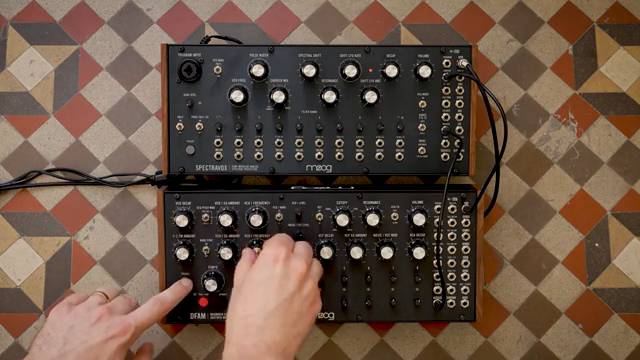
"DFAM's sequencer has two rows, one for pitch and one for velocity, and the velocity will determine how hard we're hitting the resonant body as modeled by Spectrovox."
© Screenshot/Quote: Moogsynthesizers (YouTube)
Spectravox: Ten Filters, Infinite Timbres
Spectravox’s ten resonant filters are the heart of the resonator stage, each with individual level control. By adjusting these levels, the user can simulate striking different parts of a drum—centre, edge, or anywhere in between. The spectral shift control moves all filters in unison, exaggerating the effect and mimicking changes in drum geometry.
Resonance and decay parameters further shape the sound. Increasing resonance allows the filters to ring out, while shortening decay truncates the sustain. This granular control over the filter bank enables a wide palette of percussive and tonal effects, all derived from a single excitation signal. The video demonstrates how these adjustments can evoke everything from muted thuds to ringing overtones, all within the modular domain.
Electronic Acoustics: Expanding the Modular Palette
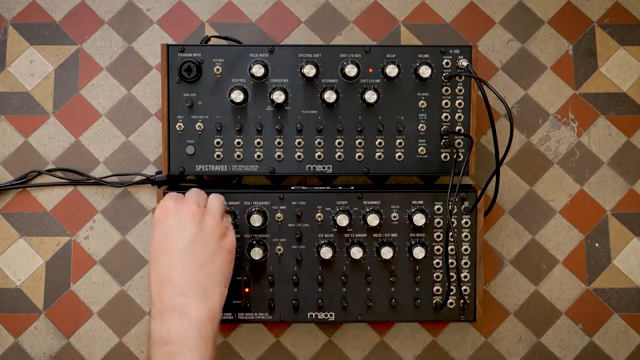
"With extremely deep and flexible control over both the excitation signal and the resonating body, open the doors to a vast world of electronically generated acoustically inspired sounds."
© Screenshot/Quote: Moogsynthesizers (YouTube)
By combining DFAM and Spectravox, Moog showcases a modular approach to generating acoustically inspired sounds. The flexibility of analog patching allows for deep exploration of physical modeling principles, with every parameter tweak offering a new sonic possibility. The video underscores how these tools can move beyond traditional synthesis, venturing into territory usually reserved for digital modeling or sample-based systems.
Ultimately, this pairing opens up a vast world of electronically generated, acoustically nuanced timbres. For modular enthusiasts, it’s an invitation to experiment with the boundaries between the synthetic and the organic, using voltage, envelopes, and filter banks to craft sounds that feel alive and tactile—even when no real drum is in sight.
This article is also available in German. Read it here: https://synthmagazin.at/moog-music-dfam-und-spectravox-physical-modeling-im-modularformat/
Watch on YouTube:
Latest articles
Watch on YouTube:
Visit the channel:
https://www.youtube.com/MoogSynthesizers
https://www.youtube.com/MoogSynthesizers
Links from MoogSynthesizers:
website: https://moogmusic.com
instagram: https://instagram.com/moogsynthesizers
facebook: https://www.facebook.com/moogmusicinc
twitter: https://twitter.com/moogmusicinc
Sponsored links:
If you purchase via these links, we may earn a small commission – at no extra cost to you. The link opens an Amazon keyword search, and results may vary depending on availability.
DFAM
🔗 Check price on Amazon
🔗 Check price on Amazon
Spectravox
🔗 Check price on Amazon
🔗 Check price on Amazon