Moog Music returns with another deep dive into the heart of synthesis, this time shining a spotlight on the Voltage-Controlled Filter (VCF). In this educational instalment of their ‘Synthesizing with Moog’ series, the team unpacks the VCF’s pivotal role in shaping the very fabric of electronic music. Expect a blend of technical clarity and historical reverence, as Moog’s experts demonstrate how filters carve out timbre, introduce resonance, and bring dynamic expression to the modular landscape. For anyone curious about why the VCF remains a cornerstone of synthesis, this lesson is a must-watch.

30. October 2025
MILES
Moog Music and the Voltage-Controlled Filter: Sculpting Sound Since the Sixties
The VCF: The Heart of Sonic Alchemy
The video opens by tracing the roots of the Voltage-Controlled Filter (VCF) to Bob Moog’s 1966 patent, originally intended to emulate acoustic instruments like oboes and violins. However, as the narrator points out, the VCF quickly transcended its initial purpose, becoming an engine for entirely new sonic worlds. Without the VCF, many genres of electronic music would be unimaginable—a testament to its foundational status in synthesis.
Moog Music’s approach here is both reverent and practical, emphasising how the VCF allows musicians to sculpt sound in ways that oscillators alone cannot. The filter’s ability to shape harmonics and timbre is presented as the key to moving beyond simple geometric waveforms, setting the stage for the rest of the lesson. The narrative makes it clear: the VCF isn’t just another module, but the very tool that gives synthesizers their voice.

"Many genres today would be unthinkable without the distinctive sound of the voltage-controlled filter."
© Screenshot/Quote: Moogsynthesizers (YouTube)
How Filters Shape Sound: Types and Signal Flow
"This approach, starting with an oscillator tone rich in harmonics and then filtering it, came to be known as subtractive synthesis."
© Screenshot/Quote: Moogsynthesizers (YouTube)
The lesson then shifts to the mechanics of filtering, explaining that a filter is fundamentally a circuit for removing frequencies. The cutoff frequency is introduced as the pivotal control, determining where filtering begins in the spectrum. Moog’s team illustrates the differences between low-pass, high-pass, bandpass, and notch filters, using clear diagrams and analogies to the human ear.
A key point is that filtering is most effective when applied to harmonically rich waveforms, like sawtooth or square waves. This leads to the concept of subtractive synthesis: starting with a bright, complex oscillator tone, and then sculpting it by subtracting frequencies. The low-pass filter, in particular, is highlighted as the classic choice for shaping the harmonics above the fundamental, making it a staple in traditional subtractive synth architectures.
Resonance: Emphasis, Feedback, and New Tones
Attention then turns to the resonance control, sometimes labelled as emphasis, feedback, or cue. Resonance works by feeding the filter’s output back into its input, creating a pronounced bump at the cutoff frequency. As demonstrated, increasing resonance not only sharpens the filter’s effect but also introduces a distinctly nasal character to the sound—an effect compared to the way the human mouth shapes vocal timbre.
The video goes further, showing that at high resonance settings, the filter can begin to self-oscillate, generating a new tone at the cutoff frequency. This behaviour is not just a technical curiosity; it’s a creative tool, allowing the filter to act as a sine wave oscillator in its own right. The demonstration underscores how resonance transforms the VCF from a mere subtractive tool into an active sound source within a patch.
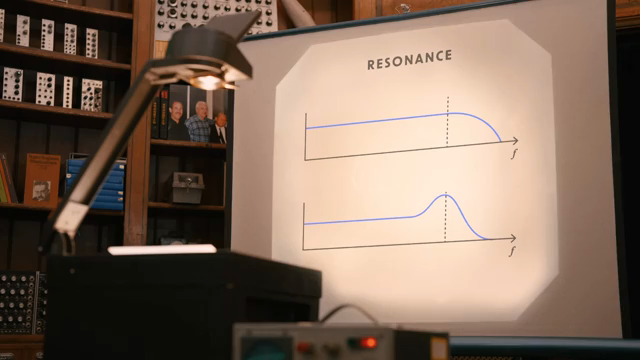
"As we increase this feedback, as we increase the resonance of a filter, we create a resonant bump at the cutoff, emphasizing all frequency content at the cutoff."
© Screenshot/Quote: Moogsynthesizers (YouTube)
VCF in Action: Dynamic Sound Design and Acoustic Mimicry
Moog’s team moves from theory to practice, illustrating how voltage control over the filter’s cutoff enables dynamic, evolving timbres. By patching envelopes into the filter, one can automate filter sweeps, mimicking the way acoustic sounds—like plucked strings or wind instruments—change over time. The video highlights how this approach allows for both realistic emulation and entirely new, expressive textures.
Keyboard tracking is also discussed, showing how the filter’s cutoff can follow the notes played, ensuring consistent harmonic shaping across the keyboard. This technique is essential for recreating the natural brightness of acoustic instruments as pitch increases, but it also opens doors to more experimental territory, especially when combined with resonance and modulation sources.
A Filter’s Legacy: From Moog’s Lab to Every Genre

"And while it may have began its life in the synthesizer, it's grown to be a ubiquitous tool used across all genres of music."
© Screenshot/Quote: Moogsynthesizers (YouTube)
The historical significance of the VCF is woven throughout the lesson, with particular attention paid to the Moog Transistor Ladder Filter. Its unique slope and sonic character are described as both a technical achievement and a defining element of the Moog sound. The Minimoog Model D is cited as a milestone, bringing the VCF—and synthesis as a whole—out of the lab and onto the stage.
Moog Music closes by reflecting on the VCF’s enduring influence, noting that what began as a tool for imitating acoustic timbres has become a ubiquitous force in music production. From the modular systems of the 1960s to today’s genre-spanning electronic music, the VCF remains a vital, ever-relevant component—its resonance still shaping the sound of the future.
This article is also available in German. Read it here: https://synthmagazin.at/moog-music-und-das-spannungsgesteuerte-filter-klangformung-seit-den-sechzigern/
Watch on YouTube:
Latest articles
Watch on YouTube:
Visit the channel:
https://www.youtube.com/MoogSynthesizers
https://www.youtube.com/MoogSynthesizers
Links from MoogSynthesizers:
website: https://moogmusic.com
instagram: https://instagram.com/moogsynthesizers
facebook: https://www.facebook.com/moogmusicinc
twitter: https://twitter.com/moogmusicinc
Sponsored links:
If you purchase via these links, we may earn a small commission – at no extra cost to you. The link opens an Amazon keyword search, and results may vary depending on availability.
Minimoog Model D
🔗 Check price on Amazon
🔗 Check price on Amazon
Moog Transistor Ladder Filter
🔗 Check price on Amazon
🔗 Check price on Amazon