Make Noise, the Asheville-based architects of modular mischief, return with a hands-on look at their New Universal Skiff System (N.U.S.S.), this time exploring the crossroads of MIDI and CV. In this video, the team demonstrates how the N.U.S.S. can serve as a flexible hub for both digital and analogue sequencing, using a MIDI keyboard and classic CV sources to drive intricate patterns and evolving soundscapes. Expect a patch-oriented walkthrough, peppered with practical modulation tricks and a healthy disregard for the boundaries between MIDI and voltage. If you’ve ever wondered how Make Noise envisions hybrid control in a modern Eurorack setup, this is your window into their workflow.

N.U.S.S.: The Hybrid Heart of the Patch
The New Universal Skiff System (N.U.S.S.) is introduced as a versatile centrepiece for both MIDI and CV-based sequencing and performance. Make Noise positions the N.U.S.S. not just as a housing solution, but as an active participant in the modular workflow, capable of bridging digital and analogue control methods. The video sets the stage by highlighting the system’s flexibility, especially in environments where hybrid approaches are becoming increasingly common.
Rather than focusing solely on traditional CV sequencing, the N.U.S.S. is shown to thrive when MIDI and CV are combined. This approach allows users to tap into the strengths of both worlds—precision and polyphony from MIDI, and the organic unpredictability of CV. The demonstration promises to reveal how these elements can be woven together for dynamic, hands-on performance.

"I gradually sort of perfected a patch to demonstrate a hybrid MIDI and CV approach that I found pretty fun."
© Screenshot/Quote: Maken0Isemusic (YouTube)
Plugging In: MIDI Keyboards Meet Modular
"The MIDI coding makes it pretty easy to activate several different channels at once on different notes by just playing a chord."
© Screenshot/Quote: Maken0Isemusic (YouTube)
The setup begins with a MIDI keyboard connected via USB-C, sending note data into the N.U.S.S. skiff through Ableton Live. This hybrid configuration is at the core of the video’s patch, enabling the performer to trigger multiple channels simultaneously by simply playing chords. The USB-C connection streamlines the integration, making it straightforward to route MIDI notes directly into the modular environment.
What stands out is the ease with which different channels can be activated, thanks to the MIDI implementation. Playing a chord on the keyboard instantly distributes notes across several voices, something that would be more cumbersome with a purely CV-based approach. This setup showcases how the N.U.S.S. can serve as a bridge between DAW-centric workflows and hands-on modular play, opening up new possibilities for live performance and studio experimentation.
Clockwork Modulation and Rhythmic Complexity
The demonstration quickly moves into the realm of modulation, using a fast clock from the Multimod module to drive the Polymaths in parallel mode. This creates a foundation of continuous clock-divided patterns, which are then further animated by a slow triangle wave patched to modulate the span on Polymaths. The cyclical modulation ensures that each pass through the sequence is slightly different, as the pattern isn’t being reset—introducing subtle variations and a sense of movement.
Additional layers of modulation are added by routing outputs to panning and rhythmic timbre shifts, particularly through the QXG and QPOS modules. The video also explores alternative sequencing sources, such as the Korg SQ-1, demonstrating how decoupling pitch and gate sequences can yield even more variation. The SQ-1’s independent rows and pattern selection knobs allow for quick changes in sequence structure, further enhancing the rhythmic complexity of the patch.
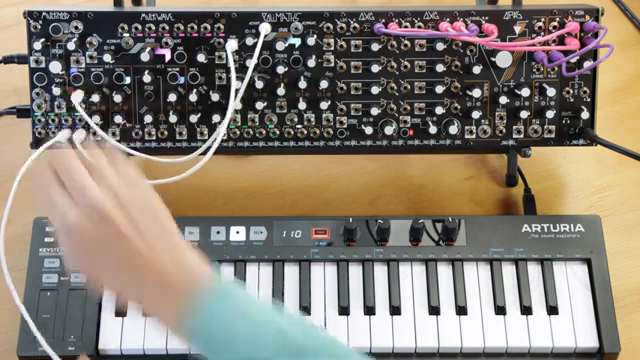
"I've got a fairly quick clock coming from Multimod to continually activate the polymaths, which is in parallel mode."
© Screenshot/Quote: Maken0Isemusic (YouTube)
Embracing Unpredictability: Creative Workflow in Action

"I like to use this to, for example, keep bass notes in the lower channels and add some sparkly high variations to the upper channels."
© Screenshot/Quote: Maken0Isemusic (YouTube)
The workflow highlighted in the video is all about flexibility and creative exploration. By using different sources—MIDI keyboard, SQ-1, and internal modulation—the patcher is able to introduce unpredictable variations and keep the sequence evolving. For example, the pitch sequence can be routed through the Multimod for additional shaping, or the modulation shapes themselves can be swapped out on the fly to alter the character of the sequence.
Make Noise’s approach encourages experimentation, whether it’s locking sequences to held notes, changing gate patterns, or using modulation to shift timbres and rhythms. The system’s ability to handle both MIDI and CV inputs means that performers can quickly adapt to new ideas, layering structured MIDI control with the spontaneous quirks of analogue modulation. The result is a patch that feels alive, constantly shifting in response to both planned and improvised changes.
This article is also available in German. Read it here: https://synthmagazin.at/midi-cv-und-das-make-noise-n-u-s-s-skiff-system-im-hybrideinsatz/
Watch on YouTube:
Latest articles
Watch on YouTube:
Visit the channel:
https://www.youtube.com/MAKEN0ISEMUSIC
https://www.youtube.com/MAKEN0ISEMUSIC
Links from MAKEN0ISEMUSIC:
website: https://www.makenoisemusic.com
instagram: https://www.instagram.com/makenoisemusic
twitter: https://twitter.com/makenoisemusic
facebook: https://www.facebook.com/makenoiseco
Sponsored links:
If you purchase via these links, we may earn a small commission – at no extra cost to you. The link opens an Amazon keyword search, and results may vary depending on availability.
Korg SQ-1
🔗 Check price on Amazon
🔗 Check price on Amazon
Multimod
🔗 Check price on Amazon
🔗 Check price on Amazon
New Universal Skiff System (N.U.S.S.)
🔗 Check price on Amazon
🔗 Check price on Amazon
Polymaths
🔗 Check price on Amazon
🔗 Check price on Amazon
QPOS
🔗 Check price on Amazon
🔗 Check price on Amazon