Metamyther, our cinematic-industrial sleuth, dives headfirst into the gritty world of modular signals and the Zoom L6 mixer. If you’ve ever wondered why your kicks sound like they’re coming from a broken toaster, this video’s your forensic report. Expect clipped kicks, hard truths about 32-bit float, and a no-nonsense breakdown of what the L6 actually does when faced with hot modular levels. Metamyther’s style is sharp, practical, and just a bit sarcastic—perfect for anyone who’s tired of marketing fluff and wants the real dirt on recording modular. Grab your detective hat and let’s get messy.
15. January 2026
SPARKY
Metamyther vs. Zoom L6: Modular Mayhem and Mixer Mysteries
Antumbra ATN8, Expert Sleepers ES-8, Shakmat Battering Ram, Zoom L6, Zoom L6 Max
Suspect Number One: The Zoom L6
Metamyther kicks off the investigation with a nod to his previous kick drum comparison, where some sounds came out more mangled than a rave at closing time. The culprit? The Zoom L6 mixer, a budget-friendly box that promises 32-bit float recording on every stem. On paper, this thing should be bulletproof—dual A-to-D converters on channels 1 and 2, and a spec sheet that reads like a producer’s wish list.
But here’s where things go sideways: the L6 skips traditional input gains, betting everything on that floating-point magic. The marketing says you’ll never need to touch a gain knob again. In reality, Metamyther’s kicks still came out cooked. Turns out, specs don’t always match up with modular’s wild voltage swings. If you’re expecting the L6 to tame your Eurorack beast straight out of the box, you’re in for a surprise.
The Test Lab: Four Ways to Fail (or Win)
Time for some proper science—Metamyther lines up the suspects: direct modular into channel 1, attenuated and unattenuated signals into channel 3, and the trusty Expert Sleepers ES-8 as a control. The BatRig RAM module gets pushed to max volume, with the Antumbra ATN8 acting as an attenuator and channel wrangler. If you’re thinking this sounds like a toaster-fight waiting to happen, you’re not wrong.
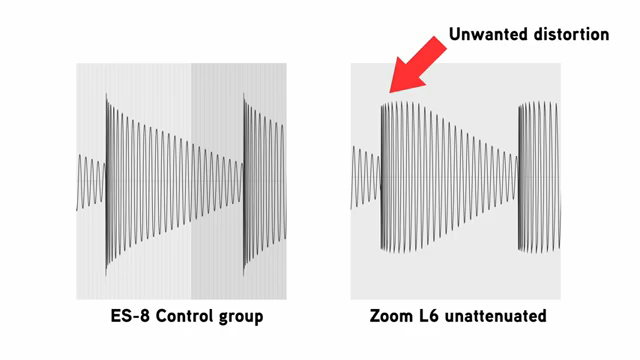
The results? Channel 1 with its fancy converters handles the heat, and attenuated signals into channel 3 behave. But slam unattenuated modular straight into channel 3 and you get distortion that’s impossible to ignore. The ES-8, meanwhile, just shrugs and keeps things clean. If you want the gory details—noise, signal flow, and why the ATN8 isn’t perfect—Metamyther’s video is the place to see it all in action.

"The Zoom is not the only way I get audio into my DAW. I also use the Expert Sleepers ES-8, so we'll use that as our scientific control group."
© Screenshot/Quote: Metamyther (YouTube)
32-Bit Float: Not a Miracle Cure
"However, Zoom's article told me that recording in 32-bit float would save my information. So what's going on?"
© Screenshot/Quote: Metamyther (YouTube)
Here’s where the myth-busting begins. Zoom’s own article claims 32-bit float means you can set and forget your levels, but Metamyther proves otherwise. The problem isn’t digital headroom—it’s the analog input stage. Modular signals can hit 10 volts peak-to-peak (or more), while the L6’s channels 3-10 max out at just over 6 volts. That means your precious modular kicks are clipping before the digital magic even gets a look in.
Metamyther breaks down the numbers, showing that modular’s voltage range is in a different league from mics or line-level gear. If you thought 32-bit float would save your bacon, think again. The analog world still bites, and the L6’s input limits are the real bottleneck. Watch the video for the full voltage chart and a lesson in why specs matter more than marketing.
Enter the Zoom L6 Max: Padding for the Win
Just when you think all hope is lost, Metamyther introduces the Zoom L6 Max—a mixer that actually listens to modular users. The Max adds -20 dB pads to the channels that need it, making them far more friendly to hot Eurorack signals. More channels, a better screen, and the same 32-bit float goodness, but now with the analog headroom to back it up.
If you’re serious about recording modular without frying your kicks, the L6 Max is the obvious upgrade. Metamyther doesn’t sugar-coat it: the original L6 is great for the price, but the Max is the one you want if you’re running a proper modular rig. Sometimes, size does matter—especially when it comes to headroom.

"I'd definitely advocate for getting the L6 Max, as it's not that much bigger, but you get more channels, a nice screen with your recording, and of course the attenuation."
© Screenshot/Quote: Metamyther (YouTube)
Quick Fixes: Getting Cleaner Modular Recordings
To wrap it all up, Metamyther drops some practical advice: know your mixer’s limits, use attenuation where you need it, and don’t trust 32-bit float to fix everything. The L6 is a solid mixer if you play to its strengths, but if you want plug-and-play modular recording, the L6 Max is your new best mate. For the full forensic breakdown—and some proper sound demos—go watch the video. Your kicks will thank you.
This article is also available in German. Read it here: https://synthmagazin.at/metamyther-vs-zoom-l6-modular-madness-und-mixer-mysterien/
Watch on YouTube:
Latest articles
Watch on YouTube:
Visit the channel:
https://www.youtube.com/Metamyther
https://www.youtube.com/Metamyther
Links from Metamyther:
Main Site: https://metamyther.com
Instagram: https://instagram.com/metamyther
Bandcamp: https://metamyther.bandcamp.com
Facebook: https://facebook.com/tkexit
Sponsored links:
If you purchase via these links, we may earn a small commission – at no extra cost to you. The link opens an Amazon keyword search, and results may vary depending on availability.
Antumbra ATN8
🔗 Check price on Amazon
🔗 Check price on Amazon
Expert Sleepers ES-8
🔗 Check price on Amazon
🔗 Check price on Amazon
Shakmat Battering Ram
🔗 Check price on Amazon
🔗 Check price on Amazon
Zoom L6
🔗 Check price on Amazon
🔗 Check price on Amazon
Zoom L6 Max
🔗 Check price on Amazon
🔗 Check price on Amazon