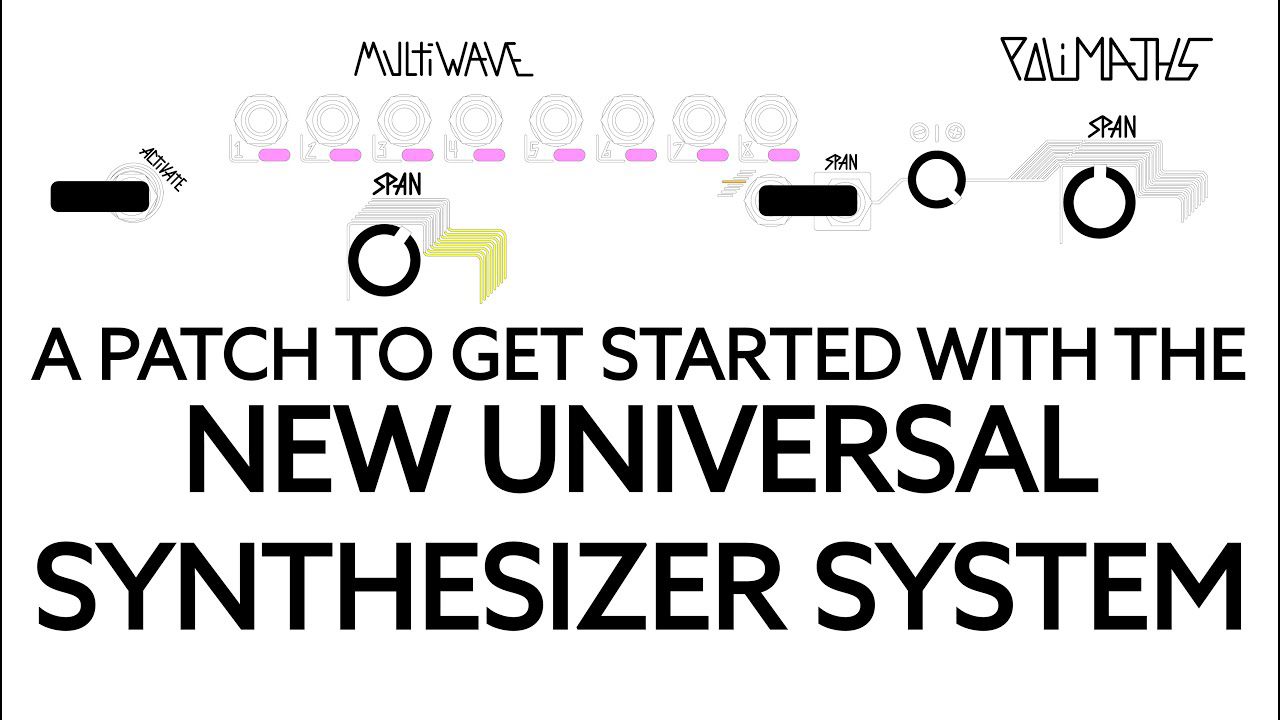
Make Noise, the Asheville-based champions of modular experimentation, introduce their New Universal Synthesizer System with a patch that’s less a rulebook and more a springboard. In this official walkthrough, the Make Noise team demonstrate how Multi-Wave, Polymaths, and QXG modules can be chained for immediate sonic results. The video is all about patching philosophy: there’s no ‘correct’ way, but this setup offers a practical launchpad for exploring the system’s interconnections and modulation tricks. For those who think in voltages and crave patchable complexity, it’s a revealing look at how these modules want to be played together.
13. November 2025
MILES
MAKEN0ISE’s Universal Synthesizer System: A Modular Starting Patch Dissected
A Modular System Without a Map
The New Universal Synthesizer System from Make Noise is presented as a modular playground where patching is entirely open-ended. The video sets the tone by emphasising that there’s no single ‘correct’ way to connect these modules—every user is encouraged to forge their own path. This approach is classic Make Noise: offering tools that invite experimentation rather than prescribing workflows.
From the outset, the system is described as a suite of interconnected modules—Multi-Wave, Polymaths, and a pair of QXGs—designed to be chained together with supplied cables. This normalisation provides a ready-made signal path, but the ethos remains clear: the best patch is the one you create yourself. The video positions the following patch as a starting point, not a template, inviting users to adapt and mutate it as they see fit.

"It is by no means a default patch, nor is it the 'correct' patch."
© Screenshot/Quote: Maken0Isemusic (YouTube)
Initial Patch: Chaining the Modules
"This is just one example of the ways in which these two modules can be connected."
© Screenshot/Quote: Maken0Isemusic (YouTube)
The demonstration begins by connecting the outputs of the leftmost QXG to the auxiliary inputs of the rightmost QXG, completing the internal audio and modulation chain. This simple connection leverages the system’s under-the-hood normalisation, where Multi-Wave provides audio, Polymaths delivers amplitude modulation, and the QXGs handle the final output routing.
Monitoring the outputs of the rightmost QXG, the patcher then links Multi-Wave and Polymaths so that both activate in synchrony. This ensures that both modules respond to the same channel activations, laying the groundwork for tightly integrated modulation and sequencing. The video is careful to note that this is just one example among many possible configurations, reinforcing the system’s flexibility.
Sequencing and Modulation: Multi-Wave Meets Polymaths
Key features of the system come to the fore as the patcher sets Polymaths to channel index mode, ensuring it can accurately track voltages from Multi-Wave. With the span panel control at noon and the span CV attenuverter fully clockwise, Polymaths is primed for precise channel following. The Multi-Wave’s channel index output is patched to the span CV input on Polymaths, and both modules are set to their preferred activation modes—round mode for Multi-Wave, indicated by a yellow display.
Sequencing is introduced by clocking Multi-Wave via Tempy and distributing the clock signal to both Multi-Wave and René. This setup allows Multi-Wave to advance through its eight channels sequentially, with Polymaths tracking each step. Pitch sequencing is achieved by routing René’s X-CV output to Multi-Wave’s volt per octave input, so each channel’s pitch updates with every activation. The result is a tightly locked system where modulation and pitch sequencing are deeply intertwined.

"Polymaths advances in tandem."
© Screenshot/Quote: Maken0Isemusic (YouTube)
Overlapping Notes and Modulation Dissemination: Creative Patch Potential

"Hopefully this patch provides you with enough of a starting point from which you can explore further."
© Screenshot/Quote: Maken0Isemusic (YouTube)
The creative possibilities of the system become apparent when the fall time on Polymaths is increased, allowing notes to overlap and blend. This produces evolving textures as successive notes bleed into one another, a technique that’s particularly effective for lush, polyphonic soundscapes. The video demonstrates how subtle tweaks to envelope times can dramatically alter the musical outcome.
Further exploration introduces the concept of modulation dissemination: each channel holds a modulation value at activation, updating only when triggered again. By patching a gate from Press Point to the fall CV input on Polymaths and adjusting the attenuverter, the patcher shows how dynamic, per-channel modulation can be achieved. This opens the door to intricate, evolving modulations across the system.
Finally, the spread parameter on Polymaths is manipulated to distribute oscillation unevenly across channels. Depending on the direction of the spread control, either the leftmost or rightmost channels receive more modulation, adding another layer of movement and complexity. The video closes by encouraging users to take this starting patch and push it in their own direction—a fitting end for a system built on open-ended exploration.
This article is also available in German. Read it here: https://synthmagazin.at/maken0ises-universal-synthesizer-system-ein-modularer-startpatch-unter-der-lupe/
Watch on YouTube:
Latest articles
Watch on YouTube:
Visit the channel:
https://www.youtube.com/MAKEN0ISEMUSIC
https://www.youtube.com/MAKEN0ISEMUSIC
Links from MAKEN0ISEMUSIC:
website: https://www.makenoisemusic.com
instagram: https://www.instagram.com/makenoisemusic
twitter: https://twitter.com/makenoisemusic
facebook: https://www.facebook.com/makenoiseco
Sponsored links:
If you purchase via these links, we may earn a small commission – at no extra cost to you. The link opens an Amazon keyword search, and results may vary depending on availability.
Multi-Wave
🔗 Check price on Amazon
🔗 Check price on Amazon
Polymaths
🔗 Check price on Amazon
🔗 Check price on Amazon
Press Point
🔗 Check price on Amazon
🔗 Check price on Amazon
René
🔗 Check price on Amazon
🔗 Check price on Amazon
Tempy
🔗 Check price on Amazon
🔗 Check price on Amazon