Make Noise, the Asheville-based Eurorack mavericks, return to their exploratory roots by revisiting Allen Strange’s iconic ‘Dream Machine’ patch. In this video, the Make Noise team takes us on a journey through a heavily modified version of Strange’s original concept, blending random voltages with sequenced structure to create a self-generating soundscape. The patch is a testament to the brand’s penchant for experimental synthesis, showing off how their modules can be pushed into unpredictable yet musically coherent territory. For those who thrive on the edge of chaos and control, this is a deep dive into the art of modular patching as both science and dreamwork.

A Modular Dreamscape: Revisiting Allen Strange
The video opens with a nod to the experimental lineage of electronic music, referencing Allen Strange’s classic ‘Dream Machine’ patch as documented in his influential book. Make Noise acknowledges that their current system doesn’t mirror the original function blocks exactly, but the spirit of Strange’s design is alive and well. The patch is described as a loose adaptation, extending beyond the original outline and embracing the unpredictability that defines much of the Make Noise ethos.
The concept is simple yet profound: once the patch is running, it essentially performs itself, blurring the line between composer and instrument. This approach is rooted in the 20th-century tradition of self-generating music, where the system’s behaviour emerges from the interplay of random and structured elements. The Make Noise team sets the stage for an exploration of how much of this randomness is, in fact, predictable—a question that sits at the heart of modular synthesis.

"Figure 6.72 is a dream machine in which the musical structure is defined on a moderately high level, but two random voltage sources are used to affect the behavior of the fixed structure."
© Screenshot/Quote: Maken0Isemusic (YouTube)
Randomness Meets Structure: The Patch’s Core Ingredients
"We'll notice that the portions of this patch are driven by random sources. Other portions of the patch, including the random sources themselves, are influenced by elements that are more predictable, including sequencing and low frequency oscillations."
© Screenshot/Quote: Maken0Isemusic (YouTube)
At the heart of the Dream Machine patch is the interplay between random voltage sources and more predictable modulation. The video highlights the use of stepped random voltages—courtesy of the Wogglebug—alongside sequencers and LFOs to shape the evolving soundscape. These random voltages are not left to run wild; instead, they’re carefully routed through attenuators and function generators, allowing for nuanced control over their influence.
Predictable elements like sequencing and cycling envelopes provide a skeleton for the patch, ensuring that the chaos remains musically meaningful. The result is a system where random voltages modulate parameters such as clock speed and dynamics, but always within a framework that keeps the output coherent. The Make Noise approach here is less about pure unpredictability and more about harnessing randomness as a creative tool within a structured environment.
Patching in Practice: Clocks, Modulation and Dynamic Control
The patching process is methodical yet open-ended, demonstrating several classic modular techniques. The stepped random voltage from the Wogglebug is multed and sent through an attenuator before reaching Maths Channel 4, which is set to cycle. The end-of-cycle gate from Maths is then used to clock René’s X Channel, creating a feedback loop where each sequence of 16 steps is played at a different, randomly determined speed. This clever use of clocking ensures that the sequence never settles into a predictable groove, keeping the listener on their toes.
Further complexity is added by clocking René’s Y Channel and triggering additional Maths channels, which in turn control the opening of DXG channels for dynamic sound gating. The video also shows how both sides of the Spectraphon are sequenced in tandem, with one side following the other for tight, interlocked melodic movement. Random voltages are used to modulate envelope lengths and rise times, subtly shifting the patch’s rhythmic and timbral character as it evolves.
Dynamics are not neglected: stepped random voltages are summed with offsets and routed to control the X-Pan’s auxiliary level, ensuring the output never drops to silence unless desired. Additional random sources are summed with sequencer outputs before hitting the VCO, and the patch even incorporates inverted sequencer outputs to modulate secondary clock rates. The result is a patch that feels alive, constantly shifting yet always under some degree of control—a hallmark of the Make Noise style.
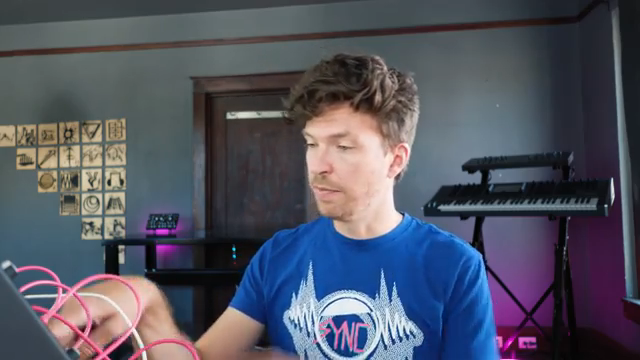
"Therefore, each time the sequence starts over, we generate a new random voltage and the sequence gets a new clock speed."
© Screenshot/Quote: Maken0Isemusic (YouTube)
Creative Workflows: Building Self-Generating Sound Worlds

"The synthesizer is a dream machine. I don't think most synthesisists would deny it."
© Screenshot/Quote: Maken0Isemusic (YouTube)
The latter part of the video is a showcase of creative modular workflows, illustrating how random and structured elements can be woven together to build complex, evolving soundscapes. The Make Noise system is shown switching between multiple René states, each with distinct scale values, using the Wogglebug to control the transitions. LFOs are brought in to modulate clock speeds, further increasing the patch’s unpredictability.
Gate and access patterns are altered as the patch shifts through different states, with the Z axis introducing additional variety. The result is a living, breathing piece of music that is both dreamlike and meticulously constructed—a fitting tribute to Allen Strange’s original vision. The video closes with a philosophical reflection on the synthesizer as a dream machine, inviting viewers to imagine what new sonic worlds might emerge when human and machine creativity collide.
This article is also available in German. Read it here: https://synthmagazin.at/maken0ise-belebt-die-dream-machine-neu-allen-stranges-patch-im-neuen-gewand/
Watch on YouTube:
Latest articles
Watch on YouTube:
Visit the channel:
https://www.youtube.com/MAKEN0ISEMUSIC
https://www.youtube.com/MAKEN0ISEMUSIC
Links from MAKEN0ISEMUSIC:
website: https://www.makenoisemusic.com
instagram: https://www.instagram.com/makenoisemusic
twitter: https://twitter.com/makenoisemusic
facebook: https://www.facebook.com/makenoiseco
Sponsored links:
If you purchase via these links, we may earn a small commission – at no extra cost to you. The link opens an Amazon keyword search, and results may vary depending on availability.
Maths
🔗 Check price on Amazon
🔗 Check price on Amazon
Mimeophon
🔗 Check price on Amazon
🔗 Check price on Amazon
René
🔗 Check price on Amazon
🔗 Check price on Amazon
Spectraphon
🔗 Check price on Amazon
🔗 Check price on Amazon
Wogglebug
🔗 Check price on Amazon
🔗 Check price on Amazon
X-PAN
🔗 Check price on Amazon
🔗 Check price on Amazon