In this exploratory session from the official MAKEN0ISE channel, Pete takes us on a sonic ramble through Asheville, gathering inspiration from record shops, movie stores, and even the roar of waterfalls. Rather than a standard module demo, this video is a patch diary—showing how environmental textures and found objects can be transformed into voltage-controlled artistry. Expect vinyl crackle, VHS tape ribbon controllers, and the sound of nature itself, all filtered through the Make Noise ethos of experimental modular synthesis. For anyone who’s ever wondered how their surroundings might shape their next patch, this is a gentle nudge to look (and listen) a bit closer.

15. May 2025
MILES
MAKEN0ISE: Patching Asheville—From Surface Noise to Waterfalls
Wandering Asheville: The Hunt for Patch Inspiration
The video opens with Pete, familiar to many from the Make Noise Instagram channel, stepping in for Walker and inviting viewers on a relaxed journey through Asheville in search of sonic inspiration. Rather than a typical studio-bound patch session, the approach here is refreshingly open-ended—an urban ramble with the explicit goal of letting the environment shape the patching process. Pete references his long-running ‘VC Environments’ series, where he’s previously translated natural sounds into modular voltage, setting the tone for a session that’s as much about listening as it is about patching.
This segment establishes the central theme: the idea that the sounds, objects, and general atmosphere of one’s surroundings can directly influence modular creativity. By framing the city as both playground and palette, Pete encourages a mindset where inspiration is not just found in gear catalogs or YouTube demos, but in the accidental music of everyday life. The invitation is clear—grab your field recorder, keep your ears open, and see what your city (or countryside) wants to patch.

"I've been interested in the ways in which the environment we're in influences the art we make."
© Screenshot/Quote: Maken0Isemusic (YouTube)
Surface Noise and Vinyl: Textures at the Threshold
"A good place to start in experiments like this are the unintentional sounds, the accidental music that's hidden in all LPs."
© Screenshot/Quote: Maken0Isemusic (YouTube)
Back in the shop, Pete demonstrates a classic Make Noise move: extracting rich, unpredictable textures from the humble surface noise of a vinyl record. By patching the output of a record player into the Morphagene at maximum gain, then routing through Mimeophon and XO, he captures the accidental symphony of clicks, pops, and hiss that lurk between the grooves. The focus here is on the musicality of imperfection—those artefacts that most listeners try to ignore become the raw material for new sonic environments.
With the Morphagene capturing a segment of label-adjacent noise, Pete manipulates the texture using Mimeophon’s built-in filtering and reverb. The result is a soundscape that oscillates between gentle rainfall and the crackle of a fireplace, demonstrating how modular tools can transform mundane artefacts into evocative atmospheres. The process is simple but effective: start with what’s available, and let the system’s character do the heavy lifting.
VHS Tape as Ribbon Controller: Voltage on Celluloid
The next stop is Orbit DVD, where Pete scavenges for old VHS tapes—specifically seeking out those with a matte finish, as these work best for the intended hack. After dismantling the cassette and extracting a strip of tape, he tapes it down and wires one end to positive voltage and the other to ground, effectively creating a DIY ribbon controller. This is classic Make Noise territory: reimagining obsolete media as hands-on voltage manipulators.
By patching a cable to a module’s volt-per-octave input and sliding it along the tape, Pete demonstrates how the position on the VHS strip translates directly to control voltage, modulating pitch or any other parameter. The higher up the tape, the higher the voltage—a tactile, lo-fi approach to modulation that’s as playful as it is practical. It’s a reminder that the modular ecosystem thrives on experimentation, and that sometimes the best controller is whatever’s lying around in the bargain bin.

"By patching a cable to an input, in this case the volt per octave input, and then touching it to a point on this ribbon controller, we can modulate that parameter by sliding it up and down the piece of tape."
© Screenshot/Quote: Maken0Isemusic (YouTube)
Waterfalls and Tape Loops: Synthesizing the Natural World
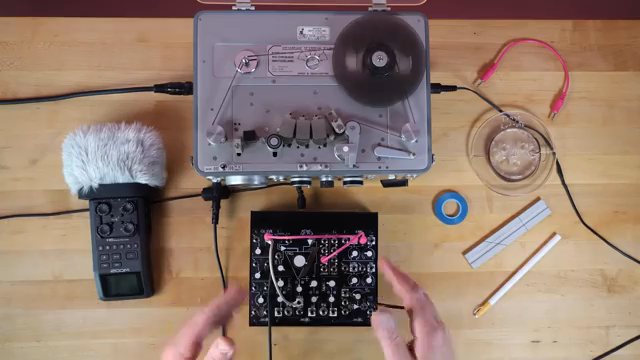
"We will have the amplifier getting quieter as the sound gets thinner."
© Screenshot/Quote: Maken0Isemusic (YouTube)
Pete shifts gears by introducing a field recording from Looking Glass Falls, a picturesque waterfall outside Asheville. He uses this tape loop as a noise source, aiming to recreate the sensation of a wave receding from the shoreline—a technique he previously detailed in an article for New Music. The patch is elegantly simple: the tape loop feeds into a high-pass filter (QPOS), which then routes to an amplifier (XPan), with modulation provided by an offset voltage from Channel Saver.
The key trick is sending the same modulation signal to both the crossfade input of XPan and the frequency input of QPOS, but with the filter’s attenuverter set counterclockwise to invert the control voltage. This causes the amplifier to get quieter as the sound thins out, mimicking the natural fade of water retreating. Pete notes that reverb is essential for this kind of patch, adding spatial depth and realism to the synthetic recreation of environmental sounds.
Throughout this segment, the emphasis is on subtlety and restraint—using modular tools not just for bombast, but for delicate, evocative sound design. The result is a patch that blurs the line between field recording and synthesis, inviting the listener to inhabit a liminal sonic space shaped by both nature and voltage.
Everyday Inspiration: Patch What You Hear
As the session winds down, Pete circles back to the core message: inspiration is everywhere, if you’re willing to listen. Whether it’s the hiss of a record, the tactile feel of VHS tape, or the roar of a waterfall, each element becomes a springboard for creative patching. The video closes with a gentle nudge to explore your own environment—urban or rural—and see what unexpected sounds might find their way into your next modular experiment.
Rather than offering a prescriptive workflow, the video champions curiosity and play. It’s a reminder that the best patches often begin not with a manual, but with a question: what does your world sound like, and how might you translate that into voltage? For modular enthusiasts, it’s an invitation to treat every day as a potential source of new sonic material.
This article is also available in German. Read it here: https://synthmagazin.at/maken0ise-asheville-patchen-von-oberflaechenrauschen-bis-wasserfaellen/
Watch on YouTube:
Latest articles
Watch on YouTube:
Visit the channel:
https://www.youtube.com/MAKEN0ISEMUSIC
https://www.youtube.com/MAKEN0ISEMUSIC
Links from MAKEN0ISEMUSIC:
website: https://www.makenoisemusic.com
instagram: https://www.instagram.com/makenoisemusic
twitter: https://twitter.com/makenoisemusic
facebook: https://www.facebook.com/makenoiseco
Sponsored links:
If you purchase via these links, we may earn a small commission – at no extra cost to you. The link opens an Amazon keyword search, and results may vary depending on availability.
Channel Saver
🔗 Check price on Amazon
🔗 Check price on Amazon
Mimeophon
🔗 Check price on Amazon
🔗 Check price on Amazon
Morphagene
🔗 Check price on Amazon
🔗 Check price on Amazon
QPOS
🔗 Check price on Amazon
🔗 Check price on Amazon
XPan
🔗 Check price on Amazon
🔗 Check price on Amazon