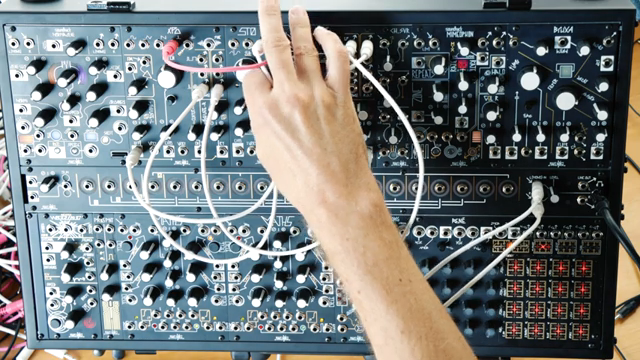
What if, instead of simply layering slightly detuned oscillators, you turned them loose as modulators for one another? In this latest video from MAKEN0ISE, the Asheville-based champions of experimental Eurorack, we’re treated to a deep dive into phase relationships, detuning, and the peculiar magic that happens when oscillators interact in less-than-obvious ways. The patch on show doesn’t just sum signals—it explores how phase drift and subtle tuning shifts can carve out new sonic terrain, with a healthy dose of frequency modulation and feedback thrown in for good measure. If you’re after inspiration for wrangling more from your VCOs than just fat unison, this is a patch journey worth your attention.
26. September 2024
MILES
MAKEN0ISE: Oscillators as Modulators – Phase Shaving for the Adventurous Patchhead
Make Noise DXG, Make Noise Maths, Make Noise QPAS, Make Noise STO, Make Noise XPO
Oscillators Off the Beaten Path: Modulators, Not Just Mixers
The video takes a refreshing detour from the usual practice of summing slightly detuned oscillators for a thicker sound. Instead, the focus here is on using oscillators as modulators for each other, a move that immediately opens up a world of phase-based sonic intrigue. Rather than simply blending their outputs, the patcher explores what happens when the periodic phase drifts between oscillators are allowed to interact more directly.
This approach highlights the unique textures that emerge when oscillators are patched to influence one another, rather than just reinforcing the fundamental tone. The result is a soundscape where phase relationships become more pronounced, and the moments when oscillators drift out of phase are thrown into sharp relief. It’s a subtle but powerful shift in patching philosophy, inviting the listener to focus on the interplay between signals rather than their sum.

"What if instead of monitoring these oscillators together, we use them as modulators for each other?"
© Screenshot/Quote: Maken0Isemusic (YouTube)
Phase Relationships: Shifting Sands and Sonic Contrasts
Phase shifting and the delicate dance of detuning are at the heart of this exploration. The video employs a visual analogy—superimposed stripes moving in and out of alignment—to illustrate how oscillators at similar frequencies can create a constantly evolving phase relationship. When two oscillators are tuned closely, their phase drift isn’t just a background effect; it becomes a central feature of the sound, morphing a static tone into something fluid and alive.
By detuning one oscillator ever so slightly, the patcher demonstrates how the resulting phase cancellations and reinforcements generate a timbre that feels almost liquid. This isn’t about static beating or simple summing; it’s about making the phase interaction itself the star of the show. The effect is more pronounced and musically interesting than traditional approaches, with the out-of-phase moments standing out in sharper contrast and lending the patch a sense of movement and unpredictability.
Creative Workflows: Modulation, FM, and Rhythmic Complexity
"The fine-tuned control of the STO lets us choose the exact degree to which these two oscillators are out of tune with each other."
© Screenshot/Quote: Maken0Isemusic (YouTube)
The patching workflow showcased here is a playground for anyone interested in complex modulation. Frequency modulation is introduced as a way to further enrich the interaction between oscillators, with the STO’s sine wave modulating the XPO and the results being filtered and monitored through the DXG. The fine-tune control on the STO is used to dial in the precise degree of detuning, effectively controlling the tempo of the phase shifts and the rhythmic feel of the resulting timbral changes.
Additional modulation sources, such as a channel from Maths, are brought in to add yet another layer of rhythmic and timbral variation. By patching Maths into the frequency input of the filter, the patcher demonstrates how even more extreme modulation can be achieved, with the wave shape of the modulator (in this case, a sawtooth) imparting its own character to the phase shifts. Feedback is also introduced by routing the filter’s output back into the oscillator’s FM input, creating a feedback loop that further intensifies the complexity and unpredictability of the patch. The result is a rich, evolving texture where every small tweak yields a new sonic surprise.
Tiny Tweaks, Massive Impact: The Art of Precision Patching
The video closes by underscoring just how sensitive this style of patching is to small adjustments. Even the slightest nudge of a tuning knob or modulation depth can send the sound into dramatically different territory—sometimes smooth and harmonic, sometimes wild and furry. This sensitivity demands a gentle touch and a keen ear, rewarding those who pay close attention to the interplay of frequencies. It’s a reminder that in modular synthesis, the difference between chaos and beauty often lies in the subtlest of moves.

"It requires a gentle touch and close attention to the various relative frequencies."
© Screenshot/Quote: Maken0Isemusic (YouTube)
This article is also available in German. Read it here: https://synthmagazin.at/maken0ise-oszillatoren-als-modulatoren-phase-shavin-fuer-patch-feinschmecker/
Watch on YouTube:
Latest articles
Watch on YouTube:
Visit the channel:
https://www.youtube.com/MAKEN0ISEMUSIC
https://www.youtube.com/MAKEN0ISEMUSIC
Links from MAKEN0ISEMUSIC:
website: https://www.makenoisemusic.com
instagram: https://www.instagram.com/makenoisemusic
twitter: https://twitter.com/makenoisemusic
facebook: https://www.facebook.com/makenoiseco
Sponsored links:
If you purchase via these links, we may earn a small commission – at no extra cost to you. The link opens an Amazon keyword search, and results may vary depending on availability.
Make Noise DXG
🔗 Check price on Amazon
🔗 Check price on Amazon
Make Noise Maths
🔗 Check price on Amazon
🔗 Check price on Amazon
Make Noise QPAS
🔗 Check price on Amazon
🔗 Check price on Amazon
Make Noise STO
🔗 Check price on Amazon
🔗 Check price on Amazon
Make Noise XPO
🔗 Check price on Amazon
🔗 Check price on Amazon