Make Noise, the Asheville-based champions of modular mischief, return with a deep dive into their Spectraphon module—a spectral amplitude modulation powerhouse designed for the adventurous Eurorack explorer. In this video, they demonstrate how echoes, dynamic controls, and oscillator mixing can be harnessed to sculpt complex, evolving soundscapes. Expect a patch-oriented walkthrough that doesn’t just show off features, but reveals how Spectraphon’s unique approach to arrays and modulation can transform your rack into a playground of spectral textures. If you’re after nuanced sonic layering and creative modulation, this one’s for you.
14. August 2025
MILES
Make Noise Spectraphon: Spectral Bouncing Balls and Echoes in the Array
Make Noise DXG, Make Noise Maths, Make Noise Mimeophon, Make Noise Morphagene, Make Noise Spectraphon, Make Noise X-Pan
Spectraphon: A Spectral Playground
The Spectraphon from Make Noise is introduced as a module that thrives on spectral amplitude modulation, offering a distinctive approach to sound manipulation in Eurorack systems. The video opens with musings on sonic signatures and how certain characteristics of sound are either accentuated or obscured when processed through spectral techniques. This philosophical angle sets the stage for a hands-on exploration, highlighting the module’s capacity to shape and transform audio in unexpected ways.
Spectraphon’s buzzy, fuzzy character is immediately foregrounded, especially when paired with decaying echoes. The module is positioned not just as a sound source, but as a tool for sculpting complex timbres—ideal for those who want more than just another oscillator in their rack. The focus here is firmly on what happens when you push sound through the Spectraphon’s unique signal path, rather than on technical specs or marketing jargon.
Echoes, Pulses, and Dynamic Manipulation
The video quickly moves into patch territory, building a pulse and echo sound using a sine wave from Spectraphon’s side B, routed through the DXG and triggered by Morphagene’s end-of-splice gate. This creates a percussive, resonant starting point, which is then sent through Mimeophon to generate a cascade of echoes. The result is a lively, evolving texture that forms the raw material for further spectral processing.
Instead of monitoring the direct output, the patch is routed into Spectraphon’s side A input for spectral amplitude modulation. The creator demonstrates how adjusting the color parameter can dramatically alter the resulting timbre, with different settings yielding a variety of textures. This approach underlines the value of dynamic controls and creative routing in extracting the most from Spectraphon’s architecture.
Oscillator Mixing and Envelope Follower Tricks
A key technique highlighted is the mixing of Spectraphon’s internal oscillator with the external source sound, using the X-Pan. This blend provides a useful frame of reference for locating the fundamental within the spectral array, which is crucial for achieving musically coherent results when sequencing pitches. The video notes that arrays lacking a strong fundamental can sound less convincing when transposed, a practical tip for anyone crafting their own spectral banks.
Further refinement comes from leveraging envelope followers—both from Morphagene and Spectraphon itself. The Morphagene’s envelope follower is patched to control the sine wave’s level, preventing it from becoming a static drone and adding dynamic interest. Meanwhile, Spectraphon’s own envelope follower offers visual feedback on input dynamics, helping users fine-tune levels for optimal spectral capture. These techniques collectively enhance the module’s responsiveness and musicality.
Arrays, Modulation, and Layered Textures
The workflow then shifts to creating and navigating arrays within Spectraphon. The presenter advises setting partials up and FM down for the most accurate spectral previews and full-volume array creation. Once the array is established, the even and odd outputs are monitored, and the source is removed from the input to focus on the resynthesized sound.
Modulation is brought to the fore by scanning through the array with a slow Maths function, introducing rhythmic stretching and squashing reminiscent of a bouncing ball. The focus parameter is explored, showing how it compresses or expands the dynamic range—transients become more pronounced with focus down, while higher settings yield a smoother array. Layering these modulations with additional filtering and parameter tweaks results in a rich, evolving sonic landscape.
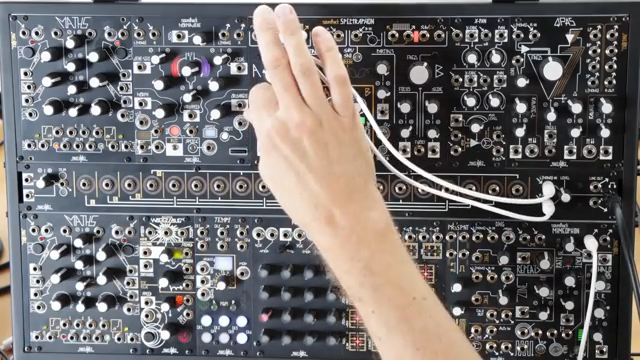
"Slide moves us through the array."
© Screenshot/Quote: Maken0Isemusic (YouTube)
Modes, Versatility, and the Call to Experiment
The final section showcases Spectraphon’s versatility, with attention given to the interplay between detune, FM, partials, and filter settings. The presenter demonstrates how slide modulation can be paired with filter sweeps for further timbral variation, encouraging users to experiment with different combinations to unlock new textures.
Spectraphon’s multiple modes—SAO, noise, and chaos—are briefly mentioned, with a nod to the ongoing appeal of SAO mode for certain patches. The video closes by inviting viewers to share their own experiences and patching strategies, reinforcing Make Noise’s ethos of open-ended exploration and community-driven discovery.
This article is also available in German. Read it here: https://synthmagazin.at/make-noise-spectraphon-spektrale-flummis-und-echos-im-array/
Watch on YouTube:
Latest articles
Watch on YouTube:
Visit the channel:
https://www.youtube.com/MAKEN0ISEMUSIC
https://www.youtube.com/MAKEN0ISEMUSIC
Links from MAKEN0ISEMUSIC:
website: https://www.makenoisemusic.com
instagram: https://www.instagram.com/makenoisemusic
twitter: https://twitter.com/makenoisemusic
facebook: https://www.facebook.com/makenoiseco
Sponsored links:
If you purchase via these links, we may earn a small commission – at no extra cost to you. The link opens an Amazon keyword search, and results may vary depending on availability.
Make Noise DXG
🔗 Check price on Amazon
🔗 Check price on Amazon
Make Noise Maths
🔗 Check price on Amazon
🔗 Check price on Amazon
Make Noise Mimeophon
🔗 Check price on Amazon
🔗 Check price on Amazon
Make Noise Morphagene
🔗 Check price on Amazon
🔗 Check price on Amazon
Make Noise Spectraphon
🔗 Check price on Amazon
🔗 Check price on Amazon
Make Noise X-Pan
🔗 Check price on Amazon
🔗 Check price on Amazon