Make Noise, the Asheville-based champions of modular experimentation, unveil the ReSynthesizer—a 7U system that’s less a fixed instrument and more a sonic blackboard for the adventurous. Drawing from eight years of module design, this system pairs the spectral wizardry of Spectraphon with the granular prowess of Morphagene, all underpinned by a robust CV generation suite. In typical Make Noise fashion, the video walks through the instrument’s conceptual roots, its patching philosophy, and a series of encounters with traditional instruments at Drop of Sun Studios. The ReSynthesizer isn’t just a collection of modules—it’s a platform for reimagining sound, inviting users to sculpt, mangle and reassemble audio in ways both familiar and utterly new.

31. October 2024
MILES
Make Noise ReSynthesizer: A Modular Blackboard for Sonic Reinvention
4 Zone 7U CV Bus case, CV Bus, DXG, Maths, Mimeophon, Morphagene, PrssPnt, QPAS, René, Spectraphon, Tempi, Wogglebug, X-PAN
A Modern Modular Blackboard
The ReSynthesizer is introduced as Make Noise’s answer to the evolving needs of modern modular musicians. Rather than a static instrument, it’s presented as a flexible, open system—a curated collection of modules that together form a platform for sonic exploration. The video traces its origins back to a Superbooth demo rig, initially assembled to showcase the SoundHack Spectraphon. What began as a temporary configuration soon proved itself indispensable, with its layout and module choices becoming second nature for the Make Noise team.
This system is not just about technical prowess; it’s about the meeting of old and new, both in terms of sound sources and musical philosophy. The ReSynthesizer is described as a tool for creating new sounds from existing materials, blending electronic history with forward-looking design. The placement of modules like Morphagene next to Spectraphon, initially a practical decision, evolved into a workflow that encourages creative patching and serendipitous discovery. The focus is on the relationship between musician and instrument, making the system as much about interaction as about circuitry.

"It's a modern modular musical instrument that brings together a number of independent modules to create new sounds from those that already exist."
© Screenshot/Quote: Maken0Isemusic (YouTube)
Spectraphon and Morphagene: The Twin Engines
"These modules are specifically geared toward chewing up sound and spitting it out, creating new sounds from those that already exist."
© Screenshot/Quote: Maken0Isemusic (YouTube)
At the heart of the ReSynthesizer are the Spectraphon and Morphagene modules, which together redefine what constitutes a sound source in a modular context. Unlike traditional oscillators, these modules are designed to chew up and spit out audio, transforming existing sounds into new textures. Morphagene operates in the amplitude and time domains, recording and replaying audio that can be manipulated through repetition, speed changes, reversal, and granular reordering. This approach turns any recorded sound into a malleable patch element, ready for further processing.
Spectraphon, on the other hand, works in the frequency domain, using spectral amplitude modulation to reinterpret audio based on its harmonic content. It’s less about literal playback and more about extracting and resynthesizing the spectral essence of a sound. Both modules can generate material without direct input—Morphagene from stored reels, Spectraphon via oscillation modes—making them versatile engines for both sampling and synthesis. The system’s supporting cast, including QPAS and Mimeophon, further blurs the line between sound source and processor, reinforcing the ReSynthesizer’s ethos of flexibility and creative misuse.
Workflow as Playground: CV, Touch, and Patchability
The ReSynthesizer’s design is all about fostering experimentation. With two Maths modules, a suite of CV generators, and the addition of DXG for stereo mixing and PrssPnt for touch interaction, the system encourages users to approach patching as play. The 4-zone CV Bus case provides ample routing and distribution, making complex modulation schemes straightforward to implement. This isn’t a system that dictates a workflow; instead, it invites users to invent their own, arranging and rearranging sonic elements on the fly.
Make Noise positions the ReSynthesizer as an open-ended instrument—a blackboard for sonic ideas rather than a prescriptive tool. The combination of classic sequencing (René, Tempi), expressive control (PrssPnt), and deep modulation (Wogglebug, dual Maths) means that users can move fluidly between generative, performative, and experimental approaches. The system’s layout, refined through real-world use, reflects a philosophy where patching is about discovery, not just execution.
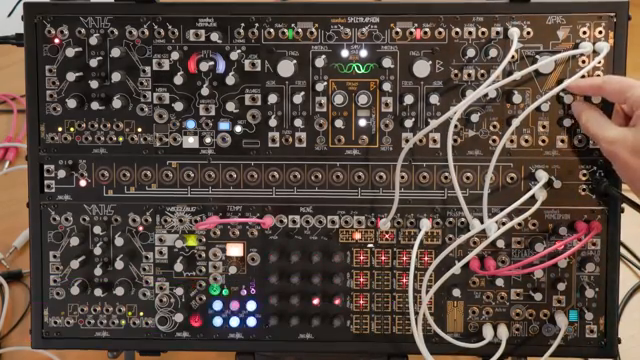
"The resynthesizer is as flexible and symbiotic as the synthesis patching it."
© Screenshot/Quote: Maken0Isemusic (YouTube)
Encounters at Drop of Sun: Tradition Meets Modularity

"So it could have some close encounters with a few different traditional musical instruments."
© Screenshot/Quote: Maken0Isemusic (YouTube)
To demonstrate the ReSynthesizer’s versatility, Make Noise takes the system to Drop of Sun Studios in Asheville, where it’s paired with traditional instruments like vocals, harmonium, electric sitar, pedal steel, and piano. These sessions highlight the system’s ability to absorb, transform, and recontextualize acoustic sounds, turning them into new electronic textures. The video features extended musical interludes, showcasing how the ReSynthesizer can blur the boundaries between source and synthesis.
This collaborative context underscores the system’s role as a bridge between worlds—acoustic and electronic, composed and improvised. The ReSynthesizer doesn’t just process external sounds; it invites musicians to engage in a dialogue with the machine, feeding it raw material and responding to its transformations. The result is a demonstration of modular synthesis not as an isolated practice, but as a living, collaborative process that thrives on interaction and unpredictability.
Watch on YouTube:
Latest articles
Watch on YouTube:
https://www.youtube.com/MAKEN0ISEMUSIC
Links from MAKEN0ISEMUSIC:
Sponsored links:
If you purchase via these links, we may earn a small commission – at no extra cost to you. The link opens an Amazon keyword search, and results may vary depending on availability.
🔗 Check price on Amazon
🔗 Check price on Amazon
🔗 Check price on Amazon
🔗 Check price on Amazon
🔗 Check price on Amazon
🔗 Check price on Amazon
🔗 Check price on Amazon
🔗 Check price on Amazon
🔗 Check price on Amazon
🔗 Check price on Amazon
🔗 Check price on Amazon
🔗 Check price on Amazon