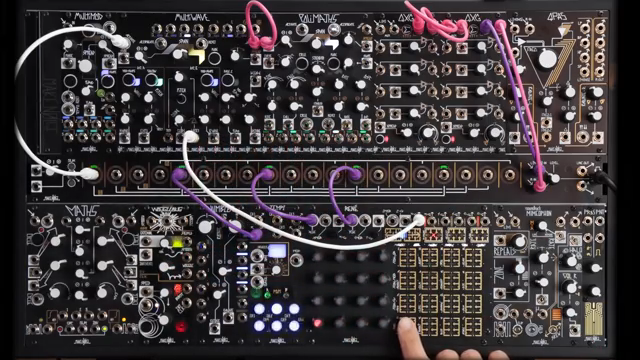
Make Noise, the Asheville vanguard of modular experimentation, unveils the MultiWAVE: an 8-channel dual wavetable oscillator designed to be the polyphonic heart of their New Universal Synthesizer System—or a wild card in any Eurorack rig. This official video walks us through MultiWAVE’s architecture, from its dual-oscillator-per-channel design to its advanced modulation and polyphony tools. As is typical for Make Noise, the focus is on creative signal flow, shared control concepts, and patching methods that invite you to explore unfamiliar musical territory. If you’re after a module that turns a single gesture into a forest of voices, this one’s worth a close listen.
13. November 2025
MILES
Make Noise MultiWAVE: Eightfold Polyphony for the Modular Frontier
From One Comes Many: MultiWAVE’s Core Concept
The MultiWAVE is introduced as the oscillator core of Make Noise’s New Universal Synthesizer System (NUSS), but it’s equally at home in any Eurorack modular setup. With eight independent channels, each featuring dual wavetable oscillators, MultiWAVE is designed to generate a multitude of audio signals from a single, centralised set of controls. This approach embodies the Make Noise philosophy: rather than simply replicating familiar sounds, the aim is to create new musical possibilities that stretch beyond the known.
MultiWAVE’s eight outputs are normalled to the QXG module’s inputs, while integration with PoliMATHS provides a powerful control structure. The system is built so that every channel’s output remains available for patching elsewhere, encouraging creative rerouting and complex voice structures. In short, MultiWAVE is less about static voices and more about dynamic, evolving polyphony.
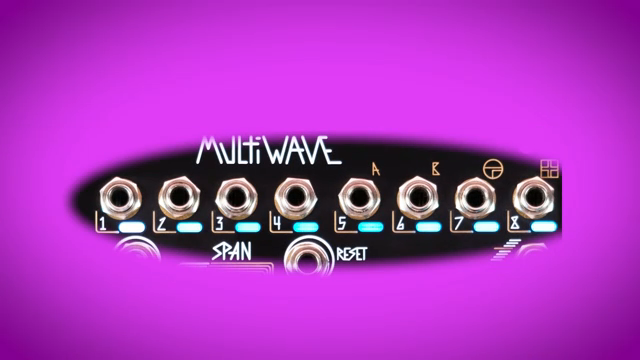
"From one comes many."
© Screenshot/Quote: Maken0Isemusic (YouTube)
Oscillators in Orbit: Independent Control Across Eight Channels
Each of MultiWAVE’s eight channels houses two fully independent wavetable oscillators—Osc A and Osc B—each with its own frequency, modulation, and wavetable position controls. The wave position parameter determines the starting point within the loaded wavetable, and this can be modulated internally using shapes from the MultiMod LFO. This allows for evolving timbres and motion within each channel, not just static waveforms.
Spread and modulation dissemination are central to how MultiWAVE distributes control across its channels. Parameters marked with gold indicators on their attenuverters are subject to these global controls, enabling per-channel variation from a single knob twist. Spread, for example, lets you skew modulation depth or wave position across the eight channels, while modulation dissemination ensures that each channel can receive unique values from shared inputs. This structure is ripe for complex, animated textures that would be tedious to patch manually.
Polyphonic Complexity: Modulation Dissemination, Spread, and Accumulate
"This allows us to use a single sequencer channel to create a polyphonic sequence across the eight channels of MultiWave."
© Screenshot/Quote: Maken0Isemusic (YouTube)
MultiWAVE’s advanced functions make it a playground for polyphonic sequencing and chordal experimentation. Modulation dissemination allows a single sequencer channel to activate and distribute parameter values across all eight voices, effectively turning monophonic input into polyphonic output. This is particularly potent for building layered sequences or harmonies from minimal external control.
The accumulate function adds another layer of control, letting users delay the effect of activations until a gate is received—ideal for synchronised chord changes or dramatic shifts in timbre. When combined with spread, these features allow for intricate, evolving sound structures that respond to both internal and external modulation. The result is a module that doesn’t just offer polyphony, but invites you to sculpt it in real time.
Shared Concepts: MultiWAVE and PoliMATHS in Tandem
A key design goal of MultiWAVE is seamless integration with related modules, particularly PoliMATHS. Both modules share a set of NUSS concepts—activate, accumulate, span, spread, channel index, round, parallel, and modulation dissemination—making it easy for users to transfer knowledge and patching strategies between them. For example, the channel index output from PoliMATHS can be patched directly to MultiWAVE’s span input, synchronising channel activations across both modules.
This shared control language means that MultiWAVE and PoliMATHS can be patched to follow each other, operate independently, or interact in hybrid workflows. The result is a system that encourages exploration, with modules designed to multiply the creative potential of each other rather than just coexist.
Custom Wavetables: Expanding the Sonic Palette
MultiWAVE isn’t limited to its factory waveforms; users can load their own wavetables in the WaveEdit format, filling up to eight banks of eight wavetables each. This opens the door to highly personalised timbres, whether you’re after classic analog shapes, Make Noise’s own variable waves, or entirely new digital concoctions. The process is straightforward: wavetables are loaded in standard wave format, and the video points to WaveEdit as a recommended tool for creation.
Beyond custom wavetables, page two of the module’s interface unlocks additional global functions. Here, users can enable alternate output schemes—such as grouping all odd or even channels together—or activate input quantisation for all pitch inputs. These options make MultiWAVE adaptable to a variety of modular setups, whether you’re building a polyphonic monster or slotting it into a more traditional rack. The flexibility on offer ensures that MultiWAVE can evolve alongside your system and your sonic ambitions.
"If you want to further customize the identity of MultiWave, you may do so by loading your own wavetables."
© Screenshot/Quote: Maken0Isemusic (YouTube)
This article is also available in German. Read it here: https://synthmagazin.at/make-noise-multiwave-achtfache-polyphonie-fuer-die-modulare-zukunft/
Watch on YouTube:
Latest articles
Watch on YouTube:
Visit the channel:
https://www.youtube.com/MAKEN0ISEMUSIC
https://www.youtube.com/MAKEN0ISEMUSIC
Links from MAKEN0ISEMUSIC:
website: https://www.makenoisemusic.com
instagram: https://www.instagram.com/makenoisemusic
twitter: https://twitter.com/makenoisemusic
facebook: https://www.facebook.com/makenoiseco
Sponsored links:
If you purchase via these links, we may earn a small commission – at no extra cost to you. The link opens an Amazon keyword search, and results may vary depending on availability.
Make Noise MultiWAVE
🔗 Check price on Amazon
🔗 Check price on Amazon
Make Noise PoliMATHS
🔗 Check price on Amazon
🔗 Check price on Amazon
Make Noise QXG
🔗 Check price on Amazon
🔗 Check price on Amazon