The Make Noise DPO stands as a modern classic in the world of Eurorack, and in this video, founder Tony Rolando takes us on a deep dive into its origins, design quirks, and sonic philosophy. With Make Noise’s signature exploratory style, we get a rare look at how the DPO’s dual complex oscillator architecture was shaped by both daydreams and circuit board sleuthing, rather than direct imitation. Expect tales of Buchla-inspired speculation, hands-on patching, and the kind of modulation magic that only a Make Noise module can conjure. For those who care about how oscillators interact, mutate, and misbehave in a patch, this is essential viewing.

A Dual Oscillator for the Curious Patchhead
The DPO is introduced as a dual complex oscillator, designed with the Eurorack explorer in mind. At the time of its creation, the market was dominated by classic VCOs from Doepfer, Plan B, and digital fare like the Hertz Donut, but the idea of a truly complex oscillator in Eurorack was still novel. Tony Rolando describes how the DPO was conceived to fill a gap, offering more than just basic waveforms and simple FM.
What sets the DPO apart, even from its earliest prototypes, is its focus on interaction and modulation between two oscillators. The module isn’t just about stacking two VCOs together; it’s about creating a playground for cross-modulation, sync, and timbral shaping. This ethos is evident throughout the video, as Make Noise’s approach is less about clinical precision and more about encouraging sonic adventure within the rack.
Modulation Buses and Timbral Alchemy
The DPO’s unique features come to the fore with its modulation bus, which allows both oscillators to modulate each other in multiple directions. This isn’t just linear FM or simple sync—Rolando highlights how the modulation bus can be circular, letting A modulate B while B simultaneously modulates A. Such feedback paths are a recipe for rich, unpredictable textures.
Timbral modification is another key ingredient. The DPO offers three distinct circuits—shape, angle, and fold—each responding at different rates to incoming modulation. By designing these circuits with varying slew rates, a single LFO patched to the modulation bus can create the illusion of multiple, independently moving modulators. This design choice gives the DPO its signature ability to generate evolving, complex waveforms from relatively simple control sources.
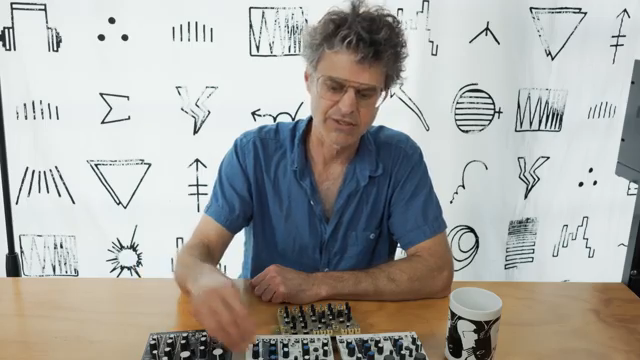
"If each of these circuits responds differently at different rates, with different slew rates, then one LFO can end up sounding like three different LFOs because the three different circuits are all responding so differently to that same LFO."
© Screenshot/Quote: Maken0Isemusic (YouTube)
Buchla Dreams and DIY Realities
"I was born out of daydreaming about what a Buchla 259 might sound like."
© Screenshot/Quote: Maken0Isemusic (YouTube)
Tony Rolando openly discusses the DPO’s design influences, most notably the Buchla 259. However, he clarifies that during development, he had never actually heard a 259 in person—a fact that shaped the DPO into more of a speculative homage than a direct clone. Instead, Rolando relied on photographs, circuit board images, and scattered schematics to imagine what such a dual oscillator might sound like.
This approach led to a module that, by Rolando’s own admission, is probably the least accurate in reproducing the Buchla 259’s sound among its Eurorack peers. The DPO’s character is described as “wooly” and beastly—more aggressive and raw than the original Buchla, which Rolando found surprisingly tame when he finally encountered one. The result is a module that channels the spirit of West Coast synthesis through a distinctly Make Noise lens.
Creative Modulation: The DPO’s Secret Sauce
The DPO’s creative potential lies in its ability to produce unique textures through its multiple modulation routes. The video delves into how the different timbral circuits—shape, angle, and fold—each respond differently to the same modulation source, thanks to their individually tuned slew rates. This means a single LFO can animate the sound in three divergent ways, turning a simple patch into a living, breathing organism.
Rolando also touches on features like oscillator sync and the infamous strike input, which injects a burst of aggression into the wavefolder. These design decisions weren’t just technical choices; they were inspired by real-world patching needs and the desire to offer users a wide palette of sonic possibilities. The DPO, in this light, becomes less a static instrument and more a toolkit for ongoing exploration.
From Patch Table to Sonic Landscapes
In practical terms, the DPO proves its worth as a centrepiece for expansive sound design. Rolando describes how it played a central role in his own shared system patches, notably on the album “Imagine a Dolphin,” where the DPO was driven by recordings of water to create fluid, FM-rich textures. Here, the module’s ability to handle both subtle sine waves and aggressive FM shines.
The video closes by highlighting the DPO’s enduring concept: the way its three timbral circuits respond differently to the same modulation source. This early form of multimodulation has become a hallmark of Make Noise design, allowing a single LFO to push each parameter in its own direction. For patchers looking to create evolving, organic soundscapes, the DPO remains a powerful and inspiring tool.
"That concept of this sort of multimodulation definitely started with the DPO."
© Screenshot/Quote: Maken0Isemusic (YouTube)
This article is also available in German. Read it here: https://synthmagazin.at/make-noise-dpo-das-biest-im-rack-eine-entstehungsgeschichte/
Watch on YouTube:
Latest articles
Watch on YouTube:
Visit the channel:
https://www.youtube.com/MAKEN0ISEMUSIC
https://www.youtube.com/MAKEN0ISEMUSIC
Links from MAKEN0ISEMUSIC:
website: https://www.makenoisemusic.com
instagram: https://www.instagram.com/makenoisemusic
twitter: https://twitter.com/makenoisemusic
facebook: https://www.facebook.com/makenoiseco
Sponsored links:
If you purchase via these links, we may earn a small commission – at no extra cost to you. The link opens an Amazon keyword search, and results may vary depending on availability.
Make Noise DPO
🔗 Check price on Amazon
🔗 Check price on Amazon