Joranalogue Audio Design, the Belgian masters of precision analogue, unveil Walk 4—a quad Brownian accumulator that’s as much a voltage playground as it is a utility powerhouse. In their official quick overview, we’re treated to a brisk yet revealing tour of what happens when you combine four accumulators, a clock generator, white noise, and auto-reset into a single Eurorack module. The result isn’t just another random voltage source, but a versatile tool for stepped voltages, subharmonic textures, and complex modulation. Let’s dissect how Walk 4’s design philosophy and hands-on controls invite creative patching and nuanced sound shaping.
27. September 2025
MILES
Joranalogue Audio Design’s Walk 4: Four Accumulators, Infinite Possibilities
Meet the Quad Brownian Accumulator
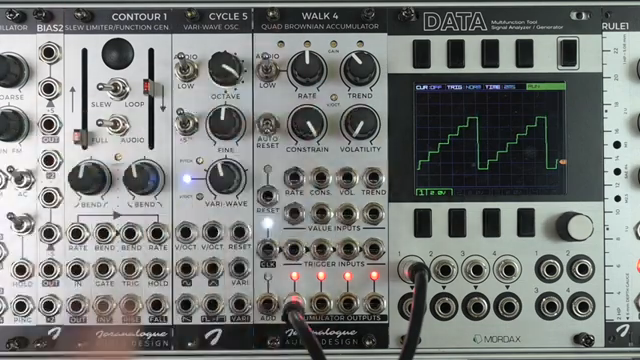
Joranalogue’s Walk 4 is introduced as a quad-Brownian accumulator, a term that may sound like something from a Victorian laboratory but, in practice, opens up a world of creative voltage manipulation. The video wastes no time in highlighting its versatility: Walk 4 can function as a staircase generator, a telephone-like sequencer, or even a VCO, depending on how you patch and tweak it. This isn’t your typical random voltage module—its stepped Brownian walk is distinct from the usual stepped random voltage, offering a more nuanced and controllable approach to unpredictability.
The module’s ability to generate subharmonic-like sounds and process external control voltages sets it apart from simpler random or sample-and-hold circuits. By combining four independent accumulators, Walk 4 provides multiple outputs that can be used simultaneously, each capable of its own unique behaviour. This makes it a powerful tool for those who want to inject both structure and surprise into their patches, whether you’re after evolving melodies, shifting modulation, or unpredictable pitch sequences.

"You can use Walk4 as a staircase, telephone or VCO."
© Screenshot/Quote: Joranalogue (YouTube)
Core Features: Four Accumulators and Beyond
At the heart of Walk 4 are its four analogue accumulators, each with its own output, allowing for parallel streams of stepped voltages. The built-in clock generator drives the stepping process, with a rate knob that sets the tempo for all accumulators. Each clock pulse adds a voltage to the output, determined by the trend parameter, and this addition can be finely controlled or modulated externally for evolving patterns.
Walk 4 isn’t just about internal processes; it’s designed to play well with others. You can process external CV by routing it into the module, controlling the size of steps or even the clock rate itself. The normalization of trigger inputs allows for cascading or independent operation, and patching into these inputs breaks the internal routing, giving you granular control over each channel’s behaviour. This flexibility is key for integrating Walk 4 into complex modular setups, where it can serve as a modulation hub or a source of controlled chaos.
Creative Workflows: Randomness and Stepped Voltage
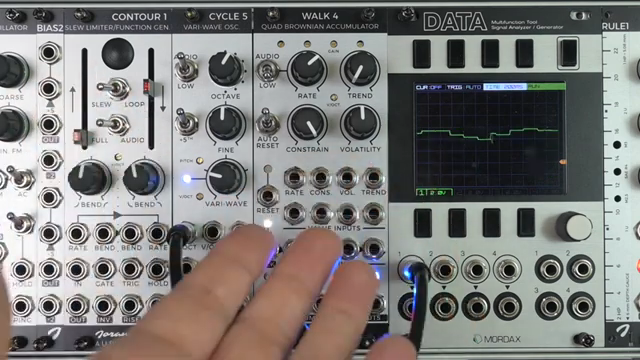
"Walk4 is not a sample and hold module sampling noise, no it's an accumulator, so it always looks at the value of the noise when a clock trigger hits, and it adds or subtracts this from the previous value."
© Screenshot/Quote: Joranalogue (YouTube)
Walk 4 shines in creative workflows by enabling users to blend random voltage with deterministic trends, producing stepped outputs that are both musical and unpredictable. By sending random voltages into the value inputs or modulating the trend parameter, you can create Brownian walks that differ from standard sample-and-hold randomness. The module’s accumulators always reference the previous value, so each step is a sum of what came before plus the new input—resulting in more organic, less abrupt changes.
This approach is particularly effective for generating complex soundscapes, evolving melodies, or modulating parameters in a way that feels both structured and lively. The four independent outputs mean you can simultaneously run a staircase VCO, a Brownian walk LFO, and other stepped modulations, all with their own timing and voltage behaviour. For those who enjoy patching outside the box, Walk 4 encourages experimentation with trends, constraints, and volatility to sculpt voltage in ways that go far beyond simple random or clocked sources.
Hands-On Control: Rate, Trend, Constraint, and Volatility
The Walk 4 interface is built around four key parameters: rate, trend, constraint, and volatility. The rate knob governs the internal clock, setting how quickly the accumulators step, while the trend parameter determines the size of each voltage increment—ranging from subtle nudges to dramatic leaps. By modulating trend via CV or external signals, users can animate the stepping behaviour in real time.
Constraint acts as a voltage ceiling, scaling down step sizes as outputs approach the set limit—much like a spring pulling voltages back towards zero. This prevents runaway voltages and introduces a natural damping effect, ideal for keeping modulations within musical bounds. Volatility, meanwhile, is the secret sauce: it injects Brownian noise into the accumulation process, adding a random value at each clock pulse. This randomness can be positive or negative, resulting in stepped voltages that meander rather than simply jump, and at audio rates, it produces a distinctively noisy, textured tone.
Each parameter is CV-addressable, and the module features individual value inputs for each accumulator, allowing for intricate patching and cross-modulation. The add input mixes in external voltages to all outputs, and the clock output provides a handy sync pulse for the rest of your system. With Schmitt-triggered inputs for reliable response and four independent outputs, Walk 4 is engineered for both precision and playfulness—offering a hands-on, patchable approach to complex voltage generation.
"By setting the VOLATILITY parameter to something else than 0, you add a random voltage to the accumulator."
© Screenshot/Quote: Joranalogue (YouTube)
This article is also available in German. Read it here: https://synthmagazin.at/joranalogue-audio-design-walk-4-vier-akkumulatoren-unendliche-moeglichkeiten/
Watch on YouTube:
Latest articles
Watch on YouTube:
Visit the channel:
https://www.youtube.com/joranalogue
https://www.youtube.com/joranalogue
Links from joranalogue:
website: https://joranalogue.com
facebook: https://facebook.com/joranalogue
twitter: https://twitter.com/joranalogue
soundcloud: https://soundcloud.com/joranalogue
modulargrid: https://www.modulargrid.net/e/vendors/view/578
instagram: https://instagram.com/joranalogue
Sponsored links:
If you purchase via these links, we may earn a small commission – at no extra cost to you. The link opens an Amazon keyword search, and results may vary depending on availability.
Walk 4
🔗 Check price on Amazon
🔗 Check price on Amazon