Intellijel’s Cascadia promises a semi-modular playground where cables are optional, not essential. In this video, the Intellijel team demystifies Cascadia’s internal routing, showing how its normalled connections let you shape and sequence sounds straight out of the box. For those wary of a forest of patch points, this walkthrough reveals how much you can achieve with just a MIDI controller and a few knob twists. It’s a practical primer for anyone curious about Cascadia’s workflow, and a reminder that sometimes, less spaghetti means more music.
30. May 2024
MILES
Intellijel Cascadia: Patchless Sound Sculpting in a Semi-Modular World
Cascadia: Semi-Modular, No Strings Attached
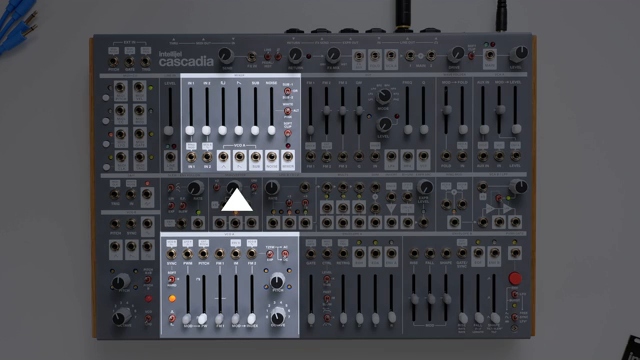
Cascadia is introduced as a semi-modular synthesizer designed to let users craft sounds without reaching for a single patch cable. The video sets out to show how its internal architecture supports this approach, making it approachable for both beginners and the patch-cable-averse. The premise is simple: thanks to a network of normalled connections under the panel, Cascadia can be played and sculpted with nothing more than MIDI input.
This design means that, straight from the box, users can generate and manipulate sounds without diving into the maze of patch points. The focus here is on demystifying the signal flow and highlighting how Cascadia’s internal routing can streamline the creative process for those who want to get started quickly.
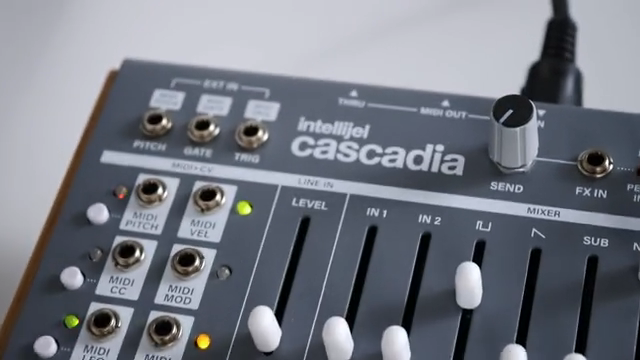
"A lot of the sections are already connected under the panel so without needing to patch sections together externally we should be able to make sounds and sculpt them as well."
© Screenshot/Quote: Intellijel (YouTube)
Signal Flow: From VCO to Output, No Cables Needed
"The mixer output is normal to the VCF section so the mix of waveforms that you've created is run through the filter."
© Screenshot/Quote: Intellijel (YouTube)
The walkthrough begins by mapping out Cascadia’s basic signal path. VCOA is internally routed to the mixer section, where its various waveforms are presented on individual sliders. This allows for immediate blending of timbres without any external patching. The output from the mixer is then normalled to the VCF, so the combined oscillator signals are automatically sent through the filter section.
From there, the filtered signal is routed to VCAA for level control before finally reaching the main output, where the overall volume is set. This chain of connections means that the essential voice architecture—oscillator, mixer, filter, amplifier, output—is ready to go, with each stage accessible via dedicated controls. The video demonstrates this by bringing up levels and adjusting filter frequency, showing how a playable tone emerges with minimal setup.
Shaping Sound: Volume, Modulation, and MIDI Magic
Once a tone is established, attention turns to shaping it. The video highlights how Cascadia’s normalled connections allow for dynamic sound control without patching. Volume adjustments are made at each stage, from the mixer through to the main output, giving granular control over the signal path. The filter’s frequency and resonance are also easily manipulated, providing immediate timbral changes.
Crucially, modulation sources are internally connected as well. By plugging in a MIDI sequencer or controller, pitch and gate signals are automatically routed to the appropriate destinations. Envelopes are triggered by MIDI gate, with Envelope A modulating VCAA and Envelope B affecting the filter’s FM input. This setup enables expressive, sequenced patches with no manual rerouting required.
MIDI Sequencer Integration: Metropolix in the Driver’s Seat
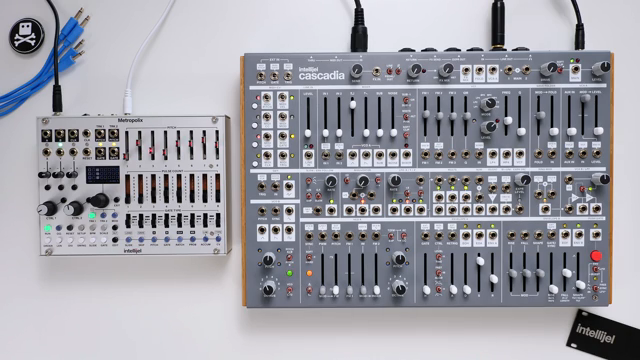
The video demonstrates how a MIDI sequencer, specifically Metropolix, can be used to control Cascadia without patch cables. By connecting via MIDI, the sequencer’s note and control data are converted to CV and gate signals internally. The MIDI to CV section handles this translation, and the default routing sends pitch to VCOA and gates to both envelope generators.
This integration means that as soon as the sequencer is connected and set to the correct MIDI channel, Cascadia responds immediately—oscillator pitch tracks the sequence, and envelopes shape the amplitude and filter movement. The video shows how adjusting envelope parameters and filter modulation can yield a variety of rhythmic and melodic effects, all without touching a patch lead.
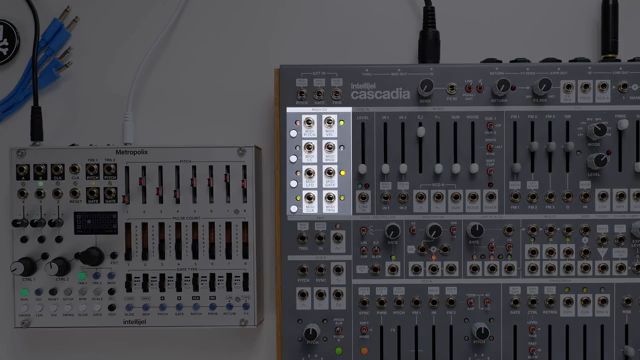
"The MIDI to CV section on Cascadia is where all of our MIDI note and CC messages are converted into control voltage."
© Screenshot/Quote: Intellijel (YouTube)
Exploring Normalled Connections: Patchless Possibilities
"Look out for any labels in a speech bubble. These will tell you where the input jack has a normal connection from elsewhere on the synthesizer."
© Screenshot/Quote: Intellijel (YouTube)
The closing section encourages users to experiment with Cascadia’s internal routing. The presenter points out that while patching is half the fun, knowing the normalled connections can save time and open up quick creative options. Labels on the panel indicate where these connections exist, helping users avoid redundant patching.
A brief jam explores further possibilities: LFO-Y modulating pulse width, the sine wave from VCOA feeding the wavefolder, and ring modulation between VCOA and VCOB—all accessible via the internal wiring. The video wraps up by reinforcing that Cascadia offers a wealth of sound-sculpting tools even before a single cable is patched, making it a flexible starting point for both newcomers and seasoned modular heads.
This article is also available in German. Read it here: https://synthmagazin.de/intellijel-cascadia-klanggestaltung-ohne-patchkabel-im-semi-modular-universum/
Watch on YouTube:
Latest articles
Watch on YouTube:
Visit the channel:
https://www.youtube.com/intellijel
https://www.youtube.com/intellijel
Links from intellijel:
website: https://intellijel.com
forum: https://forum.intellijel.com
instagram: https://instagram.com/intellijel
facebook: https://www.facebook.com/intellijel
Sponsored links:
If you purchase via these links, we may earn a small commission – at no extra cost to you. The link opens an Amazon keyword search, and results may vary depending on availability.
Intellijel Cascadia
🔗 Check price on Amazon
🔗 Check price on Amazon
Intellijel Metropolix
🔗 Check price on Amazon
🔗 Check price on Amazon