The Haken Continuum, as presented by HakenAudio and composer Josh Madoff, stands as a singular force in the world of digital and hybrid instruments. This video tour reveals how the Continuum’s ultra-sensitive playing surface, powered by the EaganMatrix engine, bridges the gap between acoustic nuance and electronic innovation. With its blend of MPE control, advanced sound design overlays, and seamless integration with both digital and analog setups, the Continuum is positioned as both a performance powerhouse and a sound designer’s playground. We explore how its architecture, firmware, and interface invite musicians to rethink expressive control, while also noting the areas where the video leaves questions for further exploration.
20. March 2025
LYRA
HakenAudio’s Continuum: A Deep Dive into Expressive Digital Architecture
A New Standard in Expressive Control
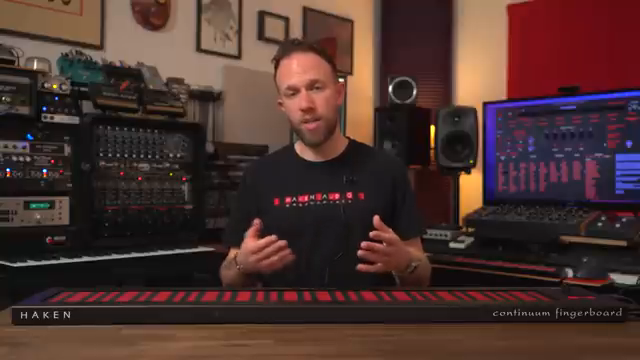
The Haken Continuum is introduced not just as an instrument, but as a paradigm shift in electronic music control. Josh Madoff, a seasoned film and TV composer, frames the Continuum as an MPE controller, synthesizer, and audio processor that offers a tactile experience unlike anything else in the digital landscape. The video’s opening moments set the stage for a device that promises to translate the subtlety of acoustic performance into the electronic realm.
This isn’t just about adding more parameters or fancier presets. The Continuum’s claim to fame is its ability to respond to the most minute gestures—pitch slides, pressure changes, and finger position—creating a feedback loop between performer and instrument. HakenAudio’s approach, as always, is to push the boundaries of what digital instruments can feel like, not just what they can do.
Precision Sensors and the EaganMatrix Engine
At the heart of the Continuum’s architecture are its precision Hall Effect sensors, which track finger movement with microscopic accuracy. Each finger benefits from up to 12 sensors, sampled at 14-bit resolution, resulting in a playing surface that captures nuances far beyond standard MIDI controllers. This level of sensitivity means that no two touches are ever exactly alike, echoing the organic unpredictability of acoustic instruments.
The video highlights how this sensor array, combined with piano-style springs beneath the surface, provides both data and physical feedback. This dual approach enables orchestral-level dynamics and expression, allowing players to shape pitch, volume, and timbre in real time. The EaganMatrix sound engine sits at the core of this system, acting as more than just a synth engine—it’s a programmable matrix that links human gestures to sound parameters, supporting everything from simple sine waves to complex, multi-dimensional patches.
The EaganMatrix’s flexibility is showcased through presets that respond to multiple axes of control. For example, one patch lets left-right motion control pitch, pressure modulate both volume and brightness, and vertical movement shape distortion. The result is a system where each finger’s actions are independent, and the instrument’s response is always evolving, making the Continuum a true extension of the performer’s intent.
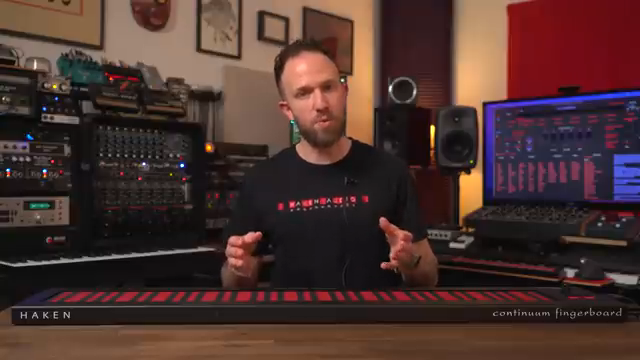
"It is physically impossible to touch the playing surface of the Continuum the same way twice."
© Screenshot/Quote: Hakenaudio (YouTube)
Performance Tools and Creative Workflows
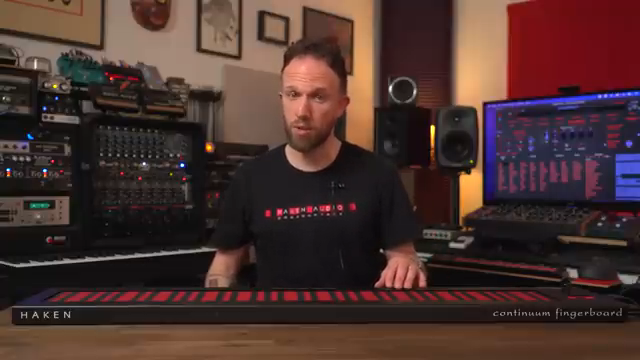
"Normally with a sustain pedal, you play a note, press a pedal, end of story. I have no more dynamics. The entire fingerboard should be held hostage."
© Screenshot/Quote: Hakenaudio (YouTube)
The video moves into practical demonstrations, showing how the Continuum’s performance tools and presets facilitate dynamic, expressive control. Touch area presets allow different hands or fingers to control distinct parameters—pitch, vibrato, volume, or timbre—on the fly. This opens up workflows where a single performer can manipulate multiple aspects of a sound simultaneously, blurring the line between instrumentalist and sound designer.
Pedal integration is another standout feature. Unlike traditional sustain pedals that simply hold notes, the Continuum supports dynamic sostenuto and even dual-pedal setups, letting performers grab and morph chords independently with their feet while continuing to play on top. The EaganMatrix allows up to 18 parameters to be assigned to pedals, with custom ranges, making foot control a powerful extension of the instrument’s expressive palette.
Bridging Digital and Analog: MIDI, CV, and the Haken CVC
Versatility is a recurring theme, and the Continuum’s ability to integrate with both traditional MIDI and analog synths is given significant attention. The EaganMatrix engine can be controlled via a standard MIDI keyboard, with modulation mapped to wheels or external controllers, demonstrating that the Continuum’s sound engine is not limited to its unique surface.
The Haken CVC (Control Voltage Converter) takes things further, translating the Continuum’s high-resolution MPE+ data into CV signals for modular and vintage analog synths. The CVC offers 16-bit resolution—higher than the Continuum’s own internal engine—enabling per-finger control over multiple analog voices. The video shows setups where a single Continuum drives up to eight monophonic analog synths, each with independent envelopes and filter control, effectively turning the Continuum into a master controller for complex hybrid rigs.
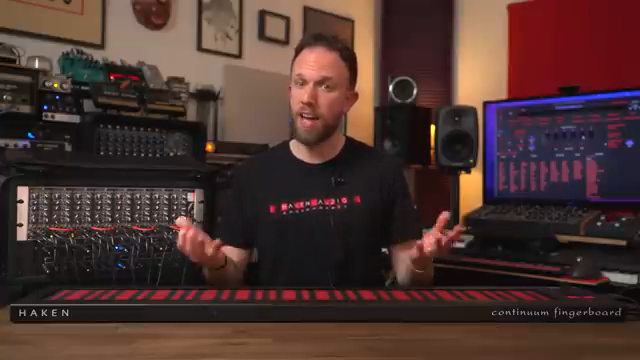
"Using the Hakken CVC, the continuum's MPE+ data gets converted into control voltages, which can communicate with your synthesizers."
© Screenshot/Quote: Hakenaudio (YouTube)
Firmware Evolution and Expanding Possibilities
HakenAudio’s commitment to continuous firmware development is underscored in the video’s closing remarks. Each update brings new features, overlays, and presets, often for free, expanding the Continuum’s capabilities for both sound design and performance. The instrument’s architecture is designed to evolve, with overlays like Ratio, Genie, and Loris introducing new synthesis methods and workflows. This ongoing development ensures that the Continuum remains at the forefront of expressive digital instruments, though the video leaves open questions about editor dependency and long-term integration in large, multi-device setups.
This article is also available in German. Read it here: https://synthmagazin.at/hakenaudio-continuum-ein-architektur-blick-auf-das-expressive-digitalsystem/
Watch on YouTube:
Latest articles
Watch on YouTube:
Visit the channel:
https://www.youtube.com/HakenAudio
https://www.youtube.com/HakenAudio
Links from HakenAudio:
website: https://www.hakenaudio.com
youtube: https://www.youtube.com/@HakenAudio
Sponsored links:
If you purchase via these links, we may earn a small commission – at no extra cost to you. The link opens an Amazon keyword search, and results may vary depending on availability.
EaganMatrix
🔗 Check price on Amazon
🔗 Check price on Amazon
Haken Continuum
🔗 Check price on Amazon
🔗 Check price on Amazon
Haken CVC
🔗 Check price on Amazon
🔗 Check price on Amazon