Step into a mist-laden soundscape where resonance shimmers and history hums beneath your fingertips. HAINBACH, ever the explorer of sonic oddities, invites us to drift inside the String Armonica MK2—a modern vessel inspired by Benjamin Franklin’s glass armonica, yet reborn for today’s ambient voyagers. This is not just an instrument; it’s a magnetic bridge between ancient psalter and futuristic shimmer, where every note blooms like fractured light through fog. Prepare to be enveloped by overtone-rich textures and the peculiar beauty of a machine that feels as much spirit as circuitry. The real magic, as always with HAINBACH, is best experienced with headphones and open ears.

2. February 2026
LUMINA
HAINBACH and the String Armonica MK2: Overtone Dreams and Sonic Glasswork
Glass and Wire: The Enchantment of the String Armonica MK2
The String Armonica MK2 emerges as a spectral presence—its body reminiscent of an ancient psalter, its heart pulsing with modern ingenuity. HAINBACH draws us into its orbit, tracing the instrument’s lineage back to Benjamin Franklin’s glass armonica, yet revealing a machine that feels both timeless and startlingly new. This is an acoustic synthesizer that doesn’t just play notes; it exhales fog and fractured light, each tone a ripple in a pool of sonic ghosts.
From the first touch, the String Armonica seduces with overtone-rich sound, inviting us to lose ourselves in a nebula of harmonics. The creators at Merkaba Electronics have conjured an instrument that feels like a secret passage—one that beckons arrangers and sound designers to explore its depths. HAINBACH’s approach is immersive, letting the instrument’s character unfold in layers, each bloom of resonance hinting at stories yet untold.
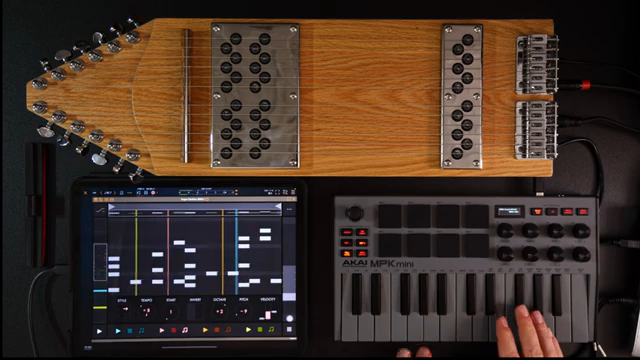
"Like its namesake, Benjamin Franklin's glass armonica, it has an overtone rich sound, allowing control of four octaves of pure tones."
© Screenshot/Quote: Hainbach (YouTube)
Harmonic Nebulae: Four Octaves of Resonance
"It uses a master crystal oscillator that vibrates at several megahertz."
© Screenshot/Quote: Hainbach (YouTube)
At the core of the String Armonica MK2 lies a harmonic engine built from scratch—a top octave generator, painstakingly reverse-engineered from the ghosts of obsolete organ chips. This crystalline brain divides a master oscillator into 48 discrete square waves, each one a thread in the tapestry of overtones. The result is an instrument that spans four octaves, with each note swelling and shimmering through primitive VCAs and transistor amplifiers that set the strings alight.
The sonic palette is vast: from delicate, glassy highs to a shimmer that sits low in the mix like a memory. HAINBACH demonstrates how the instrument’s modes—normal, staccato, harp, and arpeggiator—open up new dimensions, allowing notes to bloom, stutter, or cascade like rain on metal. The tactile act of playing or manipulating the strings adds another layer of intimacy, making the String Armonica less a tool and more a living, breathing companion in the studio.
Tuning the Spirits: Quirks of a Hybrid Instrument
Yet, to coax these spectral tones from the String Armonica, one must embrace its idiosyncrasies. This is a hybrid beast—part synthesizer, part stringed instrument—and it demands the care and attention of both worlds. The acoustic strings require tuning and adjustment, much like a guitar or harp, and their placement must be exact to unlock the instrument’s full resonance. For those unaccustomed to stringed instruments, this ritual may feel arcane, but it is essential to the armonica’s magic.

"This is labeled as a synthesizer, but it's also a stringed instrument."
© Screenshot/Quote: Hainbach (YouTube)
Magnetic Hiss and Power Rituals: Technical Challenges

"There's always a little background hiss, which I don't find too bad."
© Screenshot/Quote: Hainbach (YouTube)
Every instrument with a soul has its shadows, and the String Armonica MK2 is no exception. Its overtone-rich signal demands a generous helping of gain—up to 50 decibels—posing a challenge for many audio interfaces. HAINBACH reveals the necessity of a DI box to bridge the gap, and warns that any touch, intentional or accidental, can send shockwaves through the mix. The instrument’s brightness brings with it a persistent hiss, a spectral presence that lingers but can be tamed with EQ or simply embraced as part of its character.
Power, too, becomes a ritual. The included switched power supply hums contentedly on American soil, but in Europe, it conjures a nasty buzz—a reminder that every machine is haunted by its own geography. HAINBACH’s solution is poetic: a heavier, linear brick from Electro-Harmonix, banishing the noise and restoring clarity. For those who hoard old power supplies, this is a moment of vindication. The String Armonica asks for patience and adaptation, rewarding those who listen deeply.
Into the Future: Bass Dreams and New Horizons
The story of the String Armonica does not end here. HAINBACH hints at experiments with bass versions—tine-based systems and thick strings that promise to anchor the instrument’s ethereal voice in deeper waters. While technical limits remain, the vision is clear: a future where the armonica’s resonance stretches further, perhaps splitting into hybrid forms or dedicated bass companions. For now, the MK2 remains a rare artifact—twenty in the world, each a vessel for sonic storytelling, and more to come for those willing to drift inside its magnetic field.
This article is also available in German. Read it here: https://synthmagazin.at/hainbach-und-die-string-armonica-mk2-obertongesaenge-und-klangliches-glaswerk/
Watch on YouTube:
Latest articles
Watch on YouTube:
Visit the channel:
https://www.youtube.com/Hainbach
https://www.youtube.com/Hainbach
Links from Hainbach:
Bandcamp: https://hainbach.bandcamp.com
Instagram: https://instagram.com/hainbach101
Homepage: https://hainbachmusik.com
Sponsored links:
If you purchase via these links, we may earn a small commission – at no extra cost to you. The link opens an Amazon keyword search, and results may vary depending on availability.
String Armonica MK2
🔗 Check price on Amazon
🔗 Check price on Amazon