Frap Tools takes us on a meticulous journey into the world of electroacoustic composition, where the elegant resonance of a Yamaha C3 grand piano is woven into the fabric of a modular synth patch. In this detailed walkthrough, Francesco Gennari demonstrates how acoustic and electronic elements can be made to converse, not merely coexist, using a host of Frap Tools modules and some carefully chosen extras. The video is a masterclass in routing, modulation, and sonic layering, offering a rare glimpse into the mechanics of integrating traditional instruments with the modular ecosystem. For those who think patch cables and piano hammers belong to separate worlds, this piece is a persuasive argument to the contrary.
19. November 2025
MILES
Frap Tools: Wiring a Grand Piano into the Modular Matrix
Disting EX, Doepfer Lopass Gate, Ears, Frap Tools 321, Frap Tools 333, Frap Tools CGM, Frap Tools Cunsa, Frap Tools Falistri, Frap Tools Sapèl, Frap Tools USTA, Noise Engineering Imitor Versio, Random Source NTO, Rode NT55, Yamaha C3
Where Wood Meets Wire: The Electroacoustic Blueprint
The video opens with Francesco Gennari introducing ‘Studio No.8,’ an electroacoustic composition that places a grand piano at the heart of a modular synth environment. Rather than simply layering the two, the piece is constructed as a dialogue, with the piano and modular voices influencing each other’s roles. The acoustic and electronic sounds are not forced into competition but are instead arranged to complement and shape one another, resulting in a balanced sonic landscape.
This approach is evident from the outset, as the piano’s natural timbre is allowed to breathe, then gradually entwined with modular textures. The performance is not just a demonstration of technical prowess but an exploration of how acoustic articulation and electronic processing can be fused in a single, evolving patch. The result is a composition that feels both organic and meticulously constructed, with each element given space to interact and transform.
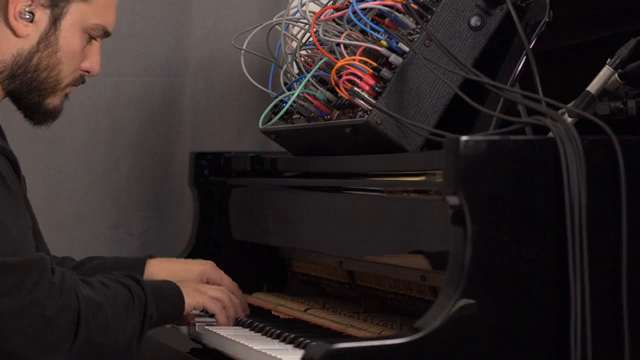
"The piece is mainly based on the piano, which is processed through filters, wave shapers and other effects."
© Screenshot/Quote: Fraptools (YouTube)
Routing Realities: From Piano Strings to Patch Cables
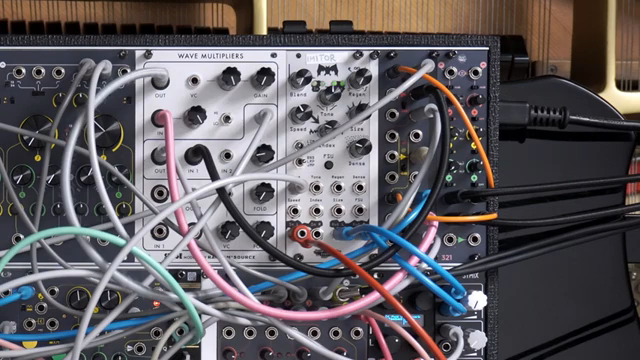
"The 321 can increase the level by up to 6 decibels."
© Screenshot/Quote: Fraptools (YouTube)
The setup is a study in advanced signal routing, with the Yamaha C3’s sound captured by a pair of Rode NT55 microphones. These mics are positioned above the action to pick up both the tonal and mechanical nuances of the instrument. The raw piano signal is first recorded via an audio interface, then sent back out into the modular system for further processing.
Once inside the modular, the signal hits the Frap Tools 321 for a gain boost, before being multiplied and distributed by the 333 module. From there, the piano’s journey diverges: it’s routed through the CGM mixer for aux sends to effects, into Ears for gate extraction and envelope following, and into various filters and wave multipliers for spectral shaping. The careful allocation of signal paths allows the piano to trigger events, modulate effects, and even control the opening of VCAs, blurring the line between performer and patch.
Throughout the patch, the piano’s signal is dosed with intent—effects are applied judiciously, never overwhelming the acoustic source. This modular rig is not just a processing chain but a responsive environment, where the piano’s dynamics and gestures ripple through the entire system.
Double Escapement: Piano Mechanics as Patch Modulation
A highlight of the demonstration is the use of the grand piano’s double escapement mechanism, a feature that allows for nuanced control over hammer travel and dynamic response. By exploiting this second leverage point, Francesco achieves extremely soft and controlled chords, which are then fed into the modular system for further treatment.
This mechanical subtlety is not just a pianistic flourish—it becomes a modulation source in its own right. The delicate articulation enabled by double escapement is mirrored in the patch, where soft attacks and controlled envelopes shape how the piano interacts with the electronics. It’s a reminder that in a hybrid setup, the physicality of the instrument can be as modulatable as any voltage.

"It's basically a second leverage point compared to the single escapement."
© Screenshot/Quote: Fraptools (YouTube)
Sequencing and Texture: Modular Voices in Conversation
Sequencing duties fall to the Frap Tools USTA, which orchestrates two main synth voices: one built around the Random Source NTO and Doepfer Lopass Gate, and another using Falistri at audio rate with a Cunsa filter. The USTA’s channels control pitch, clock, and pattern variation, allowing the modular voices to weave in and out of the piano’s orbit.
Noise is introduced as a textural layer, with Sapèl’s white noise routed through Falistri’s four-quadrant multiplier, shaped by envelopes extracted from the piano’s signal. This noise isn’t just background—it’s dynamically blended with the main synth voice, adding grit and air that respond to the performer’s touch. The interplay between sequenced synth lines and reactive noise layers exemplifies the patch’s ethos: every element, acoustic or electronic, is both a source and a destination for modulation.
Effects and Final Flourishes: The Sonic Finishing Touches
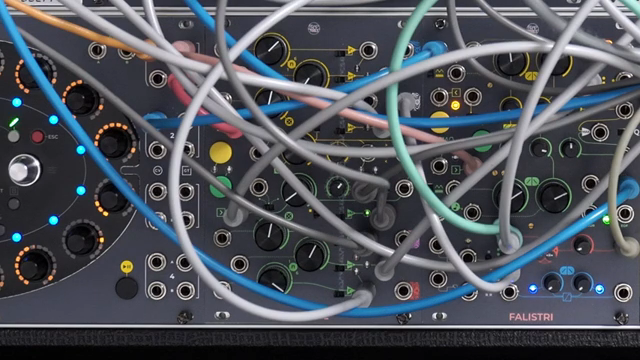
"This results in an interesting effect, where the repetitions evolve differently each time."
© Screenshot/Quote: Fraptools (YouTube)
The effects section is where the patch’s complexity truly shines. Disting EX handles both ping pong delay and reverb duties, with the delay clocked by a random output from Sapèl for ever-shifting rhythmic repeats. The reverb is fed from a separate aux send, allowing for independent spatial treatment of different elements. This dual approach ensures that effects are not just tacked on, but integral to the evolving soundscape.
Noise Engineering’s Imitor Versio is deployed as a reverse delay, with its wet/dry blend modulated by an envelope extracted from the piano. This means that the more Francesco plays, the more the effect blooms—a clever way to tie the acoustic performance directly to the electronic processing. In the final moments, wave multipliers add a layer of distortion, routed through the QSC mixer for precise placement in the mix.
The cumulative effect is a piece that feels alive, with every effect and modulation source responding to the nuances of the performance. Rather than overwhelming the piano, the modular system acts as an extension of its expressivity, offering new colours without masking the instrument’s core character.
This article is also available in German. Read it here: https://synthmagazin.at/frap-tools-ein-konzertfluegel-im-modular-labyrinth/
Watch on YouTube:
Latest articles
Watch on YouTube:
Visit the channel:
https://www.youtube.com/FrapTools
https://www.youtube.com/FrapTools
Links from FrapTools:
website: https://frap.tools
instagram: https://instagram.com/fraptools
facebook: https://www.facebook.com/fraptools
twitter: https://twitter.com/fraptools
soundcloud: https://soundcloud.com/fraptools
Sponsored links:
If you purchase via these links, we may earn a small commission – at no extra cost to you. The link opens an Amazon keyword search, and results may vary depending on availability.
Disting EX
🔗 Check price on Amazon
🔗 Check price on Amazon
Doepfer Lopass Gate
🔗 Check price on Amazon
🔗 Check price on Amazon
Ears
🔗 Check price on Amazon
🔗 Check price on Amazon
Frap Tools 321
🔗 Check price on Amazon
🔗 Check price on Amazon
Frap Tools 333
🔗 Check price on Amazon
🔗 Check price on Amazon
Frap Tools CGM
🔗 Check price on Amazon
🔗 Check price on Amazon
Frap Tools Cunsa
🔗 Check price on Amazon
🔗 Check price on Amazon
Frap Tools Falistri
🔗 Check price on Amazon
🔗 Check price on Amazon
Frap Tools Sapèl
🔗 Check price on Amazon
🔗 Check price on Amazon
Frap Tools USTA
🔗 Check price on Amazon
🔗 Check price on Amazon
Noise Engineering Imitor Versio
🔗 Check price on Amazon
🔗 Check price on Amazon
Random Source NTO
🔗 Check price on Amazon
🔗 Check price on Amazon
Rode NT55
🔗 Check price on Amazon
🔗 Check price on Amazon
Yamaha C3
🔗 Check price on Amazon
🔗 Check price on Amazon