Frap Tools, the Italian maestros of modular design, deliver a masterclass in texture creation using nothing more than a sample and hold, a signal multiple, and their flagship complex oscillator. In this video, Federico demonstrates how a single stream of random voltages, multiplied and distributed, can animate a patch into a living, evolving soundscape. With the BRENSO oscillator at the core and SAPÈL generating the chaos, every clock tick brings a new timbral twist. For those who appreciate the subtle art of modulation and the unpredictable beauty of random voltages, this is a patching technique worth dissecting.
3. July 2024
MILES
Frap Tools: Stepped Random Voltages Unleashed – Infinite Textures with Just Three Modules
One Random Source, Infinite Possibilities
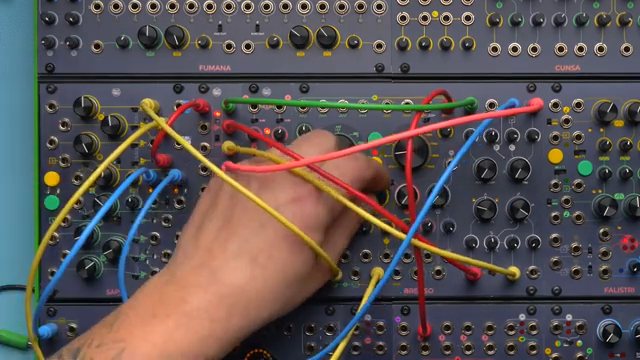
The video opens with Federico’s signature approach: extracting maximum complexity from minimal means. Here, a single unquantized sample and hold output from SAPÈL is routed into the 333, Frap Tools’ utility multiple, instantly creating up to nine identical copies of the random voltage. This is classic modular thinking—one unpredictable source, fanned out to orchestrate chaos across the system.
BRENSO’s final output is chosen as the sonic canvas, prized for its abundance of modulation points. By starting with just three modules, Federico sets the stage for a demonstration of how strategic patching can yield a soundscape that feels anything but minimal. The focus is on how a single random stream, distributed cleverly, can drive a patch far beyond its apparent simplicity.

"This patch is a great example of Federico's patching style that relies on many copies of a single sample and hold signal."
© Screenshot/Quote: Fraptools (YouTube)
Multiplying Mayhem: Modulating BRENSO’s Core
With the 333 distributing the sample and hold signal, Federico patches each copy to a different part of BRENSO’s complex section. The first copy modulates the source parameter, shifting the balance between the oscillator’s two wave shapers, ensuring that each random pulse nudges the timbre in a new direction. Next, a copy is sent to the first wave shaper, morphing between sine, triangle, and a logarithmic waveform, while another copy targets the comparator threshold for pulse width modulation.
The patching continues with the fourth copy routed to the wave folder, introducing sweeping effects when combined with BRENSO’s ping circuit. Federico also experiments by sending a random clock output to the USTA sequencer, keeping options open for further rhythmic complexity. The fifth copy finds its way to the symmetry control, though he later swaps this for a fluctuating random voltage, seeking a less grid-bound movement. Each modulation point is chosen to maximise the sonic variety generated by the random voltages.
Dialling In: Frequency, Modulation, and Evolving Timbres
"As you can see with that many modulations going on, every turn of the knob causes incredible changes in timbre."
© Screenshot/Quote: Fraptools (YouTube)
Once the patch is established, Federico demonstrates the power of fine-tuning. Adjusting the oscillators’ frequencies and modulation amounts, he shows how even small tweaks can radically alter the patch’s character. Increasing the clock speed and playing with FM depth, the sound morphs in real time, each knob turn yielding a new shade of timbre.
He also explores the impact of re-routing modulation sources, such as patching the fifth copy of the sample and hold to the pulse shaper, overriding previous routings and stripping away timbre bus modulation. Removing the ping trigger and further adjusting clock and frequency settings, Federico illustrates how the interplay of random voltages and manual control keeps the texture in perpetual motion.
Randomness as Texture: The Art of Evolving Soundscapes
The final act introduces a second sample and hold circuit, this time clocked by the yellow generator and patched into the remaining section of the 333. By using the random clock output in “more than” mode to trigger the new sample and hold, Federico injects another layer of unpredictability. The ping circuit is now activated only by sufficiently high random values, creating a more erratic, less predictable behaviour.
The result is a patch that constantly reinvents itself. Each strike of SAPÈL’s sample and hold brings a fresh twist, making the sound nearly impossible to tire of. Federico’s demonstration underscores the creative power of random voltages in modular synthesis, showing how even a simple setup can yield a rich, ever-changing sonic landscape.

"And so this is it, as you can hear the patch is incredibly developed in the realm of texture."
© Screenshot/Quote: Fraptools (YouTube)
This article is also available in German. Read it here: https://synthmagazin.at/frap-tools-gestufte-zufallsspannungen-entfesselt-unendliche-texturen-mit-nur-drei-modulen/
Watch on YouTube:
Latest articles
Watch on YouTube:
Visit the channel:
https://www.youtube.com/FrapTools
https://www.youtube.com/FrapTools
Links from FrapTools:
website: https://frap.tools
instagram: https://instagram.com/fraptools
facebook: https://www.facebook.com/fraptools
twitter: https://twitter.com/fraptools
soundcloud: https://soundcloud.com/fraptools
Sponsored links:
If you purchase via these links, we may earn a small commission – at no extra cost to you. The link opens an Amazon keyword search, and results may vary depending on availability.
Frap Tools 333
🔗 Check price on Amazon
🔗 Check price on Amazon
Frap Tools Brenso
🔗 Check price on Amazon
🔗 Check price on Amazon
Frap Tools Sapèl
🔗 Check price on Amazon
🔗 Check price on Amazon