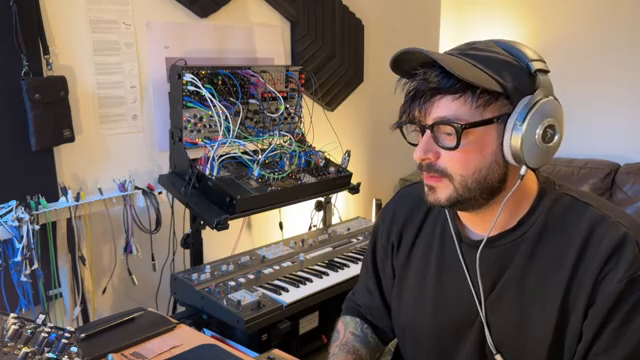
Frap Tools, the Italian modular maestros, host Australian producer Sam Sakr for a deep dive into the world of modular synthesis and textural sound design. Sakr, known for his work with pop heavyweights and his introspective solo project, shares his journey from drums to Eurorack, revealing how modular gear has become central to his creative process. The conversation traverses everything from patching philosophies and the role of noise, to the practical realities of mixing, collaboration, and the ever-present lure of new module ideas. If you’re curious about how a seasoned producer integrates modular into daily production, or just want patch tips from someone who sold a motorcycle for a rack, this episode is pure voltage.
11. September 2024
MILES
Frap Tools: Sam Sakr on Modular Textures, Noise, and the Art of Patchwork
Filter 8, Frap Tools 321, Frap Tools 333, Frap Tools Brenso, Frap Tools CGM, Frap Tools FELISTRI, Harmonic Oscillator, Javelin, Just Friends, Marbles, Torso T1, Verbos Scan & Pan
From Drums to Drones: Sam Sakr’s Sonic Evolution
The episode opens with Sam Sakr recounting his musical upbringing, beginning as a young singer and violinist before gravitating toward drums. Despite not coming from a musical family, Sakr’s fascination with music led him to a scholarship in Sydney and a deepening interest in rhythm. His journey took a pivotal turn when curiosity about studio engineering and sound design eclipsed his focus on performance. This shift saw him leave a formal music degree behind, enrolling instead in Ableton Live School to immerse himself in production and the technical side of music-making.
Sakr’s eventual encounter with modular synthesis was serendipitous—a visit to Berlin’s Schneidersladen exposed him to the tactile, open-ended world of Eurorack. The experience was transformative, prompting him to sell his motorcycle and invest in his first modular system during the COVID lockdowns. He describes the modular as an instrument for repurposing musical ideas, likening the process to casting sonic shadows from different angles. This conceptual approach underpins his ongoing obsession with modular, which he credits as the most inspiring tool he’s discovered since learning Ableton.

"I sold my motorbike, which I was sad about, but my parents were stoked. And I, yeah, start like, like really sort of slowly started buying Eurorack modules."
© Screenshot/Quote: Fraptools (YouTube)
Modular as a Daily Production Tool: Workflow and Inspiration
"So yeah, Eurorack is kind of magical in that way. It's, it's, it's, it's just like, for the artists, it feels like this like really like grown up toy, which is how I kind of like see it anyway."
© Screenshot/Quote: Fraptools (YouTube)
For Sakr, modular synthesis isn’t just a side project—it’s integral to his daily production workflow. He explains how Eurorack systems offer a level of creative freedom and happy accidents that are difficult to replicate with closed-architecture synths or software. In collaborative sessions, the modular often acts as both a sonic palette and a tactile playground for artists, fostering a sense of ownership and excitement in the music-making process.
When inspiration runs dry, Sakr turns to modular for its unpredictability and capacity to generate new ideas. He describes using granular modules, loopers, and spontaneous patching to break creative blocks, often capturing these moments live and building tracks around them. The modular’s role shifts fluidly between being the foundation of a piece and providing the “sprinkles on top”—those unique textures and moments that can’t be found elsewhere. This duality, he notes, is what makes modular so magical in both collaborative and solo contexts.
Patch Dissection: Noise, Sub-Audio Modulation, and Textural Alchemy
Sakr offers a detailed breakdown of his patching techniques, focusing on how he sculpts textural and melodic elements using a combination of Frap Tools modules and creative modulation. He begins with the percussive, textural sound built from BRENSO’s yellow oscillator running at sub-audio rates, modulated by bipolar stepped random voltages from Marbles and offset via the 321 utility. Noise, a recurring theme in his work, is injected into through-zero FM inputs and wavefolders, adding grit and complexity to the sound.
The melodic content is handled by BRENSO’s green oscillator, processed through FELISTRI and shaped with noise and random modulation for evolving timbres. Additional voices, like the Harmonic Oscillator, are subtly layered, while rhythmic elements such as the kick drum are synthesized by pinging filters and employing sidechain envelopes routed through the 321 and 333 modules for dynamic movement. Sakr highlights the importance of noise not just as an audio source, but as a modulation tool—feeding it into FM and filter inputs to create organic, unpredictable textures that interact with the rest of the patch in real time.
Throughout the patch, Sakr’s approach is exploratory rather than prescriptive. He admits to messy cabling and a lack of rigid planning, preferring to let the system “speak back” and guide the creative process. This philosophy extends to his use of stereo mixing, panning, and the interplay between mono and stereo sources, all contributing to the evolving, collaborative nature of the patch.

"Because the Yellow Oscillator is now in that low sub-audio rate, you get the clicks from the waveforms. And I really, really love the sound of it out of the Brenzo, and I think it's because you can modulate so much of the wave and what's going on."
© Screenshot/Quote: Fraptools (YouTube)
Songwriting: Collaboration vs. Exploration in the Sakr Project
Sakr contrasts his approach to producing for others with his personal work as Sakr. In collaborative sessions, his role is to help artists realize their vision, often drawing on their stories or emotional cues to shape the music. Modular synthesis becomes a tool for engagement, allowing artists to physically interact with the sound and contribute to the sonic identity of the track.
For his solo project, the process is more exploratory and less structured. Sakr describes a workflow of recording long improvisations, then sifting through the material to find compelling moments. This method, akin to throwing paint at a canvas and rearranging the pieces, allows for a more personal and experimental outcome. He notes the challenge of translating the organic interplay of sounds in a modular patch into a multi-stem mix, especially when working in formats like Dolby Atmos, but values the unique life and interaction that modular brings to his music.
Future Modules and Modular Mindsets: Sakr’s Wishlist

"I want like I just yeah, just so it's like, you know, maybe like a 8 HP, 10 HP half half a Felistry. If you can fit the slow limiter on there. Awesome. I think that would go a really long way."
© Screenshot/Quote: Fraptools (YouTube)
As the conversation winds down, Sakr shares his ideas for future Frap Tools modules. His “selfish” wish is for a half-sized FELISTRI, providing more function generation in a compact form. More ambitiously, he envisions a Frap Tools take on multi-output function generators—something akin to Mutable Instruments’ Tides or Mannequins’ Just Friends, but with individual control over each envelope or LFO, and the ability to cascade or offset them for complex rhythmic and melodic interplay.
Sakr’s suggestions reflect his broader modular philosophy: a desire for tools that encourage exploration, interaction, and the organic blending of modulation sources. He values modules that can serve both as sound sources and as modulation hubs, blurring the lines between function and timbre. The discussion closes with a sense of excitement for the future of modular design, and the ongoing dialogue between artists and manufacturers in shaping the next wave of creative tools.
This article is also available in German. Read it here: https://synthmagazin.at/frap-tools-sam-sakr-ueber-modulare-texturen-noise-und-die-kunst-des-patchings/
Watch on YouTube:
Latest articles
Watch on YouTube:
Visit the channel:
https://www.youtube.com/FrapTools
https://www.youtube.com/FrapTools
Links from FrapTools:
website: https://frap.tools
instagram: https://instagram.com/fraptools
facebook: https://www.facebook.com/fraptools
twitter: https://twitter.com/fraptools
soundcloud: https://soundcloud.com/fraptools
Sponsored links:
If you purchase via these links, we may earn a small commission – at no extra cost to you. The link opens an Amazon keyword search, and results may vary depending on availability.
Filter 8
🔗 Check price on Amazon
🔗 Check price on Amazon
Frap Tools 321
🔗 Check price on Amazon
🔗 Check price on Amazon
Frap Tools 333
🔗 Check price on Amazon
🔗 Check price on Amazon
Frap Tools Brenso
🔗 Check price on Amazon
🔗 Check price on Amazon
Frap Tools CGM
🔗 Check price on Amazon
🔗 Check price on Amazon
Frap Tools FELISTRI
🔗 Check price on Amazon
🔗 Check price on Amazon
Harmonic Oscillator
🔗 Check price on Amazon
🔗 Check price on Amazon
Javelin
🔗 Check price on Amazon
🔗 Check price on Amazon
Just Friends
🔗 Check price on Amazon
🔗 Check price on Amazon
Marbles
🔗 Check price on Amazon
🔗 Check price on Amazon
Torso T1
🔗 Check price on Amazon
🔗 Check price on Amazon
Verbos Scan & Pan
🔗 Check price on Amazon
🔗 Check price on Amazon