Frap Tools brings us a deep dive into the musical world of Trevor Tunnacliffe, a Vancouver-based composer whose roots in early Renaissance counterpoint intertwine with a modern modular synth ethos. In this episode of “Let’s Talk Music,” Trevor unpacks his journey from viola da gamba to Eurorack, revealing how modal counterpoint and oceanic inspiration shape his collective project, Unthunk. The discussion weaves together patch design, environmental themes, and collaborative composition, all filtered through Frap Tools’ signature lens for detail and sonic nuance. Expect a blend of historical rigor and patch-based experimentation, with plenty of voltage, timelines, and a dash of marine biology.
8. August 2024
MILES
Frap Tools: Modal Counterpoint Meets Modular—Trevor Tunnacliffe’s Oceanic Patchwork
Frap Tools 321, Frap Tools 333, Frap Tools Falistri, Frap Tools Fumana, Frap Tools QSC, Frap Tools Sapèl, Frap Tools USTA
From Renaissance Treatises to Modular Patch Cables
Trevor Tunnacliffe’s musical journey is anything but linear, tracing a path from the small-town landscapes of British Columbia to the rarefied air of early Renaissance counterpoint. His earliest influences were familial—church organ and dance band fiddles—before he gravitated toward bass guitar, Dixieland bands, and eventually the viola da gamba. The absence of a formal music program didn’t deter him; instead, it fostered a self-reliant curiosity that would later serve him well in the modular world.
What sets Trevor apart is his refusal to be bound by the cultural trappings of early music. While he reveres the modal counterpoint of the Renaissance, he’s keen to shed the courtly costumes and embrace a more contemporary, even lumberjack-esque, aesthetic. This blend of historical discipline and modern sensibility finds its outlet in Unthunk, his collective project. Here, Trevor fuses chamber and pop influences, writing and recording pieces that draw on both strict voice leading and the freedom of modern instruments—including, crucially, modular synthesizers.
Ocean Swells in Voltage: Trevor’s Modular Patch
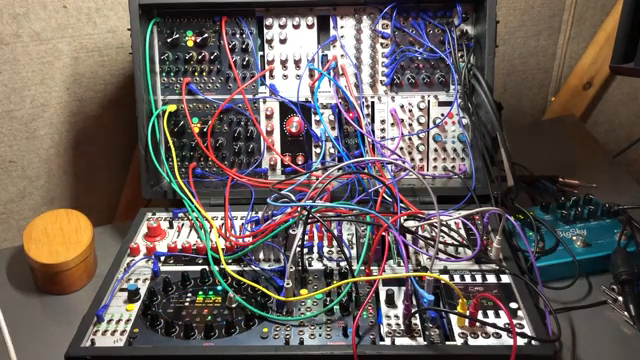
Trevor’s featured patch is a sonic homage to the ocean’s natural rhythms, constructed as a drone piece that mimics the interplay of independent swells. Each of the three melodic sequences—soprano, alto, and bass—operates with its own period, amplitude, and direction, much like ocean waves approaching from different vectors. The USTA sequencer is at the heart of this setup, with each track assigned a unique stage length, ensuring that the swells phase in and out of sync, creating evolving textures over time.
Amplitude is shaped by digital envelopes, with each voice’s loudness proportioned to its period—soprano stays subtle, bass dominates. Spatialization is achieved through panning: the higher voices sweep left and right, while the bass anchors the centre, evoking the sensation of standing on a Pacific shore, surrounded by converging tides. Trevor’s use of low pass gates adds a dynamic brightness, simulating the crest and decay of waves as they approach and recede from the listener.
The patch’s complexity is heightened by subtle modulations—wavefolding, filter drive, and frequency modulation—applied at key moments in each envelope’s cycle. A summed voltage curve, representing the combined energy of the swells, acts as a timeline, triggering additional events like baritone pitches and percussive hits when the voltage peaks. The result is a living, breathing patch that captures both the calm and drama of the ocean, all orchestrated through careful sequencing and modulation.
"It is a simple drone type piece, a stylistic representation of the open ocean swell which consists of three independent subswell each with its own period amplitude and direction."
© Screenshot/Quote: Fraptools (YouTube)
The Voltage Timeline: Structure Amidst Ebb and Flow
Central to Trevor’s compositional approach is the concept of a voltage timeline—a single, evolving control voltage that shapes the macrostructure of a piece. Rather than relying solely on manual knob-twiddling, Trevor programs this timeline to coordinate multiple modulations, imbuing his modular performances with a sense of organic ebb and flow. The timeline can be as simple as the sum of several envelopes, each with different lengths, creating a slow-moving voltage that rises and falls unpredictably, much like the tides.
This approach allows Trevor to sidestep the mechanical rigidity often associated with sequenced music. Instead, the piece breathes: modulations are coordinated, but not strictly predetermined, and the timeline’s peaks and valleys trigger sonic events that feel both inevitable and surprising. The unpredictability is intentional—Trevor likens it to setting up an environment or biome, where the outcome is always musically satisfying, but never fully under control.
The timeline isn’t always a strict envelope with a defined start and end; sometimes, it’s more like an underwater current, providing a continuous structural framework that can repeat indefinitely. For Trevor, this mirrors the endless cycles of the ocean, and in practice, it means recording long takes and editing out the most evocative segments for release. The timeline thus becomes both a compositional tool and a metaphor for natural processes.
Layered Textures and Collaborative Workflows
Trevor’s modular synths are more than just solo instruments—they’re collaborative tools within the Unthunk collective. His workflow centres on layering sounds to build rich, evolving textures, often integrating live musicians for added depth and character. Each part is conceived as a distinct voice, with its own melodic identity, and Trevor strives to have these roles performed by different musicians whenever possible.
This collaborative ethos extends to the recording process, where detailed discussions with drummers and vocalists shape the final outcome. Trevor’s approach is to write the core material, then invite others to interpret and embellish, resulting in music that’s both structurally rigorous and alive with individual expression. The modular system, with its flexibility and capacity for nuanced modulation, is the glue that holds these diverse elements together.
Environmental Inspiration: Rachel Carson and Oceanic Reverence
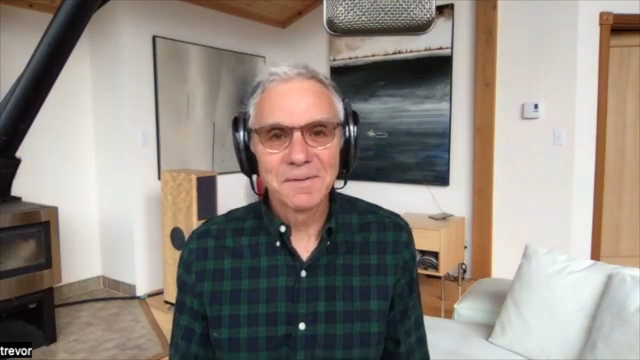
"I want to write about the sea I always wanted to write about the sea and in fact one of those things that made me say I want to do modular synth is because I've always tried to write music that reflects what I like about the ocean."
© Screenshot/Quote: Fraptools (YouTube)
Throughout the conversation, Trevor’s deep connection to the ocean is palpable. He’s currently planning a concept album inspired by marine biologist Rachel Carson, whose writings on the sea and environmental stewardship resonate with his own experiences living near the Pacific. For Trevor, the ocean is both a source of sonic inspiration and a metaphor for musical structure—its rhythms, unpredictability, and vastness all find echoes in his modular compositions.
This environmental focus is more than thematic; it informs the very architecture of his patches and the collaborative spirit of Unthunk. By channeling the complexity and beauty of marine environments, Trevor’s music becomes a form of ecological storytelling—one where voltage, counterpoint, and environmental awareness merge into a singular artistic vision.
This article is also available in German. Read it here: https://synthmagazin.at/frap-tools-modale-kontrapunkte-und-modulare-ozeane-trevor-tunnacliffes-patchkunst-2/
Watch on YouTube:
Latest articles
Watch on YouTube:
Visit the channel:
https://www.youtube.com/FrapTools
https://www.youtube.com/FrapTools
Links from FrapTools:
website: https://frap.tools
instagram: https://instagram.com/fraptools
facebook: https://www.facebook.com/fraptools
twitter: https://twitter.com/fraptools
soundcloud: https://soundcloud.com/fraptools
Sponsored links:
If you purchase via these links, we may earn a small commission – at no extra cost to you. The link opens an Amazon keyword search, and results may vary depending on availability.
Frap Tools 321
🔗 Check price on Amazon
🔗 Check price on Amazon
Frap Tools 333
🔗 Check price on Amazon
🔗 Check price on Amazon
Frap Tools Falistri
🔗 Check price on Amazon
🔗 Check price on Amazon
Frap Tools Fumana
🔗 Check price on Amazon
🔗 Check price on Amazon
Frap Tools QSC
🔗 Check price on Amazon
🔗 Check price on Amazon
Frap Tools Sapèl
🔗 Check price on Amazon
🔗 Check price on Amazon
Frap Tools USTA
🔗 Check price on Amazon
🔗 Check price on Amazon